

How a breed switch improved beef profit and productivity
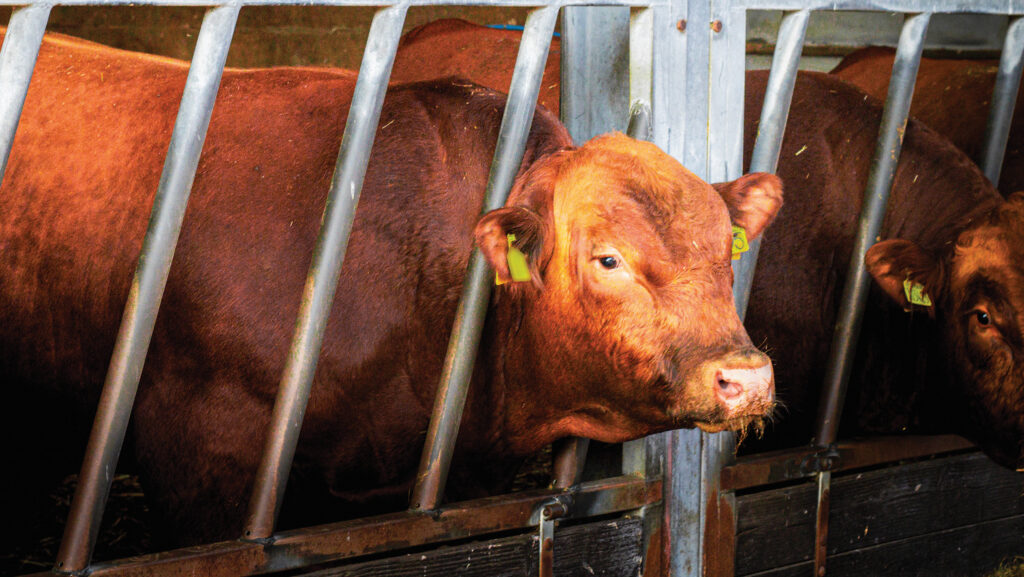 Bull beef is finished by 15 months © Rhian Price Media
 What began as a necessity to keep the family farm afloat has shaped the success of John and Rachel Geldard’s farming enterprises and put them at the forefront of the Stabiliser breed’s development.
Although they realised their dream of farm ownership in 1988, buying 108ha Foulshaw Farm, in Leven, Cumbria, within 18 months interest rates had climbed to 17%, and BSE had hit, tanking livestock prices.
To pay the mortgage, John started keeping 100 laying hens in a derelict shed.
See also: 9 ways a farm is lifting beef cow efficiency
Farm facts
Foulshaw Farm, Cumbria
- 900 Lleyn sheep, lambing from mid-March
- Farms 202ha, all owned
- 150 Stabiliser suckler cows, selling breeding stock and finished animals
- Free-range/enriched laying hens
- 13 producer farms supplying Geldard Farm Eggs
- 2.1m eggs sold each week
- 300kW solar panels
Today, the poultry sideline has developed into a major business, with the Geldards plus another 13 producer farms supplying 2.1m eggs a week to 150 customers under the Geldard Farm Eggs brand.
Customers range from major supermarkets to food service and independent retailers.
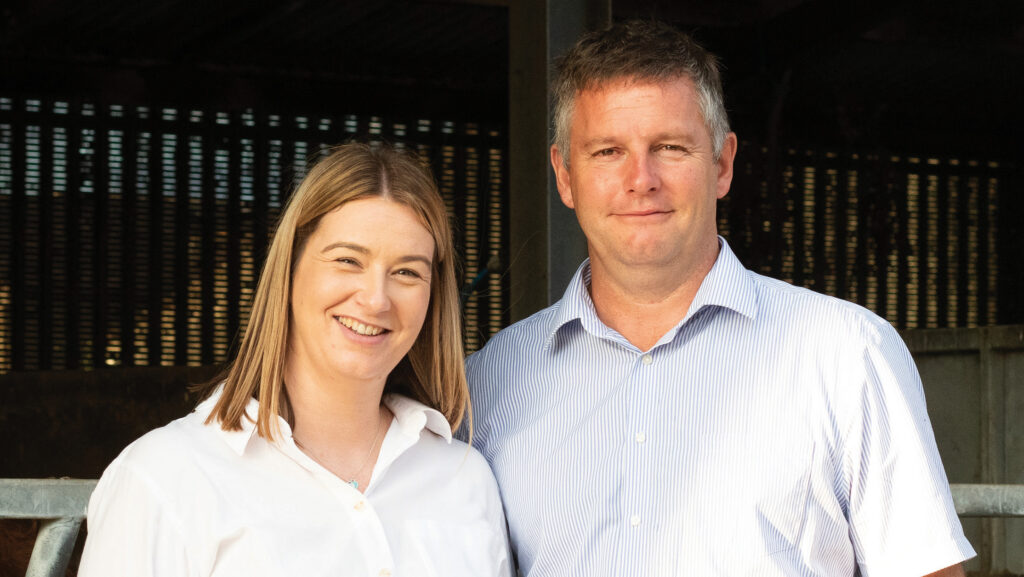
Clare and Charles Geldard © Rhian Price Media
The efficiency demanded by the poultry enterprise influenced the direction of the farm’s sheep and beef enterprises, with the Geldards seeking high-production animals that are easy to manage.
Their original commercial suckler herd comprised dairy-bred cows mated to Charolais bulls, but they became disillusioned by calving problems as the Holstein influence within the dairy herd grew.
A visit to Richard Fuller’s Givendale Stabilisers in Yorkshire (one of the UK breed’s founding members) convinced the family to change direction.
In 2003, they began using embryo transfer to fast-track the introduction of this composite breed.
Selecting suitable sheep breed
The Geldards adopted a similar approach to improving maternal efficiency within their sheep flock.
Son Charles – who farms with wife Clare, brother Richard and sister-in-law Helen – says moving from a hill farm to a Cumbrian lowland farm meant the Swaledales weren’t suitable, hence the switch to Lleyns.
“Dad bought 90 Lleyn ewes from North Wales in 1990. We had 191 live lambs at the first lambing – and they’ve been here ever since,” he explains.
Half the flock is bred to Charollais, Beltex or Texel rams and creep-fed for a fast finish.
The remainder is bred pure, with ewe lambs grazing the saltmarshes of the River Kent Estuary. Finished lambs are sold liveweight at local markets averaging 45-48kg.
The Geldards operate a multiplier herd, selling breeding bulls and heifers.
Their 150-cow Wraycastle Stabiliser herd starts calving indoors and moves outdoors, depending on the weather, over 11 weeks from the end of March to mid-June, with 85% of cows calving within the first six weeks.
“About 95% calve standing up very quickly, and the calf is up and sucking within minutes because the cow and calf are not tired,” says Charles.
Heifers calve at two years old, and Charles targets a minimum 400kg bulling weight. There is a strict culling policy to continually improve herd performance.
With strong cull cow values currently outweighing breeding heifer prices of about £2,200, Charles says there is little reason to retain older cows that are not performing.
“If it’s done something wrong, we cull it. We want to change the herd for the better,” he adds.
“Feet, legs, udders and mothering ability are among the traits scrutinised when making culling decisions.
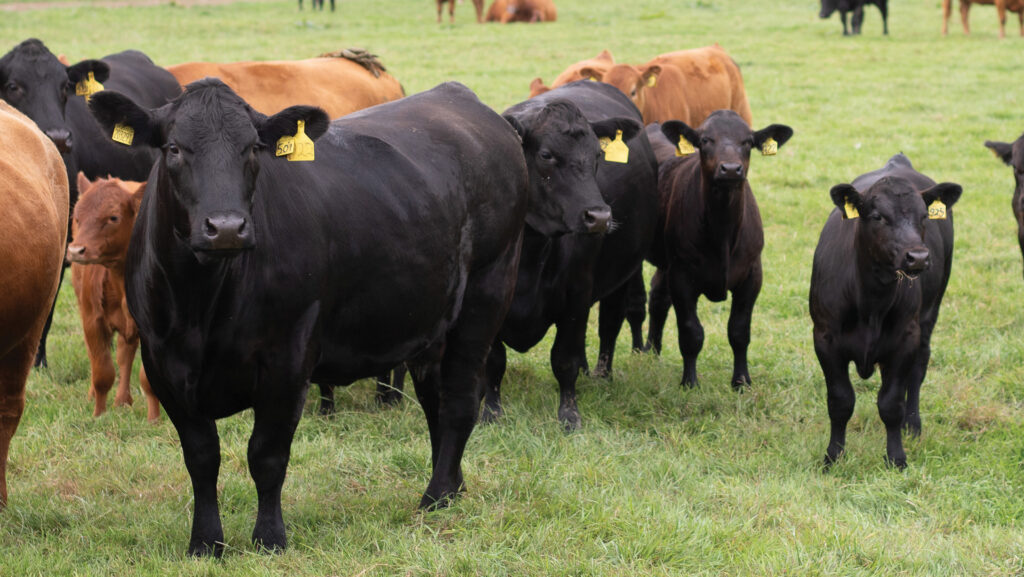
Cows calves in an 11-week block from March © Rhian Price Media
Sourcing elite beef genetics
The Geldards source the highest-indexing embryo bulls available, typically seeking animals in the top 1% of the breed’s profit index from other multiplier herds with equivalent health status.
Heifers are also genomically tested. “Genomics is another tool alongside estimated breeding values [EBVs] to help build the overall picture.
“Even though we have EBVs for everything, you still need to look at the animal and see if it is functional.”
All cows are mated to natural service. The bull Esgair Vincent has had a big effect on the herd during the past eight years and continues to be used on cows. Selside Cordy, bred by A Dixon & Son at Kitcrag, Kendal, is currently being used on heifers.
The herd typically has a 25% replacement rate, with the best heifers retained and other high-index animals sold for breeding at 13-15 months.
Potential breeding bulls are selected after Christmas based on genomic predictions, EBVs and phenotype.
These generally rank within the top 1-15% of the breed and are sold either at 13-15 months or as two-year-olds, depending on customer requirements and budget.
Bulls that don’t make the grade for breeding are finished on 4kg of moist feed alongside high-quality silage and sold as bull beef by 15 months of age.
They typically achieve 436kg deadweight and grade R+ and U.
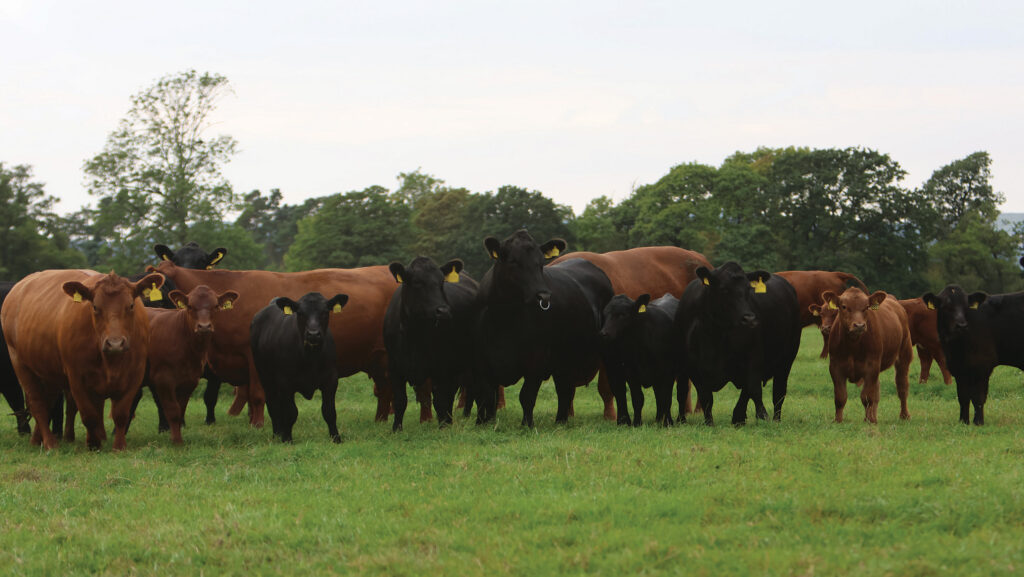
Geldard Stabiliser herd © Stabiliser Cattle Company
A focus on feed efficiency
Feed efficiency is another key focus, and Charles believes beef producers can replicate some of the efficiency gains already achieved by the poultry industry.
“A chicken will eat 125g/day and lay a 65g egg, producing 2:1. Feed is our single biggest cost, so having animals that flesh off grass and put on even more weight off feed is important.”
Lee Leachman, chief executive of Leachman Cattle and founder of the Stabiliser breed, predicts substantial improvements in feed conversion are possible.
“We are going to have cattle that convert better than 4:1 in 10 years and close to 3:1 in 15 years because feed efficiency is a highly heritable trait.”
In the US, feed efficiency is being measured in 3,000 Stabiliser animals, alongside work to assess methane emissions.
Charles says Stabiliser cows maintain condition while supporting later weaning. Calves are typically weaned in early December with, on average, heifers weighing 350kg and bulls 400-420kg.
With mature cows averaging about 670kg, the aim is for cows to wean 50-60% of their mature weight.
Operating a closed, high-health herd means the family have vaccinated against bovine viral diahorroea for 14 years and have Johne’s level 1 status, meaning there have been no positive or suspect animals for more than three years.
The farm’s location provides some natural biosecurity which supports the high health status.
A nature reserve flanks the farm to the west, and the Kent Estuary lies to the east, while woodland separates it from neighbouring livestock.
However, its location on the floodplain beside the estuary means ground conditions can quickly become wet, so housing of cows and calves is generally by mid-September.
For Charles, the beef enterprise is an important and complementary part of the farm, and he is sure they made the right decision switching breeds decades ago.
“We have three profitable enterprises. The beef is more profitable than ever because of [current] beef prices, and we are driving efficiency and selling breeding stock at a premium.”