

How to make sure suckler cows produce top-quality colostrum
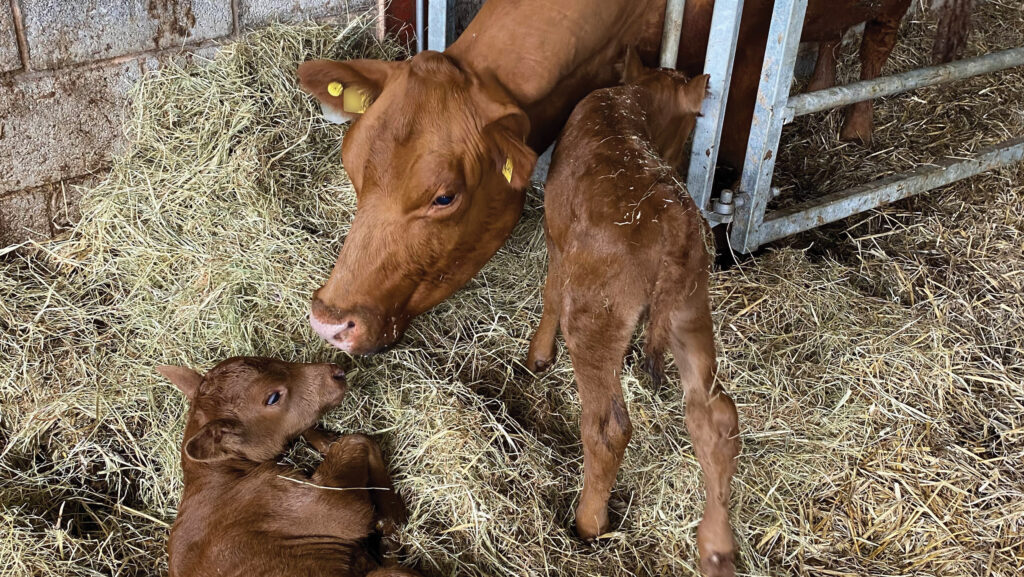 © Kat Hart
 Ensuring suckler cows have at least 14% crude protein in their diet before calving will help antibody production and improve colostrum quality.
But the drought in 2025 means that forage availability could be a challenge for some farms in the run-up to calving.
See also: How to manage common suckler calf health challenges
Colostrum production happens in the final three to four weeks of gestation.
Therefore, it is a critical time for cows to get the quality and quantity of forage they need, says vet Kat Hart of the George Vet Group in Malmesbury, Wiltshire.

Vet Kat Hart of George Vet Group © Kat Hart
This is why it is important to analyse forage to determine protein content.
“Making colostrum antibodies takes a lot of protein, so if forage quality isn’t good enough, add some concentrates to the diet,” Kat says.
“Ideally you want about 14% crude protein, though this depends on energy availability for rumen efficiency, so check results with your vet or nutritionist.”
Despite the perception that suckler cows naturally produce lots of good-quality colostrum and the calves immediately get up to suckle, Kat says the reality can be very different.
A lack of feed space, thin cows, a challenging calving, or weak maternal bonding all have an impact.
Good colostrum management requires planning (preferably involving both vet and nutritionist), being organised and good stockmanship.
Vaccinations pre-calving
Correct timing of pre-calving vaccinations and boosters is essential.
Most products for rotavirus, cryptosporidium and some clostridial infections need to be given three to four weeks pre-calving (some require two doses) to raise antibody levels in the cow.
Protection is then passed to the calf via colostrum.
“Outbreaks of scouring caused by rotavirus in calves can be linked back to poor colostrum quality.
Similarly, pneumonia in calves can be either a direct result, or a secondary effect, of poor colostrum quality and quantity,” says Kat.
Cow body condition
It is important to maintain cows in a stable weight, without gaining or losing excessive condition during the dry period and immediately after calving.
The goal is a body condition score (BCS) of 3, though Kat says operating in a range of 2.5 to 3.5 is acceptable.
She explains: “Any in-calf cow with insufficient dry matter intakes will allocate energy to the growing calf and lose condition. But losing weight before calving means she is harder to get back in-calf.
“The target is to lose no more than 0.5 score; it might be up to [BCS] 1, depending on your system.”
Ideally, calves should be weaned to give the cow a clear eight-week break before calving. For second-calving heifers, thin cows and any cow that struggled after a bad calving, an extra month will be a boost.
Kat also suggests splitting off vulnerable cows and heifers into a separate management group for the transition period covering the two to three weeks pre- and post-calving.
First-calving heifers
Although heifers are known to produce less colostrum, and of lower quality, Kat says it is often because older cows push them away from feed.
“They are not getting the same nutrition, so make sure there is plenty of feed space.”
Pre-calving checks
A blood test just before calving will confirm if pregnant cows and heifers have enough protein in their diet. It can also establish mineral status.
Calcium, iodine and magnesium levels indicate a cow’s ability to calve well; selenium is linked to cow immunity.
Kat says long-acting mineral supplements, such as a bolus or injection, should carry over benefits to breeding.
Before calving, cows should be assessed for how well they are bagging up, and whether they have four fully functioning teats that a calf can reach.
“In older cows, the back teats can be too low, so the calf may only suck from the front ones,” says Kat.
“Good stockmanship means checking if it is sucking all four and there is no mastitis and no blockages – she might need milking out.”
Safe handling
From a health and safety perspective, the aim is to leave the cow alone to get on with mothering her calf.
However, if calving indoors and space is tight, Kat suggests penning cow and calf separately for a few days.
This should also encourage sufficient colostrum intakes.
“You want a good maternal bond. But you have got to feel safe, so work in pairs and have an escape route.
“A calving gate is useful: it can safely contain the cow to use a calving aid, and it’s designed to remove side rails to let calves suck. One live calf will pay for the cost,” she says.
Colostrum intakes
Timing is crucial because what Kat calls the “magic window” for the calf to absorb immunoglobulins is very narrow – it is open for 12 hours; after this, the gut no longer allows large antibody particles to pass across.
The target is for the calf to drink 10% of its bodyweight within two hours of birth.
“This means a typical beef calf needs to drink four to five litres of colostrum, which takes at least 30 minutes and a decent suck,” she says. “If it takes a calf about 30 minutes to stand up, it leaves not much time to drink.
“It will take longer for a calf out of a heifer: she won’t know to steer her calf and she keeps moving. Her full udder is painful, and she won’t be letting milk down – this all adds time.
“You can use cameras in the shed to check that the calf is up and under [at the teats] for a good length of time.”
Having a good-quality colostrum replacer on hand allows you to teat-feed three litres to any calf with a problem. About 5% of calves may need extra help, such as twins or from an assisted calving.
“Speak to your vet and have a plan. It’s sensible to have replacer if you pull a calf, a cow has a caesarean, or a heifer has had a long and tiring calving.
“Often the cow is still tied or in the calving gate, so you safely have access to the calf straight away. Then you don’t have to re-catch cow and calf.
“The calf will still be hungry enough to find the cow, drink and bond well,” says Kat.
Quality check
A squirt of colostrum from a teat onto a Brix refractometer will confirm whether management has been successful in producing top-quality colostrum, at a minimum reading of 22%.
It is possible to blood test calves – though not easy to catch them – between two and five days from birth to check for successful passive transfer.
Kat favours a calf-side blood test that is less age-specific and works from birth to 40 days.
Regardless of whether a calf is destined for a beef unit, used as a stock bull, or becomes a herd replacement, Kat says it should have good-quality colostrum – and the right amount, at the right time.
The benefit is not just a robust immune system able to fight off infection: she points out it is part of programming the calf’s metabolism for life, increasing its ability to use feed efficiently and generating good growth rates.