

A new dairy entrant’s tips for getting into milk production
 © Debbie James
Getting into agriculture from a standing start is challenging in any sector, not least in dairy farming, where it often requires high upfront capital investment.
Yet Michael James and Rose Charnley have combined vision, tenacity and a strong work ethic with a sound understanding of budgeting and business planning to defy the odds. They are now milking 162 cows on a 134ha (310acre) farm in Pembrokeshire.
See also: How a dairy business course set new entrant up for first herd
Neither had a background in farming. Rose is the daughter of a ship’s captain and a professional musician, and although Michael’s parents weren’t farmers, from the age of 13 he would cycle three miles to milk on a dairy farm every weekend.
Farm facts: Blacknuck Farm, Maenclochog, Pembrokeshire
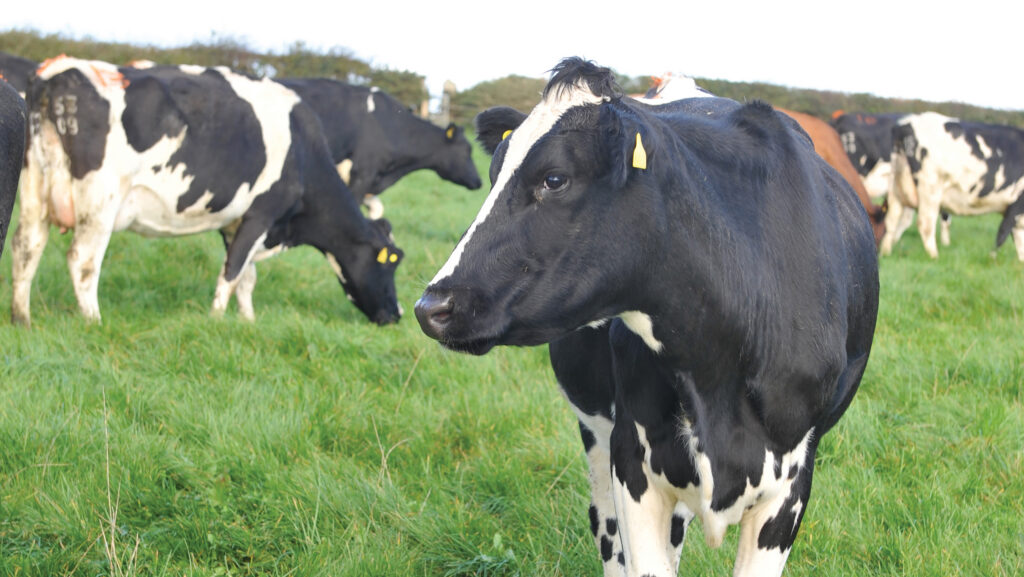
- Milks 162 Holstein Friesians
- Average annual milk yield 7,200 litres at 4.58% butterfat and 3.55% protein, produced from 1t concentrates
- 10-week calving block from July to September
- Milk supplied to First Milk
- Beef calves reared on the ABP Gamechanger programme
- Relief milker employed
- Multicut silage system
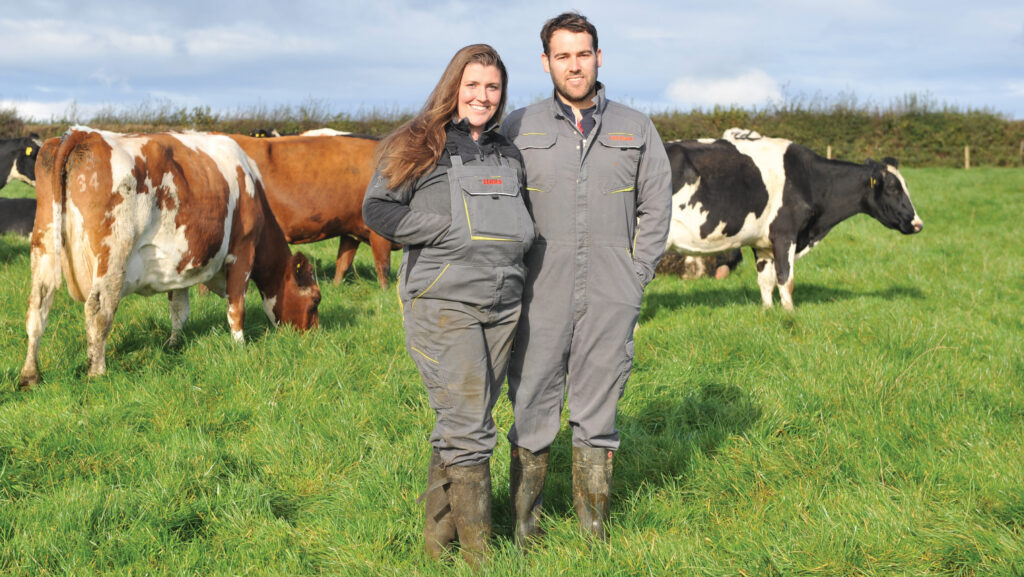
Rose Charnley and Michael James © Debbie James
After qualifying as a vet, Rose relocated from Norfolk to Pembrokeshire, where she and Michael met. Both had an ambition to farm and kept their full-time jobs while renting land, where they reared and sold dairy and beef calves and built capital, trading as James and Charnley Farm.
In July 2025, they signed a 10-year farm business tenancy (FBT) to farm Blacknuck Farm, Maenclochog. The couple, who are in their early thirties, recently hosted a Farming Connect event where they shared their tips on getting into farming as a first-time farmer and making it pay.
1. Do your research when applying for a tenancy
Farm tenancies are competitive, with demand far exceeding supply. To get on the front foot, Michael and Rose say it is important to understand what the landlord wants to gain from the tenancy.
They applied for 28 tenancies, making the shortlist of at least half of those, but were outcompeted by existing farmers with more established track records and greater resources.
They recommend attending pre-application open days, finding out what the landlord is looking for in an applicant and tailoring the business proposal and tender accordingly.
2. Build capital to secure a financial foothold
Rearing five dairy heifers on 1.6ha (4 acres) of land with a shed was a small but important introduction to farming. They took on more land and grew stock numbers on 16ha (40 acres), including rearing beef calves to supply Warrendale Wagyu.
At one point they were milking 24 heifers with a portable milking machine and rearing a new batch of 100 Wagyu calves every month. This allowed them to accumulate the capital needed to apply for a farm tenancy.
3. Understand your business plan
The Farming Connect Advisory Service supported the couple to produce a fully funded business plan. But Rose says just having a budget to present to the bank is not sufficient, it is crucial to fully understand it.
After graduating as a vet, she studied business management and bovine nutrition at Harper Adams University, which gave her an advantage. But she reckons every farmer should drill down into the details of their business plan.
“For example, if we lost 4p/ litre from our milk price today, what would we cut to compensate for that? We would know from our budget where we needed to accommodate that loss of income, what we would need to tighten up on, and what the necessities are.”
4. Don’t take no for an answer
Michael and Rose’s request to rent a block of land with a shed was initially rejected by the landowner in favour of an existing agreement. Undeterred, they were keen to know what they could offer to change that position.
“In our conversations with the landowner, we discovered that the tenant wasn’t taking as much care of the land as he would have wanted. He really wanted someone to farm it well, so we presented him with a proposal that involved reseeding and other beneficial actions, and he offered us the land,” Michael recalls.
They secured a two-year FBT and reseeded 8ha (20 acres) in the first year.
5. Build connections in the industry
Getting to know people in the industry helps farmers get ahead. One of the reasons they chose not to pursue opportunities in New Zealand was because they were unknown in that country.
Relationships with contractors, suppliers, land agents and many others are important, they suggest, and help build trust.
6. Gain knowledge
In their respective careers, Michael and Rose have visited many farms and have learned something new at each one.
“It’s not necessarily the things those farms are doing well – seeing what is being done badly, what could be improved on, is very helpful,” says Michael.
Training and skills courses are also valuable resources.
7. Tap into new-entrant initiatives
Initiatives such as Farming Connect’s Start to Farm provide valuable support for new entrants.
This offers a matching service, mentoring, business planning and legal advice aimed at providing guidance at every stage of establishing joint venture agreements between providers and seekers.
8. Target early investment in a tenanted holding
To fully reap the benefits of improvements that enhance profitability, the necessary expenditure should be made in the first two years of a tenancy.
Michael and Rose reseeded 57ha (140 acres), laid 2.2 miles of farm tracks and refenced the entire farm, all within the first year. They also installed automatic cluster flush and retention bars in the rotary to enable it to operate as a one-person parlour.
It was a significant investment, but as Michael points out: “There is less advantage in laying tracks in year six of a 10-year FBT. Every investment we have made has to pay for itself within three to five years.”
9. Efficiency is key to profitability
Every process on the farm is assessed for efficiency. In calf rearing, for example, calves are weaned at six weeks. “We cost-analyse everything. Each calf gets a maximum of a bag of calf milk replacer. That’s it, they don’t get any more,” says Rose.
“You have to know your costings – if the price of milk powder goes up, we will be able to see what that looks like in our budgeted rearing costs and what changes will need to be made to accommodate that.”
10. Focus on the basics
Doing the basics “very, very well” is what makes money, says Michael. That means good colostrum management, clean bedding and troughs for calves, not shiny new equipment, for example.
11. Don’t lose sight of ambition
Michael and Rose aim to get the maximum from the opportunity of their 10-year tenancy. In the future, they hope to be in a position to offer opportunities to other new entrants.
“We know how difficult it was for us to get into farming. We didn’t get any financial help from family, we didn’t have a farm to go to. Everything we have achieved has been done through our own money, hard work and persistence.”