

Advice on balancing fibre and concentrates in dairy diets
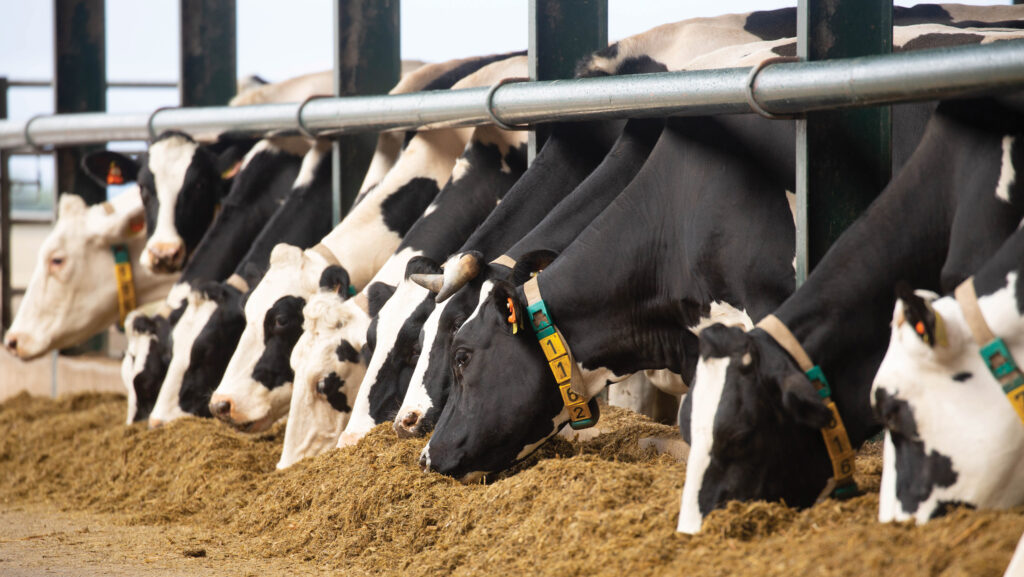 © Tim Scrivener
 Dairy farmers who capitalise on a positive milk-to-feed-price ratio by upping concentrates in herd diets risk triggering acidosis and other metabolic issues if they fail to consider fibre.
Although milk prices have now tumbled, many producers capitalised on higher prices when returns were strong, by increasing levels of concentrates fed.
At about £280/t, they offered a good return on investment given their milk yield potential.
See also: Forage analysis: Which test is best for mixed crops?
But dairy nutritionist Iwan Vaughan reports spikes in cow health and performance issues because of a failure to strike the right balance between concentrates and fibre.
Fibre is fundamental to controlling dry matter (DM) intake and the movement of feed through the rumen, which influences milk quality and dung consistency.
Feeding diets that lack fibre can lead to issues such as acidosis, inducing other metabolic issues that can result in a loss in milk yield and butterfat depression, says Iwan, of Dairy Diagnosis.
“The rumen bugs will feed off the concentrates, which are far faster to degrade in the rumen, creating more lactic acid and dropping rumen pH,” he says.
“This then inhibits the fibre-digesting bacteria – as they don’t work in lower pH conditions – and creates a downward spiral in acidic conditions. That’s why fibre is so important.”
Consistent intakes
Although a cow’s rumen will adapt to feed changes, variations must be slowly introduced.
The rumen thrives on consistency and, although feeding a low neutral detergent fibre (NDF)-based diet can be problem free, intakes must be consistent every single day, Iwan advises.
“The risk comes when a cow calves in from a high-fibre transition diet and is moved onto a low-NDF or forage diet post calving.
“If her transition management isn’t right, and DM intakes post calving don’t recover quickly enough, this puts her at risk of further metabolic issues, eventually leading to a DA [displaced abomasum].”
Cost benefit
Stocks of forage are under pressure ahead of first cut, and some farmers continue to feed high levels of concentrates because the milk-to-feed price ratio is still positive against a backdrop of well-priced supplementary feeds.
Iwan suggests a milk-price ratio of more than 1.3:1 is the sweet spot for such a strategy.
“If concentrates cost £280/t [28p/kg], and the milk price is 1.3 times that, it is worth feeding – although we are now getting below that as a lot of dairy farmers are in the low 30p/litre price band,” he says.
Rumen fill
Fibre is important because the NDF fractions in the diet control dry matter intake (DMI).
As a standard, farmers might work on a concentrate intake of 2.5% of bodyweight for youngstock or 4% of bodyweight for lactating cows.
Instead, it should be more in line with how much NDF they feed, and its type, Iwan advises.
Although NDF intake is regarded as a good predictor of DMI, factors such as total mixed ration (TMR) presentation, chop length, how often feed is pushed up, and feed space, all affect intakes.
And they become more crucial in lower fibre diets as farmers push for higher total DMI.
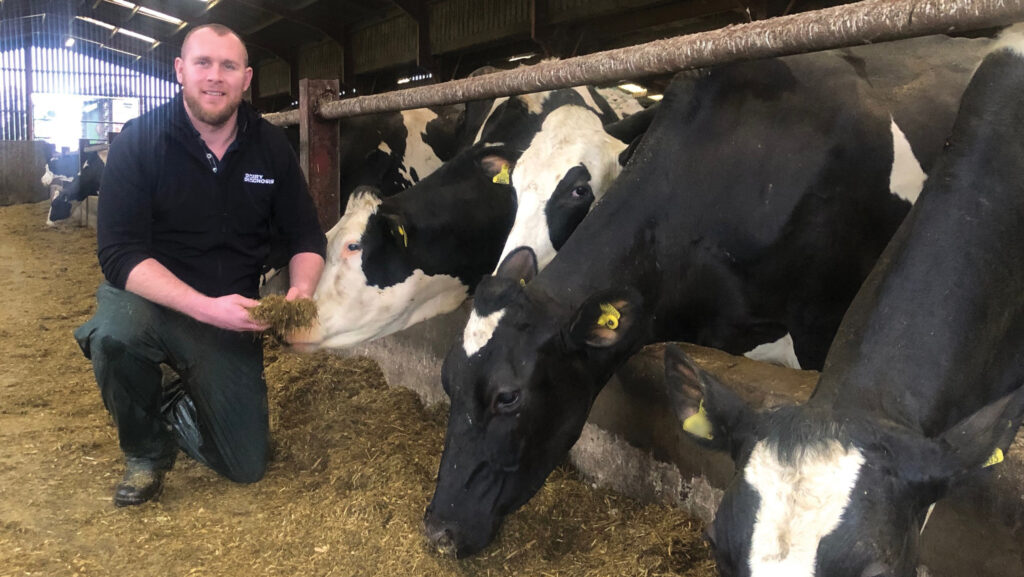
Iwan Vaughan
Iwan recommends starting with a forage analysis to establish fibre content. This can be used to work out other components in the diet.
“There is fibre and there is fibre: some is slower degrading, with a higher proportion of indigestible NDF, which can play a huge part in controlling rumen throughput and rumen fill,” he explains.
If cows are fed a low-forage diet without matching total NDF and physically effective NDF, the rumen will not maintain an effective rumen mat.
The result will be that feed leaves the rumen more quickly and undigested.
“If you are feeding a lot of concentrates, you have to keep that rumen fill to enable the ‘fill and flux’ to work well in the rumen, or you risk acidosis and DAs,” says Iwan.
Back-up measures
“It is a fine line to tread: if you do need to lower the fibre in the diet, everything must be consistent.
“And you have to get that transition management right as well to make sure fresh cows come onto that diet in a safe way.”
This includes ensuring adequate feed space, especially when mature cows and heifers are run as a single mob, as younger animals can by shy feeders.
AHDB recommendations for most Holstein-Friesian cows are at least 0.7m a cow of feed space, with more provided in early lactation.
For dry cows, the recommendation is at least 0.75m a cow.
But things can go wrong, so an “insurance policy”, such as incorporating a rumen buffer or yeast, is advisable, says Iwan.
“Lower-forage diets can also be affected by mycotoxins far quicker as the cow’s rumen can be under more pressure.
“Contamination of feedstocks from moulds and yeasts, or even the risks associated with starlings [spread of pathogens, selective feeding], could push that cow over the edge.”
If this is the case, he says farmers may want to consider using a mycotoxin binder.
High-fibre feed sources in dairy diets
Forage maize silage contains high levels of undegradable neutral detergent fibre (NDF).
However, analysis of the UK’s 2025 crop points to a higher digestibility of that NDF and to higher starch values resulting from growing and harvesting conditions.
Dairy nutritionist Iwan Vaughan says many grass silages from 2025 also have higher NDF digestibility because they were cut younger.
“Given this, when farmers are feeding more concentrates in the diet, they have to think of introducing other fibre sources,” he suggests.
Sugar beet
Sugar beet is a good source of fibre but lacks a high level of NDF, and the NDF it does contain is very digestible, he explains.
“Sugar beet hasn’t worked as well in very low-fibre diets this year because NDF in forages is lower. It has also been very expensive.
“If you have enough fibre in the diet, sugar beet works well as a top-up.
“But since we have less in the diet this year, sugar beet doesn’t supply the cow with enough fibre, and you have to feed too much of it to make up the diet.”
Sugar beet is currently averaging about £250/t.
Soya hulls
Soya hulls are high in digestible fibre and will reduce the build-up of acid that leads to sub-acute ruminal acidosis.
However, prices have firmed and there are limitations to feeding soya, as many milk contracts prohibit its use, including hulls. Expect to pay about £220/t.
Straw
Chopped straw is a very good fibre source but reduces intakes and, as a consequence, the energy needed for milk production.
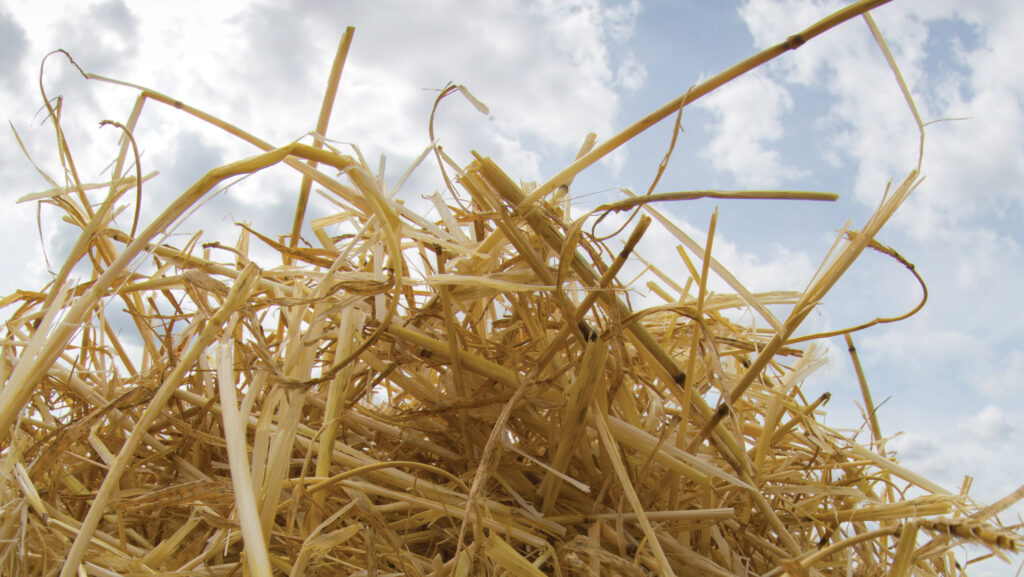
Straw © Tim Scrivener
Chopped straw works well in circumstances where physically effective NDF and total NDF content need to be increased.
Pre-chopped straw is currently trading at about £135-£160/t, depending on where a farm is located.
Other options
Although low in energy, products such as nutritionally improved straw and treated oat husk products add a great balance of fibre to low-forage diets.
They offer greater digestibility than untreated straw and a buffering capacity to increase rumen health overall.