

Cow’s milk or calf milk replacer: 5 things to consider
 © Debbie James
 Cost should not be the principal factor guiding choice of calf nutrition, but it is certainly influential.
At a breakeven point of 32-34p/litre, there is currently no clear winner on price between feeding cow’s milk and calf milk replacer.
A dairy producer’s milk contract will dictate whether fresh milk scores over calf milk replacer (CMR) on price.
See also: Tips on using and cleaning a milk pasteuriser correctly
Consider a block-calving system with an A and B pricing structure, where the B price reflects the spot milk price (currently sitting at 6-15p/litre), advises dairy consultant John Crimes, of Cara Wales.
“If a farm on that type of contract is producing any litres that will attract the B price, on a cost basis they would be far better off feeding that milk to calves rather than selling it to the dairy, as long they have robust health protocols in place for feeding fresh milk,” he reckons.
“When B litres are priced anywhere from 15p/litre downwards, there is far more value in feeding that milk to calves than selling it.”
But the current market position is confusing, he admits.
The spot milk price is falling and farmgate prices are low, yet skim milk values are increasing, pushing up the cost of CMR.
High electricity costs also need to be factored in. Heating water for mixing with calf powder, for example, can have a big energy requirement.
“Farmers can’t be too dismissive of that cost because in a large herd or a block-calving herd, a lot of hot water will be used,” says John.
Nutritional consistency, disease control and other factors must be considered, too.
1. Nutritional and volume consistency
CMR offers greater consistency because butterfat and protein levels can fluctuate in cow’s milk, as well as somatic cell counts (SCCs).
Protein is important for small calves, and they have a high demand for energy, so their feed needs to reflect that.
In addition, on some farms, supply of cow’s milk for calves can be variable.
“Some days there is a good supply and others less so, and because farmers often tend to feed what is available, it means that at times there is inconsistency in volume.
“You quickly see the physical effect of that on calves.”
In a perfect scenario, every calf would get 4.5 litres at each feed, he adds.
But he has been on farms where that volume is up to 8 litres, which he considers too much for a calf to cope with.
Time of year also needs to be considered, says John.
“Generally, I would say that mother’s milk is always best for the calf.
“But in the spring, butterfat and protein levels can quickly alter if cows are grazing, then coming back in again because of poor weather.
“Calves, particularly heifers, need a consistent ration all the way through to weaning to keep their growth rates in a straight line.
“Variable growth rates because of variable nutrition can easily be avoided.”
2. CMR preparation
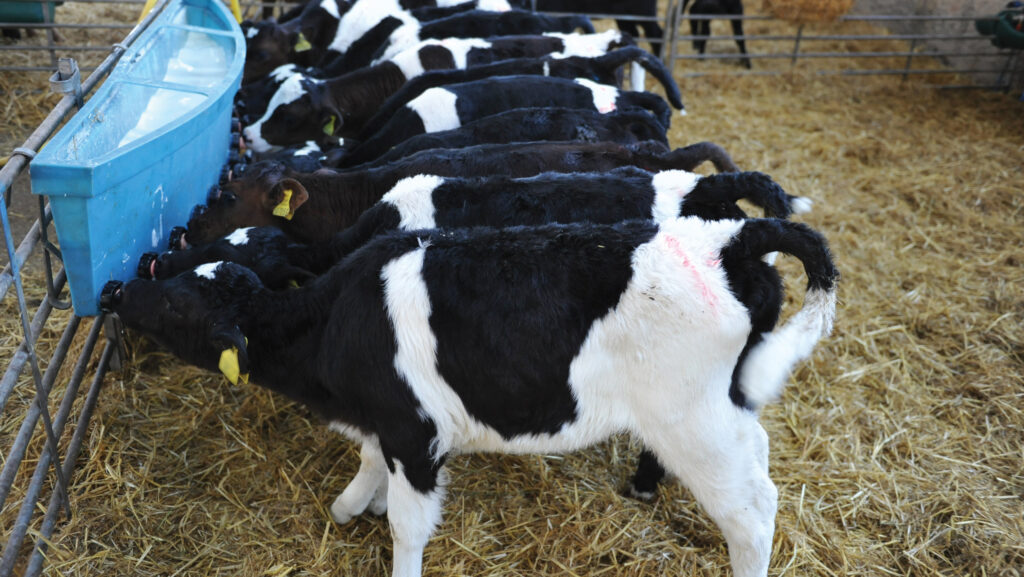
The powder should be weighed at every feed, but farms can be guilty of operating a “mug per calf” policy.
That mug can be caked in powder because it is never washed, yet powder is still allocated in the same way.
Over time, the feed each calf periodically gets is a bit more diluted, and that can be an issue.
Different powders reconstitute differently too, says John.
“Some don’t mix as well as others and you end up with sediments in the bottom of the feed: grey, dark-coloured dregs, which tend to be the minerals and the ash content.
“So, while the farmer may think they are feeding calves the minerals stipulated on the CMR label, if they don’t mix the powder and water well enough, or it isn’t absorbed properly, the calf might hardly get any.”
© Debbie James
3. Changes in CMR nutritional analysis
As a rule, CMR should have as many dairy ingredients and as few vegetable and plant ingredients as possible, John recommends.
This is because it should be as close as possible to what calves would get naturally, but in a more consistent form.
“Experts suggest little difference between whey and skim-based powders,” he says.
He adds that consistency when mixing and feeding and calf-rearing stockmanship are more important than whey or skim quantities.
4. Fat and protein levels in cow’s milk
Butterfat and protein levels in cow’s milk are now much higher than they were historically.
A butterfat of 3.9% and protein at 3.2% might once have been considered good for a high-yielding herd, but many of those herds are now achieving 4.4-4.5% butterfat and 3.5% protein, says John.
“They are getting nearly 10-15% more solids in that milk, and that is good for calves.”
Has CMR nutritional composition altered similarly in that period?
“We tend to see higher levels of protein and oil or dairy ingredients in powders than we used to, so I think they have probably altered over time too,” he says.
5. Disease control advantage of CMR
In a block-calving herd, when large numbers of cows are calving in a concentrated period of time, protocols must be robust to ensure Johne’s-risk milk is not pooled with milk for feeding to calves.
Some farms have very good protocols but others less so, says John, and the consequences can be severe.
However, more farms are now pasteurising milk for calf feeding – and in some of the devolved nations, that is being driven by grant support.
In Wales, for example, there is a 40% grant under the Small Grants Efficiency scheme for the cost of purchasing a pasteuriser or calf milk dispenser.
Cow’s milk v CMR: Which to feed?
Dairy consultant John Crimes generally advises feeding calf milk replacer (CMR) to heifer calves, and cow’s milk to male and beef calves, as CMR tends to offer consistency of nutritional values and lower disease risk.
However, often in calf nutrition, it is not the type of milk that is fed that has an impact on health and performance, but the way it is fed.
“This is going to be as important as anything, because young calves are no different from babies on a neonatal ward: they need consistency and high levels of attention,” says John.
Whether milk powder or fresh milk is fed is often not the reason why some people fail at calf rearing. Instead, much of it is down to protocols and management ability, he believes.
“It’s a bit like using a silage additive – if you get everything else right, it is sensible to have a conversation about using one or not.
“But if you don’t pay attention to everything else during the silage-making process, an additive is a waste of money.
“In calf rearing, it is sensible to have those conversations too on feeding whole milk or CMR, but using one over the other won’t paper over the cracks of poor calf-rearing protocols.”