

Farmers urged to share hoof health data to cut lameness
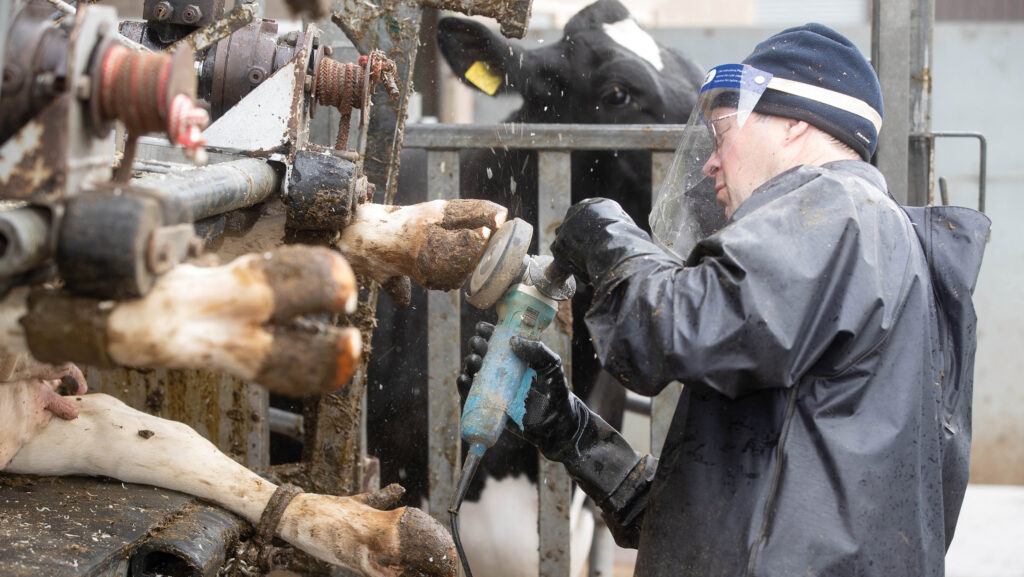 © Tim Scrivener
 Dairy producers and foot-trimmers are being encouraged to share data with the UK Hoof Health Registry to improve genetic evaluations for lameness.
Since its launch by the University of Liverpool, AHDB and industry partners in 2024, more than 300 farmers and 100 trimmers have signed up to the register, with data now flowing from 137 farms representing about 48,000 cows.
More data is expected from the remaining farms later this year.
See also: Benefits of a mentored team approach to lameness control
However, researchers say wider participation is needed to strengthen the database.
They are calling for Channel Island farms and non-Holstein breeders to also take part, as currently most bulls with hoof health evaluations are Holstein.
About the project
The project, led by Prof George Oikonomou, is creating a national database of hoof health records to improve the accuracy of the lameness advantage (LA) and digital dermatitis (DD) indexes used in dairy bull evaluations.
James Wilson, a postdoctoral researcher at the university and a dairy consultant at Herd Health Consultancy/Map of Ag, says current evaluations rely heavily on indirect measures.
“Historically, the lameness advantage index has been based on type data for legs and feet traits, data from a limited number of farms sharing data with their milk recording organisation, and data from classifiers on digital dermatitis prevalence – which isn’t the most accurate due to it being difficult to identify without lifting feet,” he says.
The registry allows the hoof health records of bull daughters to be fed into indexes, making them more robust.
Despite the dataset not being at its strongest, James says these evaluations are still accurate at predicting hoof lesions.
Early findings from 1,100 cows showed that half of all sole ulcers occurred in the daughters of just four bulls.
“If those four bulls weren’t used, we would almost halve the number of sole ulcers in those herds.
“We can have a real impact with this registry by making more strategic decisions around bull selection, which is low intervention and low cost.”
Lameness advantage awareness
Many farmers are not aware of the LA and DD indexes and do not incorporate them into their genetic selection, says James.
Instead, they are heavily focused on type traits such as feet and legs, which are less effective at producing cows resilient to lesions or lameness.
There is also a common misconception that selecting for bulls with a high profitable lifetime index (PLI) will automatically address hoof health. However, he warns that some bulls that score highly on PLI can be low for LA.
James encourages farmers to first establish their herd’s LA average, so they have a baseline for selecting bulls. This can be done in the free AHDB Herd Genetic Report.
Farmers should select a team of bulls and aim for a good proportion of them to have LA scores higher than the herd average.
Bulls with positive scores produce daughters with fewer hoof health challenges.
Lameness heritability is about 30%, on par with milk production, so real progress can be made year on year, adds James.
Data can be integrated from multiple software packages, including DairyComp, Uniform Agri, All4feet and VetImpress, and a link is being established with Hooftec.
Read more information on hoof health or to start sharing data on the AHDB website.
James Wilson was speaking at the recent National Association of Cattle Hoof Trimmers conference.