

Heat-stress strategies for grazing cows tested in NZ herds
 © Adobe Stock
 Finding ways to mitigate heat stress for cows at grass each summer is posing an increasing challenge as spells of high temperatures become commonplace.
But next year, there will be new guidance and tools for keeping cows cool when results from a New Zealand programme, evaluating practical, on-farm strategies, are released.
DairyNZ is looking at the best ways to reduce heat stress as part of its Comfortable Cows Outdoors project.
See also: Why planting more trees could protect milk yields
How to recognise heat stress in cows
Cows feel comfortable (their thermoneutral range) at 4-20C.
Once it gets above 22C, they start to get hot (wind and humidity also have an effect).
Cows when heat-stressed:
- Breathe faster/pant
- Eat less – stand more but graze less – and may bunch up
- Drink more and hang around troughs
- Walk more slowly to and from the parlour
- Produce less milk
Tried-and-tested methods are being assessed (rather than new ones discovered) to establish which are the most successful at protecting milk production and improving cow welfare.
At the same time, scientists are working out which ones also fit within a realistic farm budget and can support long-term resilience to weather extremes.
The aim is to develop “layers of strategies” according to their effects on the cow, her production, and welfare.
© Kirsty Verhoek
Cows at risk far more often than farmers realise
“Heat stress is a challenge now for pasture-based dairy systems – it’s not a future problem – and farmers want information and guidance to support cow comfort,” says DairyNZ animal scientist Dr Charlotte Reed, who is leading the project.
She says that Kiwi dairy farmers underestimate how many heat-risk days they are experiencing, at 15-25 days/year.
Modelling by DairyNZ revealed cows are at risk 67-80 days/year, and this is predicted to rise further by 2050.
Researchers into heat stress in grazing systems in New Zealand developed a heat-risk predicting tool in 2023 known as the grazing heat load index (GHLI).
It combines wind speed, direct sunlight and ambient temperature in its calculation – humidity was judged to be inconsistent in predictions for grazing cows.
GHLI is now being used to understand heat-stress risk and test mitigation measures using groups of cows managed in different ways.
Demand for practical solutions
Feedback, via a survey, from 350 dairy farmers was used to develop the research programme. They requested practical, evidence-based solutions and clear answers on what works.
They admitted they were reluctant to spend on infrastructure to deal with heat stress without any idea of the return on investment, and they wanted data before committing resources.
“Farmers are also keen to know how to target existing solutions in order of priority, according to the severity of the heat stress, or the length,” Charlotte says.
Strategies such as dropping to once-a-day milking or using sprinklers/misters are common practice, yet farm owners wonder “if it’s enough”.
“Our data shows there is a mitigating effect from once-a-day – cows are not walking in the heat of the day,” she explains.
Similarly, Charlotte points out that sprinklers and misters must be used correctly to be effective.
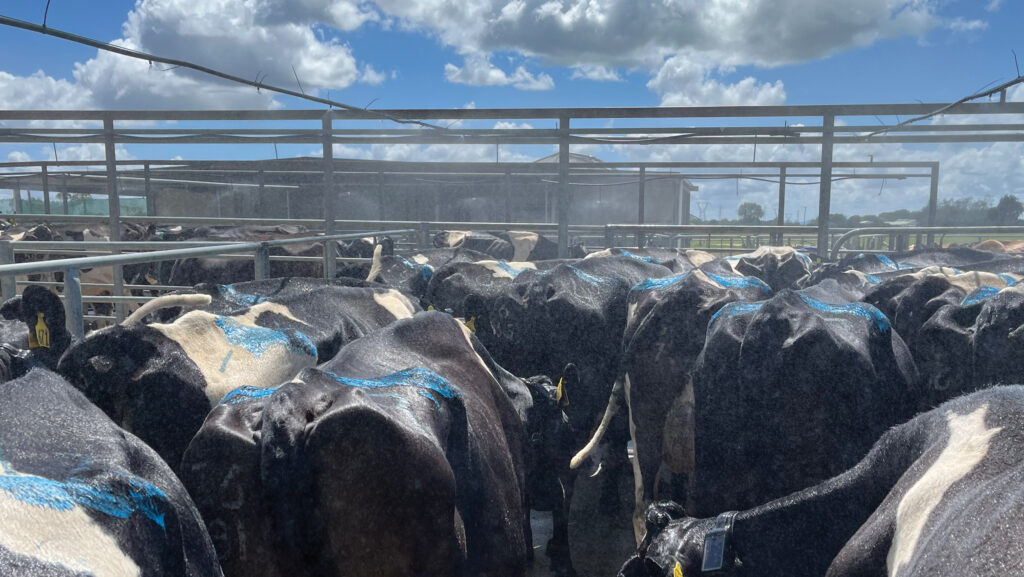
Misting dairy cows to keep them cool © Chris Burke
Misters create fine droplets to cool the environment around the cow, whereas sprinklers have large water drops to saturate the animal’s coat and provide evaporative cooling.
When sprinklers do not thoroughly wet the coat, it just increases humidity and heat stress on the cow.
Range of heat-stress mitigations on test
In addition to measuring milk production, she is looking at cow behaviour, physiology, and psychological distress.
She says the mental effects of heat stress in dairy cattle are still poorly understood, yet important for good welfare.
“We are also looking at cow behaviour and welfare as a social licence to farm and produce milk.
“What is acceptable to the general public? Is it a feed additive that meets the cow’s metabolic need, or something more visual such as supplying shade in a paddock?”
Five groups of cows have been fitted with rumen temperature boluses, pedometers and collars to provide real-time data that tells scientists how the cows are experiencing their environment.
“We have a mob that’s gone once-a-day [milking] through the summer to avoid the afternoon walk to the milking shed.
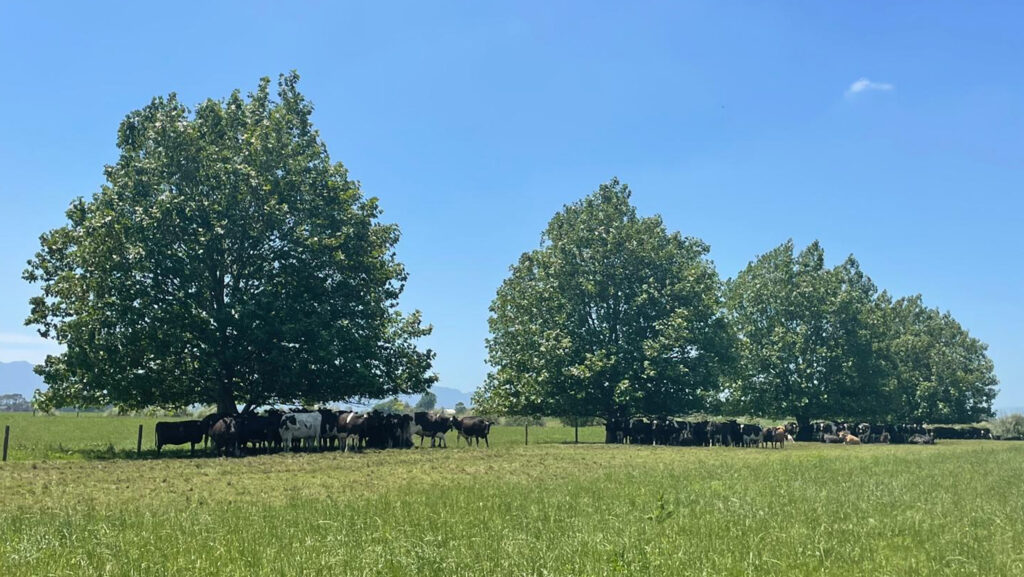
“A second mob spending their daytime in the shaded area; and a third that goes under misters in the [collecting] yard,” Charlotte says.
“A fourth mob goes under a sprinkler in the yard. A fifth mob is the control with no mitigations at all: we want to know what happens if we don’t do anything.”
The team is gathering information on the cost of “not doing anything” about heat stress, as this will determine investment decisions for individual farms.
Effectively, this means lost milk production – but it is hard to unpick the direct effect, as it is tied to feed supply (fertility is less affected because cows are in early pregnancy during summer, which lowers their energy demand).
Previous research has shown changes in milk fat and protein content occur before the effects of lower milk yield kick in.
And Charlotte says this could be related to how the overheated cow partitions nutrients.
Understanding individual cow responses to heat stress could also help target mitigation to more susceptible animals (such as cows with black coats and mature cows producing more milk), she adds.
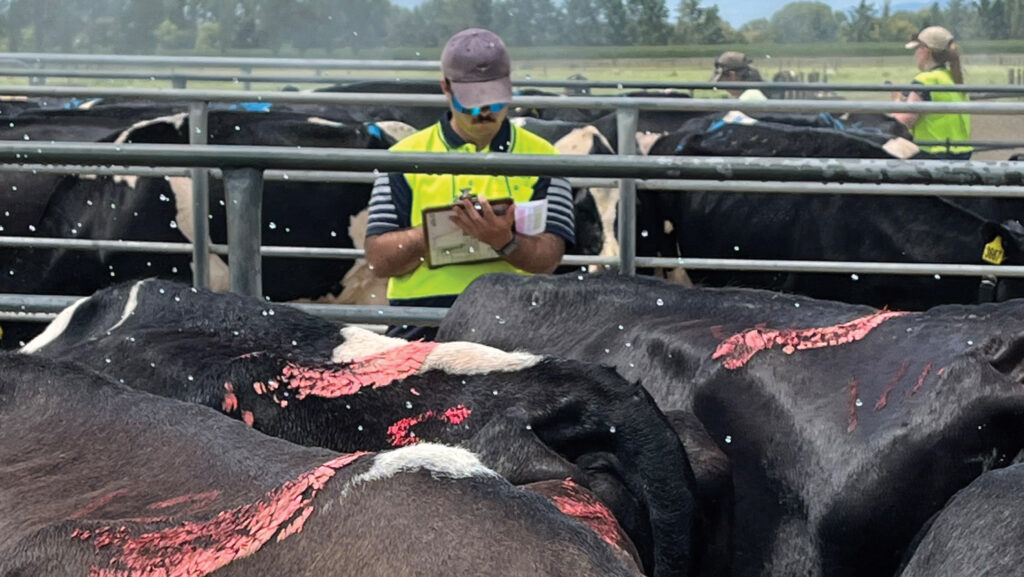
Trial cows being scored for respiration rate – how fast they are breathing is a key metric used to understand heat stress © Chris Burke
Warning system with weather forecast
As researchers continue to refine the GHLI accuracy, it has potential to be included in regional weather forecasts for farmers.
Hence part of the project is looking at how far ahead weather can be predicted, the risk of heat stress, and how to use this information.
Farmers can soon run out of options if they use up their short-term solutions (paddocks with trees/close to the parlour) and a heatwave is prolonged, Charlotte explains.
“Is it better to know [heat risk] at the start of a day, or a week? It will be a trade-off between accuracy [of the weather forecast] and planning.
“If one week’s notice is enough, we need to develop better guidance of what to do on farm,” she says.
Practical tips to minimise heat stress
- Supply extra water troughs on hot days – for example, on parlour exit
- Ensure water flow is enough to avoid troughs being drained
- Keep water clean to encourage drinking
- Use shade – up to 5sq m a cow for access by the entire herd, to minimise competition
- Shift milking times to later in the day
- Reduce walking distance and speed to the dairy
- Use paddocks closer to the shed for afternoon milkings
- Allow more yard space for cows at milking times
- Sprinklers/misters – bring cows in to stand underneath
- Feed in the cooler part of the day – cows reduce their heat load by eating less
- Change the diet to one with less fibre and more energy
- Trees can intercept the sun and reduce ambient temperature by up to 10C
- Avoid large groups of cows gathering under few trees (leads to compaction/nutrient overload/mastitis)
- Trees with broad crowns give more shade (fast growing, wind firm without brittle branches)
Source: DairyNZ