

How herd exceeds 12,000 litres on twice-a-day milking
 © Jim Wileman
 A simple, consistent system is helping a Cornish dairy to achieve the UK’s highest yield on twice-a-day milking.
According to the National Milk Records’ annual production report, cows at Sixty Acres Farm, Truro, produced 12,351 litres of milk at 4.43% butterfat and 3.35% protein in 2025.
See also: How three dairy farmers maintain high-yielding herds
Despite this feat, herd owner James Johns says he has never aggressively pushed litres. Instead, he attributes the results to building a simple system that delivers consistency for cows.
“We don’t actively chase yield. We do the essentials as best we can, and milk follows.”
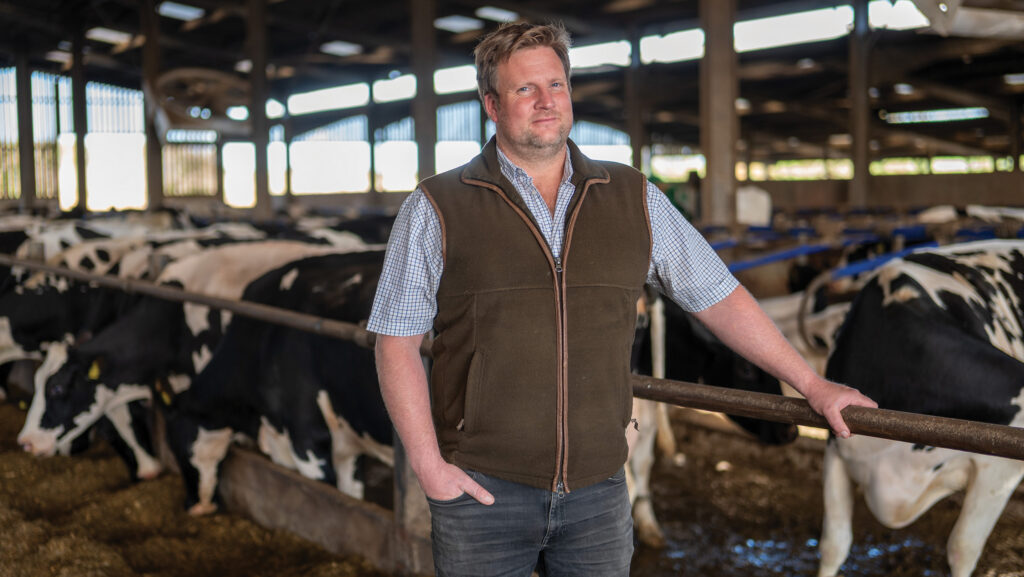
James and his father, Andrew, are tenants of the Trewithen Estate and farm alongside James’ wife, Marie, and sister, Katy, supplying Rodda’s creamery.
The family have focused particularly on increasing butterfat production within the 305-cow herd to meet the constituent requirements of their milk contract.
Below, James outlines five management areas he believes are delivering high yield.
James Johns © Jim Wileman
Farm facts: Sixty Acres Farm, near Truro, Cornwall
- Farms 303ha, including 100-121 ha winter wheat, spring barley and winter barley
- Milks 305 non-pedigree Holsteins
- Year-round calving
- Cows housed full-time; dry cows and heifers graze during summer
- Calving index of 413 days in 2025
- Somatic cell count – 150,000 cells/ml
- Five staff outside family labour
1. Nutrition and forage management
The farm practises a “loose” multicut system, targeting four cuts of grass between late April and September at roughly six-week intervals, weather permitting.
Grass silage is layered across two pits to maintain consistency in the total mixed ration (TMR) year round. They also grow 81ha (200 acres) of maize, aiming to carry enough forage to last 15 months. This allows the new crop three months to ferment before feeding.
About 65ha (161 acres) of 10-year, back-to-back grass leys make up the grazing platform and cutting leys closer to the dairy.
On the arable ground, James favours four- to five-year cutting leys of perennial ryegrass and clover. These are rotated with maize and cereals.
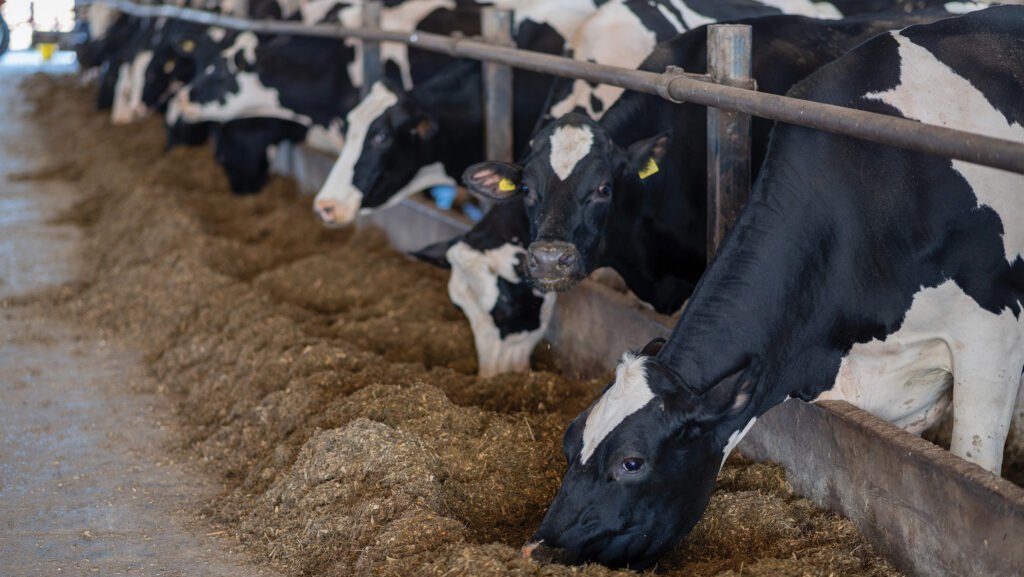
Milk from forage is currently about 3,500 litres, with a strong focus placed on growing as much cereal as possible to balance forage. To keep feeding simple, one TMR is fed to the entire milking herd once daily.
This comprises a 50:50 mix of grass and maize silage, plus 4.4kg of a rape-based protein blend, home-grown caustic wheat, home-grown rolled wheat and barley, minerals and fats.
Dry cows receive a partial dietary cation-anion difference ration from drying off to calving, which includes 6kg of milled straw. “We try to keep things as consistent as possible because cows don’t like change,” says James, adding that milk fever currently sits below 5%.
Up to 5kg of concentrate is fed to yield in the parlour, taking the overall feed rate to 0.35kg/litre of milk. This has recently been reduced to 0.29kg after production was cut by 8% to meet quotas imposed by Rodda.
This has saved about 30t of concentrate a month and is working out better financially, despite yields dropping by 2-4 litres a cow, to 38kg daily.
2. Breeding
The Johns use only Semex sires via artificial insemination (AI) and have genomically tested heifers for more than a decade. Heifers are tested from birth, so information is available by first service at 14 months. Average profitable lifetime index has risen to £198 among cows and £245 for heifers.
However, James says genomics can sometimes drive traits to extremes, with small teat size one problem they have encountered. Longer teat length is now prioritised, alongside type merit, milk fat and udder attachment, with a team of four to five AI sires used annually.
Once animals enter the herd, phenotype can override genomic predictions as more information becomes available on milking performance and temperament.
Typically, the best cows and heifers receive two or three services with sexed semen before they reach 100 days in milk. Thereafter, they are served to Belgian Blue or Limousin. Maiden heifers are served to a Limousin sweeper bull.
James operates a 50-day voluntary waiting period. The herd’s calving interval currently stands at 410 days, but James believes allowing high-yielding cows longer to get in-calf can support improved lactation yield.
“It suits the system we are running; otherwise, animals are hitting peak performance while you’re trying to get them in-calf, and the two don’t necessarily go hand-in-hand.”
Weekly vet visits ensure non-cycling cows are seen before 40 days after calving, and internal hormone release programmes are used as needed, with the pregnancy rate currently averaging 19%.
3. Housing and comfort
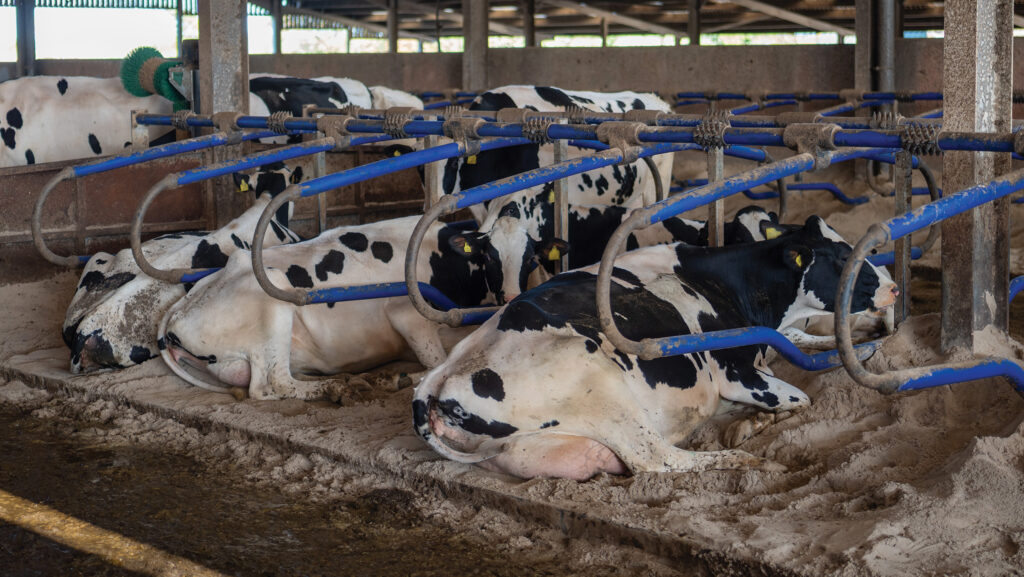
The herd is housed full-time on deep-bedded sand and flexible cubicles.
“We extended the main cubicle shed seven years ago and installed Easyfix cubicles. Three years ago, we replaced all the older fixed cubicles with them, because we found the cows performed much better in them compared with galvanised ones.”
High-yielders typically peak at 51kg average at eight to 10 weeks of lactation. Milk leakage on beds can therefore be difficult to avoid, so beds are cleaned twice daily and fresh sand is applied once a week.
Housing also features high-volume fans, cow brushes and fast-emptying water troughs, which are cleaned three times a week. Rubber matting has been installed in high-traffic areas, including water-trough crossovers, to support foot health.
© Jim Wileman
4. Milking routine
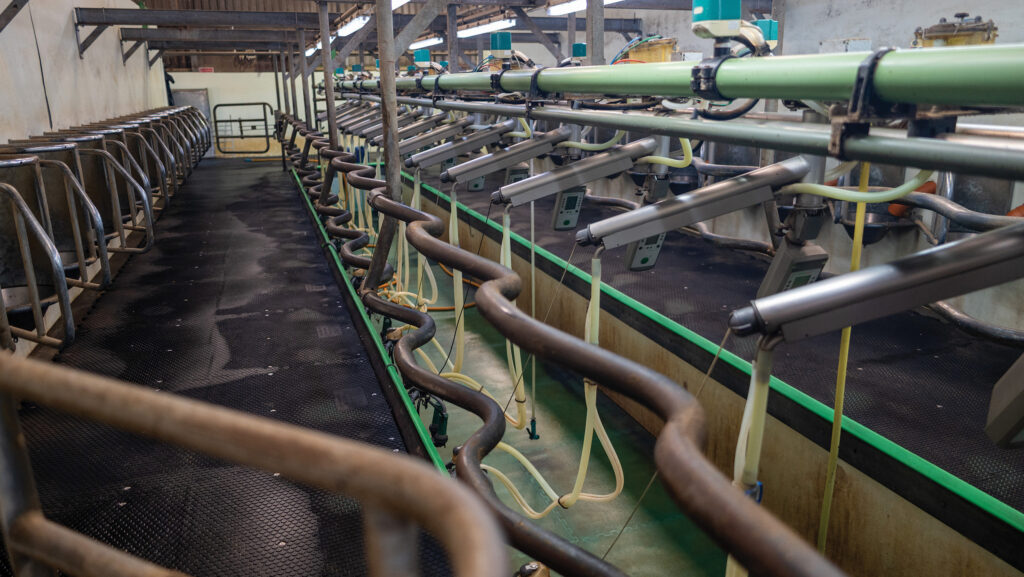
Cows are milked at 13/11-hour splits through a 15/30 herringbone swingover parlour. Milking starts at 6am and 5pm and takes two people four hours, including washdown and calf feeding.
Although the whole herd receives the same ration, cows are divided into four groups – pregnant/low-yielders, high-yielders, fresh calvers and treatment/older cows – to minimise parlour waiting times.
“Cows are never out of the shed for more than one-and-a-half hours from the first to the last cow,” adds James.
Despite the herd’s high yield, he has never seriously considered moving to three-times-a-day milking. He says the current routine works well, and the additional labour required for a third milking and associated yard work is a major deterrent.
© Jim Wileman
5. Heifers
Heifers averaged 10,236 litres at 4.41% butterfat and 3.41% protein in 2025. James believes nutrition during the first six months of life lays the foundation for heifers to calve by two years and perform strongly in their first lactation and beyond.
Calves receive colostrum for three to four days followed by pasteurised milk. Milk volumes increase gradually from five to seven litres daily, with calves weaned by 12 weeks once they are eating 3kg of concentrate a day alongside ad-lib barley straw.
From five to six months, heifers receive TMR leftovers from the milking herd before transitioning to grass silage from nine to 10 months. They are served at 14 months and calve at 23-24 months, on average.
The future
A proposed major housing development is making the farm’s future uncertain. As a result, major capital investment is on hold for the next two to three years until their fate is decided.
However, James is resolute they will continue farming, and the focus remains on cow health, comfort and nutrition. “We work on the philosophy that if you look after your cows, they will look after you.”