How slurry investment will slash dairy unit’s energy bills
 © John Eveson
 It takes courage to spend more than £700,000 on a small-scale anaerobic digestion plant and slurry separator when milk prices are under pressure.
However, the new setup at a Cumbrian dairy farm is expected to pay for itself in less than five years.
See also: Farmers Weekly Awards 2025: Dairy Farmer of the Year
The investment at Jenkin Cragg Farm, Kendall, generates an income for the business from sales of some of the energy produced.
It also results in significant cost savings by making the business self-sufficient in electricity and cow bedding.
Farmers Weekly’s 2025 Dairy Farmers of the Year, John and Nicola Young, committed to the 74kW plant when milk prices were strong.
Although prices have since plummeted, John reckons it was a sound decision. “Investing smartly when times are good, in something that will cut costs, helps a business to survive the bad times,” he says.
Farm facts: Jenkin Cragg Farm, Kendal, Cumbria
- 477ha owned and rented
- Average annual yield 13,740 litres at 3.85% butterfat and 3.15% protein
- 3,320 litres milk from forage and 2.2t a cow a year concentrates fed
- Three-times-a-day milking
- 32% replacement rate
- Four-cut silage system
- 750 head of youngstock
- 200 freshly calved heifers sold annually
- Milk sold to Dale Farm
- Six full-time and five part-time staff
Business resilience
“In the case of electricity, you will never get to a position where you don’t have another electricity bill to pay, unless you do something about it.
“So making that decision when our milk price was strong, when we could afford to invest, will reduce our cost base in the more difficult times and make our business more viable and sustainable.”
With a herd of 550 high-yielding pedigree Holsteins already maxing out acreage and infrastructure, herd expansion is not an option.
Diversifying into another venture instead reduces cost of production and creates additional income.
A 75kW rooftop solar system was installed in 2018 and now provides 30% of the farm’s electricity needs.
When the anaerobic digestion (AD) plant is up and running in April, all electricity used on the farm will be produced on-site and 35kW of surplus exported to the grid.
Securing planning permission was straightforward, with approval granted in December 2025 with no opposition.
The plant has been sited in a field close to the cubicle housing to minimise slurry pumping distance – it will utilise 70% of the slurry produced by the herd.
The components of the plant were built at manufacturer Biolectric’s base in Belgium and shipped to the UK. As a result, the on-site construction process is only a four-day job.
“Our project manager, Charlie Bell, has guided us with his knowledge and experience and overseen the groundworks,” says John.
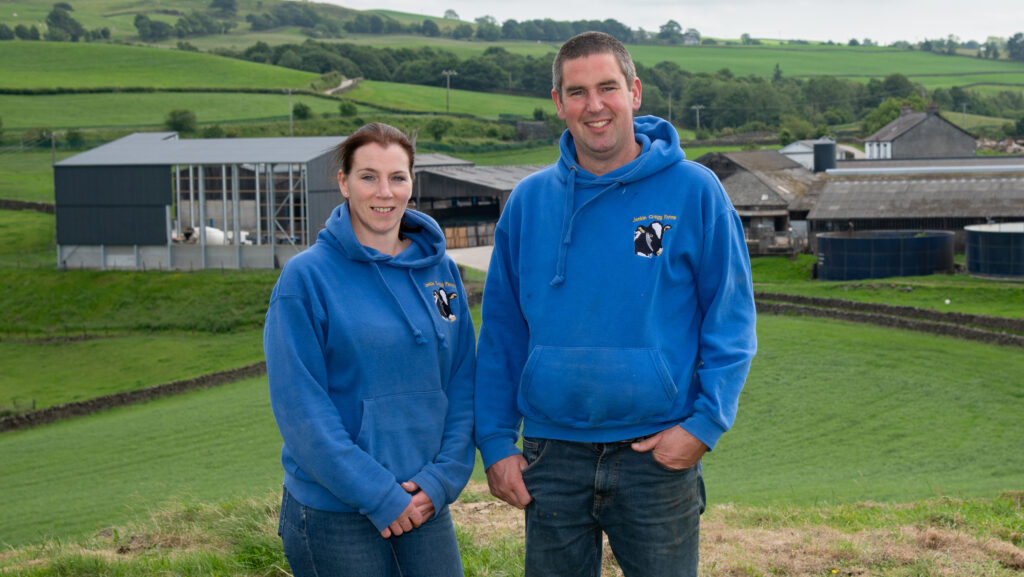
Nicola and John Young © John Eveson
Slurry separator
The plant cost £595,000 ex VAT, an outlay projected to be covered within four-and-a-half years.
The Youngs spent a further £120,000 on a slurry separator to enable conversion of the solids from the AD process to green bedding.
In 2025, they also spent £55,000 on sand, chopped straw and dried sawdust to bed the 600-stall cubicle housing. In future, though, all green bedding will be used.
The separation system was factored into the design of a new eight-bay feed store constructed in 2025.
The shed, which is 14m at its peak to allow ample tipping clearance for articulated delivery lorries, facilitated the farm’s transition to feeding cows straights instead of a blend – a significant cost saving.
“It is really paying dividends in these tougher times – it’s another good example of investing when you can cut your future costs,” says John.
Feed is stored in seven bays and a drying floor has been installed in the eighth; the slurry separator is suspended over that floor, and the system will produce material (80% dry matter) for use as bedding.
The digestate produced from separating the slurry will be applied to the land, reducing the farm’s purchased fertiliser requirement by 30%.
There is another potential income source from selling the excess digestate to arable growers, a move that would further reduce the Youngs’ slurry storage requirement.
There is currently sufficient capacity to store four-and-a-half months’ worth of slurry – the housed herd produces about 55,000 litres a day.
Planning consent is in place to extend the existing lagoon to increase capacity to six months of storage.
“That wouldn’t be a big project but, if we sell some of the digestate, we will have enough storage without extending the lagoon,” says John.
Servicing and maintenance
As well as the capital expenditure, there is a labour cost associated with operating the AD plant.
The Youngs are responsible for daily checks and for the servicing of engines, but all other costs are covered by its service contract with Biolectric.
“They replace any broken parts, including engines, but we have to do the physical checks,” he explains. This includes a daily visual inspection.
“It will take about 10 minutes a day to check the monitors to make sure everything looks and sounds right, but we have a phone app to alert us if there is an issue,” he adds.
“Other than that, we have to service the engines, but the service packs are provided. The engines run 24/7 and need servicing every 400 hours so it is a regular job but only takes half-an-hour.”
The excess energy is being sold to British Gas; until recently, small-scale generators of renewable electricity did not receive a Feed-in Tariff (FIT), says John.
“We had some issues getting it across the line because small-scale AD has not been recognised with the FIT.
“But the industry has done a lot of work behind the scenes in the past 12 months to get these systems recognised, and operators are now getting paid the FIT by utility companies.”
The energy is being fed into the general grid, but John hopes that in future it will be used to power local homes, swimming pools and other public buildings.
“That would require the help and backing of the local council; we can’t do that on our own.”
Environmental benefit
The Lynster Farmers Group, to which the Youngs belong, aims to monitor the progress they make with their AD plant.
The group wants to see how the system might work for other farms and to raise awareness of what is possible in farming.
John is confident the AD plant will “significantly” reduce the farm’s carbon footprint.
“We want government and councils to see what a great system this is for farms. We are very keen to have visits by the local community and the local authority to showcase what farming can do.”
With two sons, James and Matthew, now in the business, the Youngs have embarked on their new venture with the future in mind.
It also “completes the circle” of the business, John adds.
“It would be a bit of a challenge for us to increase cow numbers – we are not a farm where we can add hundreds of cows.
So, we have approached business growth differently, investing to make us as self-sufficient and profitable as possible and to give another string to our bow.”