

Monitoring your performance is key to success
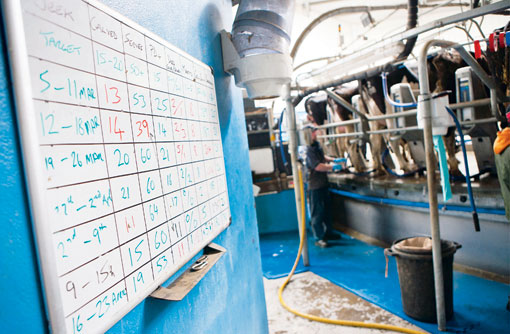
Focusing on key performance indicators can help large scale producers improve productivity and staff efficiencies according to two Somerset dairy farmers, Olivia Cooper reports.
Expanding cow numbers may sound attractive, but the practicalities of managing a large herd – and associated staff – can be difficult.
According to the experts, the key is good communication, with clear goals and regular assessment of herd performance.
Dominic Salter, Manor Farm, Somerset
Dominic Salter, who keeps 840 cows plus 660 youngstock at Y Farm Partnership, Manor Farm, Downhead, Somerset, adopted a new approach to staff and cow management about a year ago.
“We expanded from just over 400 cows to 840 cows 18 months ago, by buying a whole herd and retaining more youngstock,” he says.
“As a result we’ve had to introduce three more staff, including night staff to cover three times a day milking.”
On the advice of his vet, Paddy Gordon from the Shepton Veterinary Practice, he started to focus on Key Performance Indicators (KPIs) to help staff overcome some of the difficulties of such rapid herd expansion. So far, they have been looking specifically at fertility, cell counts, mastitis and bactoscan scores. “We are always trying to compare ourselves to other large herds to see how we can improve further.”
Clear recording
Mr Salter erected a large white board by the parlour, with the KPI targets written along the top, and weekly scores underneath. Where targets are being met, the scores are written in green, with those in red indicating a failure to meet the target. “Our vet visits every Monday so we update it then, and it’s really focused people to pay greater attention to detail.”
As well as a herd manager, the farm has one person feeding, one dedicated to calf feeding, cow health and cow movement, a third overseeing the parlour, three Polish staff milking and yard scraping, and another two contract staff for night milking.
“We have a monthly meeting with the vet to look at where we are, and all the staff will be involved in that. And every morning everyone meets with the herdsman to go through what needs to be done. We do keep saying we’ll have regular meetings with all the staff but haven’t got round to doing it yet – it’s one of our weaker points.”
Cow information sheets
In addition to focusing on KPIs, the staff carry cow information sheets to fill out as they spend time with the cows. These include details on any cows receiving mastitis treatment, plus those which are bulling or sick. “We walk the cows four times a day and use Kamars to spot bulling activity. Freshly calved cows are marked with blue chalk, and if they’re not bulling after 60 days they will see the vet. It’s a great help – nothing is forgotten if it’s written down, and fertility has improved quite considerably as a result.”
In a bid to reduce mastitis and cell counts, the milking team have a full parlour routine, stripping, foam dipping, and dry wiping before milking, with iodine teat spray applied after milking. The cows are bedded on sand or mattresses, and Bactoscan scores have dropped by 10-15, with mastitis down to 40%. “We’re obviously saving on vet bills, and are targeting further reductions to 25%.”
Mr Salter wants to increase cow numbers to 1,000 cows, and plans to introduce lameness as the next KPI to focus on. “We’re going to have a vet student coming in to look at cow condition and lameness. The key is to keep giving our staff as much information as possible, and keep picking up ideas on how to improve as we go along.”
Martin Hoddinott, Barrowhill Farm, Somerset
It is not just huge herds that can benefit from KPIs. Martin Hoddinott milks 260 cows at Barrowhill farm, North Wootton, Somerset, and has seen great results since introducing targets in 2007.
“We split the family business and sold 200 cows as a result, so I cut down to just 50 cows at the time. We’ve then built back up to the current level, and changed vets to Shepton Vets’ Sotirios Karvountzis. We thought it was an opportunity to do things a bit differently and take on some new ideas.
Working with the vet
Mr Karvountzis meets with Mr Hoddinott once a month to go through cell counts, bactoscan scores, milk butterfat and protein content, and fertility.
“The milk protein enables our vet to detect cows which might be suffering from ketosis in early lactation, and it’s proved very useful. We discuss any problems and identify reasons behind them and how to tackle them going forward.”
Although he hasn’t set specific goals, Mr Hoddinott is part of the Dairy Crest/Sainsbury’s health recording and benchmarking group. “We are constantly looking to see what other people are doing, and adjusting our management to try and keep in the top 25% of producers,” he says.
He is also in the process of changing staff management, as he is planning to cut back beef numbers and increase dairy cows to 310. At the moment, he has one full-time milker and a tractor driver; his father looks after calves and youngstock and another employee was working between the beef cattle and dairy.
“We’re training him up to just do the health, lameness and fertility in the dairy, as well as yard work – I think it’s better to have someone who’s focused on a specific job.”
Lameness
“Recently we’ve had a big focus on lameness – I had been doing the cows’ feet but was getting behind on it. Now we’ve got a dedicated person it has made a big difference – we’ve cut lameness by 50% over the past two months.”
Spraying the cows’ teats pre-milking, and spreading lime on the sand cubicles every day had also had a dramatic effect on mastitis, cutting rates by a third since last August.
“As we’ve built up numbers we have kept a lot of older cows – and we should get further improvements in performance as we start to cull those cows which shouldn’t be here.”
As part of a small team, Mr Hoddinott has regular discussions with his staff about cows’ performance and how to improve conditions.
“There are plenty of times when my staff have come up with fresh ideas which have worked out really well. It has to be a two-way dialogue because the staff have to be happy in what they are doing, and if I don’t know what’s going wrong I can’t do anything to improve it.”