

Ways housed herds can plan for the next heatwave
 © MAG/Shirley Macmillan
 Mitigating heat stress needs to be a key element of a farm’s management strategy for cows housed in summer.
But taking inspiration from hot climates and simply investing in an array of fans (for instance) may backfire without first considering a UK dairy unit’s climate and farming quirks.
See also: What worked on dairy units to combat this year’s heatwaves?
With extensive experience of working in the Middle East (including running a 20,000-cow dairy herd), Devon vet Alasdair Marshall points out that UK cow housing is designed to work using natural ventilation and the stack effect.
In places such as Saudi Arabia, however, it is so hot that the stack effect doesn’t work.
Alasdair, of Dairy Health Services, explains that hot air at cow level can’t rise into hot air higher up. Cow accommodation in this region is, instead, built with flat roofs to create less airspace.
These sheds then rely on assisted ventilation – using fans to push air in and out to create circulation.
Rise in night-time temperatures
Conversely, fans in the typical UK shed have to operate in a huge volume of air and can’t shift enough of it to ventilate the building.
“The underside of non-insulated roofs also becomes extremely hot, which reduces heat from cows being able to rise,” he adds.
Furthermore, the UK climate has higher levels of humidity generated by “an abundance of greenery” (grassland, crops, hedges and trees) and tends to see some wind even when it’s hot.
“A lack of wind is another major contributing factor [to heat stress],” says Alasdair. “Heat stress is cumulative and the UK has lower night-time temperatures, allowing cows to recover in a 24-hour period. But this is changing and we are now seeing periods with hotter nights [above 20C].”
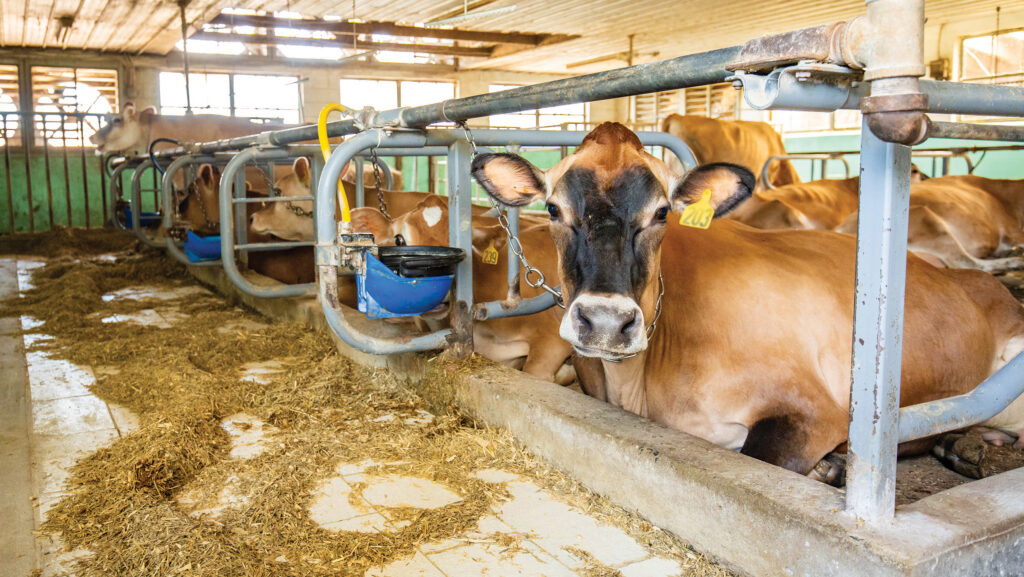
Hot countries build sheds with low roofs and artificial ventilation © Adobe Stock
Farm-specific strategy
He thinks the biggest lesson to be learned from this year’s consecutive heatwaves is to spend winter preparing a strategy for 2027 (and beyond), when prolonged high temperatures are again forecast.
The goal is to minimise heat stress and its effects. His advice is to sit down with the whole team (including staff and advisers) to explain what the repercussions have been for the herd.
They can then work together on what needs to be done for cows, dry cows and youngstock, taking employee ideas on board. It will help motivation when everyone is having to work harder in hot temperatures, he says.
But Alasdair points out that heat stress and climate control are farm specific. Plans must be based on analysing information from this year, using the farm’s own data for peak temperatures, humidity levels, and disease incidence.
Building infrastructure, farm topography, cow breed and milk yield should also be assessed. All these areas influence the level at which cows begin to experience heat stress.
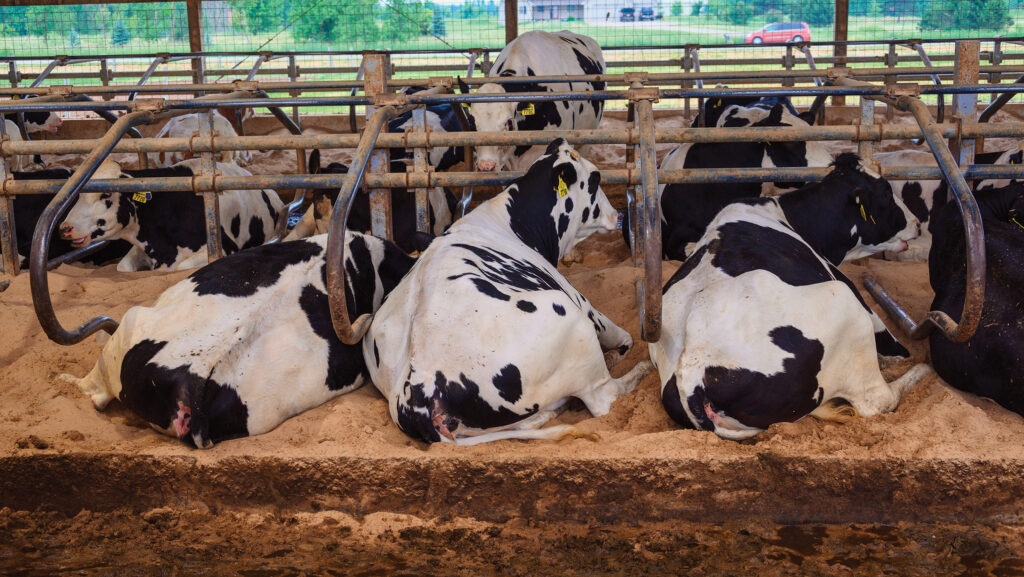
Cubicles need to be the correct size, comfortable, well bedded and clean © Adobe Stock
Cost of inaction
It was evident to Alasdair this year how dairy farms with good buildings delayed the onset of heat stress. Nonetheless, he thinks the number of days that well-designed sheds provide the right environment is falling.
The next step in building design, he says, is for more adaptable cow housing. This might be removable curtains instead of walls, or doors that remain open in longer, hotter summers.
The cost of interventions is becoming justified with changing weather patterns, and particularly when offset against potential losses. Heat stress “highlights weaknesses in a system”, meaning that cell counts rise, fertility falls or lameness increases because cows are under extra pressure.
Temporary milk yield and losses in quality are less than the financial impact of having to cull cows for lameness and poor fertility. “It’s common to lose more cows culled for lameness three to four months after heat stress,” he says.
Pinch points
When reviewing the farm, he first recommends understanding the pinch points in sheds and what fans might try to achieve: air exchange every hour, or air circulation to remove hot spots?
Be realistic about how sheds work on a good day before considering how good they are in high temperatures, he advises.
“Smoke bombs can establish patterns of ventilation or [external] barriers to good airflow such as the presence of silage clamps, trees or other sheds.
“Hang temperature loggers close to cows where cows lie [out of harm’s way]. They determine when heat stress begins – it’s farm specific – and highlight when to start hot weather policies such as soaking cows,” he says.
Cow comfort
Cubicle comfort remains important, even in summer: correct sizing, plus the state of mattresses, bedding and cleanliness, should be checked. Stocking rate is another concern. Alasdair finds that many herds operate at the upper end.
“More cows in a building produce more heat. Two hours after milking we want to see 80% of cows lying down and 20% eating. In a highly stocked shed, they can’t do it. It might not be an issue on a normal day, but it will be in a heatwave.”
Every farm will have different options to destock, he says, including drying cows off early or culling early. However, prioritising destocking groups of fresh cows or first-lactation heifers will protect the most vulnerable animals.
Water demand
Water availability is another restriction when supply, quality and pressure haven’t kept pace with expanding cow numbers and yield. Switching on soaking systems in hot weather only makes things worse, as they use up large volumes of water throughout the day.
Alasdair says areas around troughs tend to be cooler from water evaporation, meaning cows will congregate and obstruct animals lower down the social order from getting a drink.
“Farms on boreholes need to understand how their water tables are changing, affecting quality and supply. We usually say to give 10cm water space a cow, but more is better – 15cm a cow is used in hot climates.”
Feed management
Feed plans for heatwaves need to operate on two levels: ration composition to support the cow’s immune system, and the practicalities of keeping feed fresh, palatable and toxin-free on hot days.
A heatwave diet requires top-quality silage, digestible fibre and energy, says Alasdair. Not only that, but the mineral spectrum needs to change to support the stressed cow’s immune system.
He recommends splitting feeds or switching to night-time feeding. And plans must be put into action when a heatwave is on the horizon, to mitigate intake drops.
Other actions to anticipate are when to stop doing routine tasks to hot cows on hot days. “If you can, do more in the night, less in the day. Can you do jobs next week when you know it’s going to be cooler? Don’t vaccinate if it’s hot, as the cow’s body can’t deal with it. In the breeding area, have a hosepipe and soak the cow before she goes back to her group,” suggests Alasdair.
“Start with things that are of minimal or no cost first and measure the impact, then look at what point do you need to start financial investment in water, soaking, or moving sheds [that are in the way]. Use your farm data to justify it and inform any future building projects.”