

French farming new entrants find price rewards in bison production
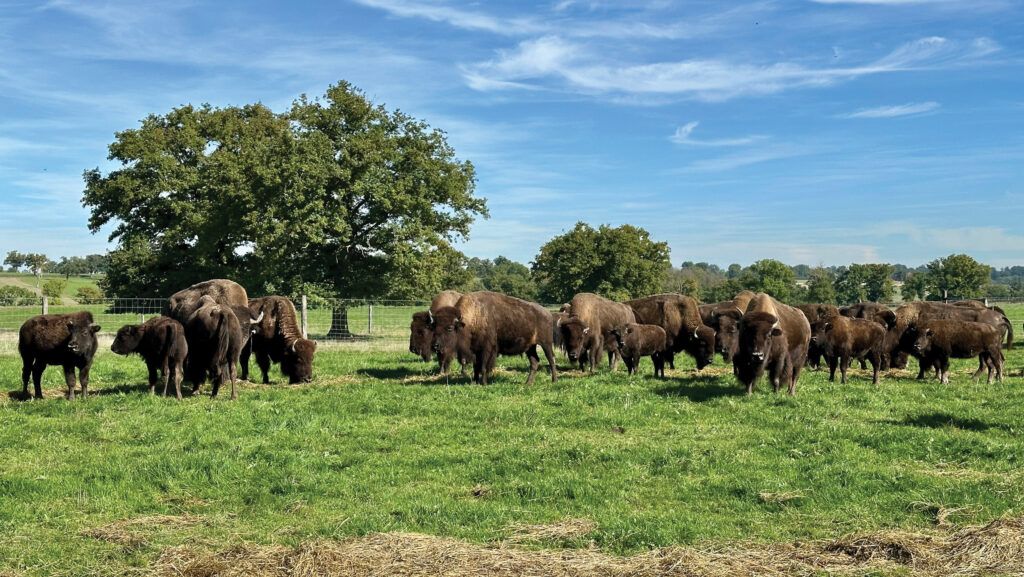 © MAG/Judith Tooth
 A keen eye for a commercial opportunity and a willingness to take a risk have paid off for a French couple looking for a way into farming.
Establishing a herd of bison has not been without its challenges, but the reward is meat that sells for twice the price of beef, direct from the farm.
See also: Why a mixed farm’s focus is on local food for local people
Farm facts
- Bisons d’Auvergne, Le Plaix, Alliers
- 230ha rented, predominantly herb-rich grassland
- 100 bison cows, and 400 animals in total
- 80 bison slaughtered a year aged three to five years
- On-farm butchery, online sales and farm shop
Thirteen years on, Matthieu Peron and his wife, Christel, who both trained as agricultural engineers, now have 100 breeding females, and 400 bison in total.
Direct meat sales account for 90% of business from their 230ha (568-acre) farm at Le Plaix, between Moulins and Montlucon in central France.
After eight years in Paris marketing tractors for export, Matthieu was ready to get his hands dirty.
“I enjoyed commercial business, but the moment came when I wanted to choose a new direction,” he says.
“I wanted to find a type of production that I could sell by myself, to limit the number of people between me and the customer, and to sell that product at a level where I could make a profit.”
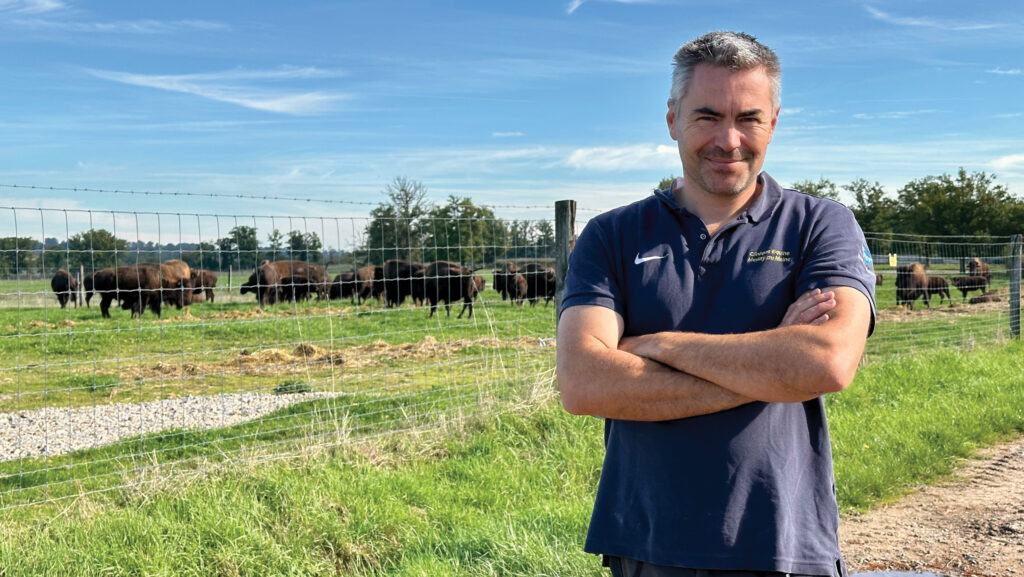
Matthieu Peron © MAG/Judith Tooth
He and Christel considered beef, chicken and lamb production, but were unsure how they could thrive in these sectors.
“I didn’t know what I could do better than people already in those businesses – they were already working well,” says Matthieu.
He turned to bison, inspired in part by rancher and author Dan O’Brien, whose book Buffalo for the Broken Heart documented the return of buffalo to his land in South Dakota after an absence of more than 150 years.
To learn more, the couple visited bison farms in Europe and Canada before researching the potential for domestic sales of bison meat.
“In France, there are 15 producers supplying [a total of] 60,000t of bison meat annually. This represents 10% of the market in France, with 90% imported from North America.
“I was very motivated by the fact that there was space for me [in this market],” says Matthieu.
Challenges getting started
The opportunity to produce meat known for its high quality also appealed: lean and tender, bison is rich in iron, protein and omega-3 fatty acids, low in cholesterol and it even contains less fat than chicken.
However, when he started to look for sources of bison genetics to start a herd, Matthieu discovered how limited his options were, so put this task ahead of finding suitable land.
Only American Plains bison can be bred for meat – the European bison is a protected species.
“I was looking for 20 cows, but with only a few farmers involved [in bison production], I found no one was about to sell me any.
“Then I heard there was a farmer in Belgium, Jean-François D’Hoffshmidt, who would be willing to sell – he was losing a part of his farm and wanted to find a partner in France,” he explains.
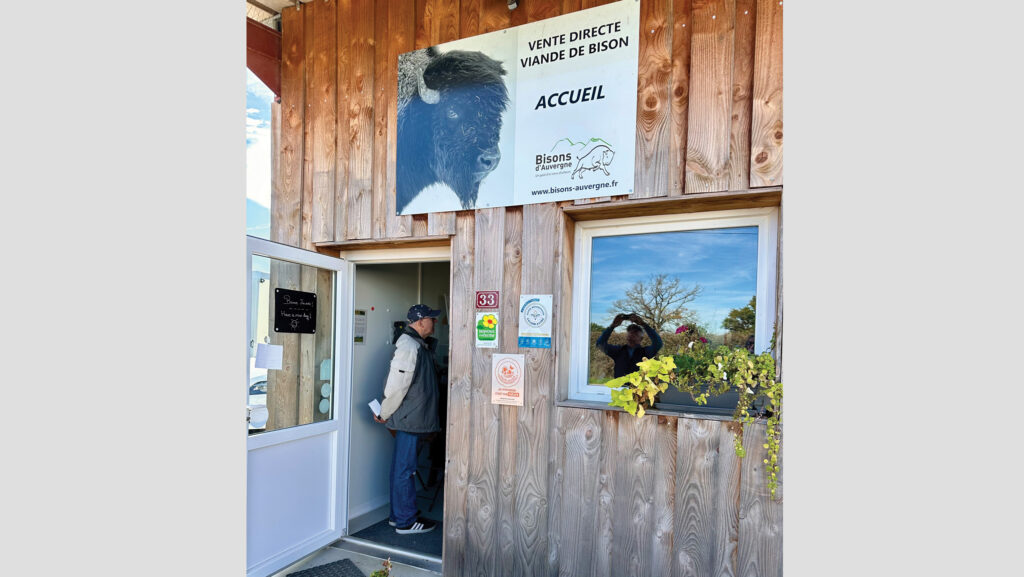
© MAG/Judith Tooth
A ring-fenced beef farm then came on the market in the department of Alliers, and collaboration with an investor enabled the couple to rent it and establish their business, Bisons d’Auvergne.
Having land in a single block is important, says Matthieu: “With bison, you can’t close a road to let animals cross it – it’s too dangerous.”
In fact, the existing cattle fencing across the farm had to be replaced with 1.8m high fencing to comply with safety regulations.
Although in France, bison are considered like cattle, they are also classed as dangerous.
Finding a suitable processor also proved difficult.
“Nobody wants to butcher a bison as it’s not a common animal,” he explains.
“We’re lucky to have four slaughterhouses within 60km [37 miles] – but none would accept us as the bison are outside the standard. So, we had to go 250km [155 miles] away, near Lyon.”
Growing the herd
Beef cattle remained on the farm to provide an income, with numbers decreasing gradually as the bison herd grew.
Starting small also gave time to learn and develop the husbandry and handling skills needed for a species with a top speed of nearly 40 miles/hour – faster than a horse.
The bison live outdoors year-round and live entirely off grass and conserved forage. They are introduced at an early age to the central handling facilities in the field, but are only handled twice a year, to minimise stress.
“We only go into fields in a tractor, never on foot,” stresses Matthieu.
The 100 cows are split across two herds, each with three bulls. First calving is at four years old, in spring, following a nine-month gestation period. Cows cycle again in mid-July.
“They must be in top condition at this point, or they won’t come back into heat – and that only occurs once a year. So, this is our top priority.
“This region can get very dry in summer, so silage is fed during this time to provide extra energy in the diet,” he says, adding that no maize is fed as it affects the taste of the meat.
Weaning is at eight to nine months; calves graze together for a further five months before being separated into males and females. Males are slaughtered before three years of age; females at four to five years.
“There’s been no selection of species, so they are very slow growing,” Matthieu explains.
“And you can’t push bison: they have a primitive digestive system – they don’t like protein and don’t digest starch.
“It’s also difficult to ensure genetic diversity in the herd, as European policy on TB prohibits importation of bison from North America, where testing is done only when animals arrive at the slaughterhouse.
“So, we have to rely on sources from other European countries like Belgium and Germany.”
On-farm butchery
Some 80 bison a year are sent for slaughter. Carcasses are returned to the farm, where a full-time butcher is employed to process them on-site.
All but 10% of the meat produced from the herd is sold fresh – French consumers consider frozen meat to be of poorer quality, Matthieu says.
Christmas sales account for one-third of business, so the challenge is to encourage a change in eating habits, he adds. A range of terrines and other preserved meats helps make use of the whole carcass.
“Some say the price is too high, but I think it’s fair; it takes twice as long to produce bison meat, with the youngest slaughtered at two and a half years,” he points out.
Recent changes to legislation mean that on-farm slaughter is now possible in France.
As a result, the business has taken the opportunity to cut out transport costs to the abattoir and further minimise stress by investing in a fixed facility to slaughter the bison.