

Are longer rest periods feasible in grazing dairy herds?
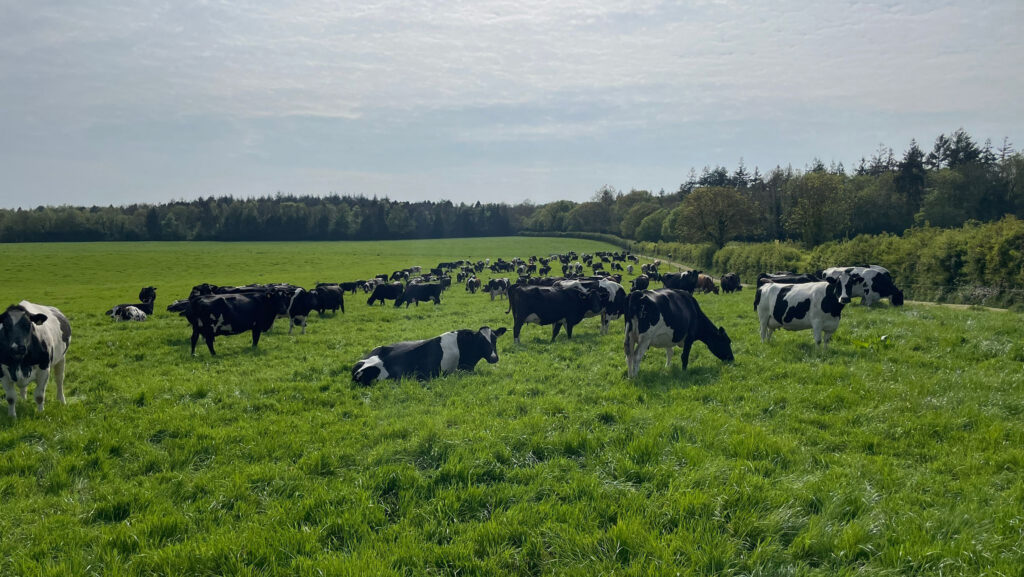 © Dan Gammon
 Changing grazing management to allow taller entry covers and residuals can be successfully used to improve degraded pastures on dairy farms, a three-year trial has shown.
Soil health improved and, overall, forage quality and milk yield did not suffer on the five farms involved in the Innovative Farmers field lab.
However, target covers had to be lowered following the first year of the trial after forage quality dropped significantly.
See also: Feeding hay as standing crop reduces milk fever on Devon farm
“Farmers were keen to find the sweet spot of soil benefits, greater resilience, and milk yield,” says Kate Still, head of farming programmes at the Soil Association.
“Some had previous experience of tall grass grazing, for example, using standing hay for dry cows, but they wanted to know if and how the practice could work across their whole dairy systems.”
What is tall grass grazing?
Tall grass grazing is a type of rotational grazing that involves:
- Long rest periods, leading to taller grasses with deeper rooting systems and greater sward resilience
- High stocking densities
- Frequent moving of livestock using electric fencing.
Similar practices include mob-, cell and adaptive (or adaptive multi-paddock) grazing.
The five farms, all organic and in the South West, each chose a control plot in a similar or adjacent field, to be managed routinely.
Management aims for the trial plots were:
- Allow the entry cover to reach a height 30-50% taller than the control field – this was about 4,500kg dry matter (DM)/ha
- Apply a one-third eaten, two-thirds residual/trampling approach, with stock removed at a minimum sward height of 7cm, or 2,000-2,500kg DM/ha
- Apply a stocking rate/land parcel size to meet the forage needs of the group of cows (using plate meters and Agrinet software)
- Be flexible with grazing cells/paddocks and rotation timing depending on the size/forage need of the group of stock (as long as entry and exit sward height protocols were maintained for both plots).
Entry covers in years two and three were set lower than the initial 4,500kg DM/ha target to maintain forage quality. These varied considerably across the five farms.
Soil sampling in 2025, at the end of three years, showed a clear advantage in the trial plots across the five farms, compared with the control:
- Improved rooting and soil structure in the bottom soil horizon (15-30cm)
- Higher soil moisture content
- Higher overall biological activity
- Significantly increased fungal activity
- Slightly higher macro- and micronutrient levels
- Lower “antagonistic” minerals such as lead and aluminium.
“Taller grass means bigger roots – here’s the proof,” says Farm Carbon Toolkit senior farm adviser Rob Purdew, who analysed the trial data.
“But there’s a caveat: we saw a decrease in soil carbon, as conditions were so hot.” The reduction was, however, less dramatic in the trial plots.
Forage quality was largely consistent (see table below). Three farms grew more forage overall, while the remaining two struggled to match the control.
Milk yield did not suffer once the trial farms adapted their approach to avoid leaving cover so long it was starting to senesce.
The five farmers are keen to continue to trial this type of grazing management.
Forage quality was similar across trial plots and controls |
||
|
Forage analysis (average of five farms in year two) |
Trial |
Control |
|
Dry matter (DM) (g/kg) |
208.8 |
204.8 |
|
Crude protein (g/kg) |
137.4 |
149 |
|
Digestibility value (%) |
66.2 |
68.8 |
|
Metabolisable energy (MJ/kg DM) |
10.4 |
10.8 |
|
Sugar (g/kg) |
99.2 |
98.8 |
|
Source: Innovative Farmers |
||
Two farmers’ feedback on the trial
Tom Gregory

Dairy and arable farmer Tom Gregory milks 600 cows across two units on 728ha (1,800 acres) on the Dorset-Devon border.
He had been struggling to manage a steep, north-facing field since taking it on in 2014. It had grown maize, but soil compaction had not been addressed.
“We put the field into a clover ley, but that wasn’t working well. It then went into winter wheat and performed poorly,” says Tom.
It was only when he let cows “trample their way through” the following ley that the field looked the best it had in years.
This encouraged him to look at where else he might incorporate tall grazing with extended rest periods.
For the trial, he spilt a 9ha (22-acre) field beside the dairy in two.
This field had been used to set-stock cows on silage during hot periods and had compaction issues.
Lessons learned
Tom experimented with the number of daily moves: “The cows didn’t like four times, but two was fine,” he says.
He realised that while trampling opened up the sward, he had put them in “far too high”, at a cover of about 5,000kg dry matter (DM)/ha. Management became easier as the trial progressed.
Tom’s conclusions for his setup:
- He should have used a sward lifter to address compaction before the trial started
- Stitching some species into the sward – “ryegrass isn’t easy” – and applying slurry would have helped
- The first graze must go ahead regardless, to maintain grass quality, and the residual left based on weather conditions
- It becomes easier to start “stretching” covers (lengthening the rotation) in the second year
- More trampling is possible as the season progresses.
“I’m not mob-grazing across the whole farm now but, for drought tolerance, I’m happy to have higher residuals and covers,” he says.
Matthew Senior

Somerset farmer Matthew Senior runs 330 cows in a split block-calving system on 263ha (650 acres) on heavy clay. Improving soil health is an ongoing commitment: soil organic matter has increased from 2% in 2009 to more than 14% across the grazing platform.
Cows average 6,000 litres, on 1.6t concentrate fed to yield through milking robots.
He reports good success running August-calving cows on standing hay from mid-June each year.
Flexible approach
Matthew was hesitant about putting milking cows into covers of 4,500kg DM/ha and opted instead for 4,000kg DM/ha in his trial field.
He says he usually targets a residual of 1,500kg DM/ha to ensure grass quality through the season, but found that regrowth was quicker from a residual of 1,650kg DM/ha.
His standard management is to give cows three allocations of grass a day.
“We aim for 10 grazings per paddock per season and managed seven in the trial paddock, though we didn’t grow much less grass,” he says.
“The cows were all content – they were never shut in and were free to roam – and there was no negative in milk quantity or quality.
“And, with the better root structure, we can now graze up to mid-November.”
Following the trial, Matthew now targets entry covers of 3,500-4,000kg DM/ha though continues to exit at 1,600-1,650kg DM/ha.
“What I learned was that when things look a bit ‘woolly’, it’s not the end of the world. We didn’t lose any production.”
The trial results were presented at the recent Groundswell festival, Hertfordshire.