

Tips on avoiding cow health risks when grazing after drought
Once rain returns, though it may be welcome, grassland managers are warned to be careful as substantial rain following a drought encourages grass growth that could be rich in nitrates.
Nutritionist Luppo Diepenbroek, of Straight Line Nutrition, says soil levels could be high where fertiliser was applied just before the drought (after first cut, for instance), or by the breakdown of organic matter from previous slurry applications.
See also: 7 ways to protect grass growth from dry weather extremes
He advises farms to take grass samples (200g is sufficient) for fresh grass analysis and results will be returned within 48 hours to determine whether grass is suitable to graze.
“Especially if potassium is present, there is increased nitrate uptake by the grass, leading to nitrate poisoning.
“This is where nitrates present in the grass are converted to nitrites in the rumen,” Luppo explains.
“Safe nitrate levels [in grass] are below 0.1% nitrate nitrogen. Issues such as poor palatability and cow infertility will arise at levels of over 0.2% nitrate nitrogen, but levels of 0.5% are toxic and you will see dead animals.”
Graze – but not straight after rain
With any luck, rain will enter cracked soils and remain in the soil profile, rather than running off, he adds.
But with decreasing day length affecting potential grass growth rates, there is less chance of being able to take a good cut of silage this autumn to make up forage shortfalls.
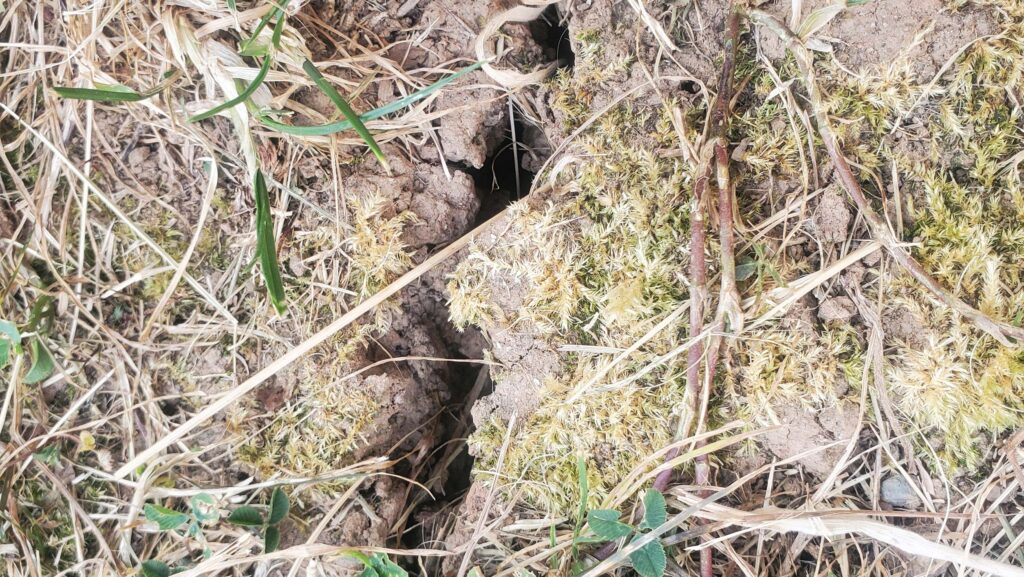
Cracked soils © Luppo Diepenbroek
Instead, Luppo suggests that swards are best grazed to maximise end-of-season growth and reduce feed costs.
However, he points out it is important not to start grazing paddocks the first day after rain.
“The initial leaf emerging is from sugar reserves in the roots. Once this first leaf is well established, after about four days, it will contribute sugars back into the plant.
“If this leaf is grazed off repeatedly, the plant will run out of sugars and die off,” he says.
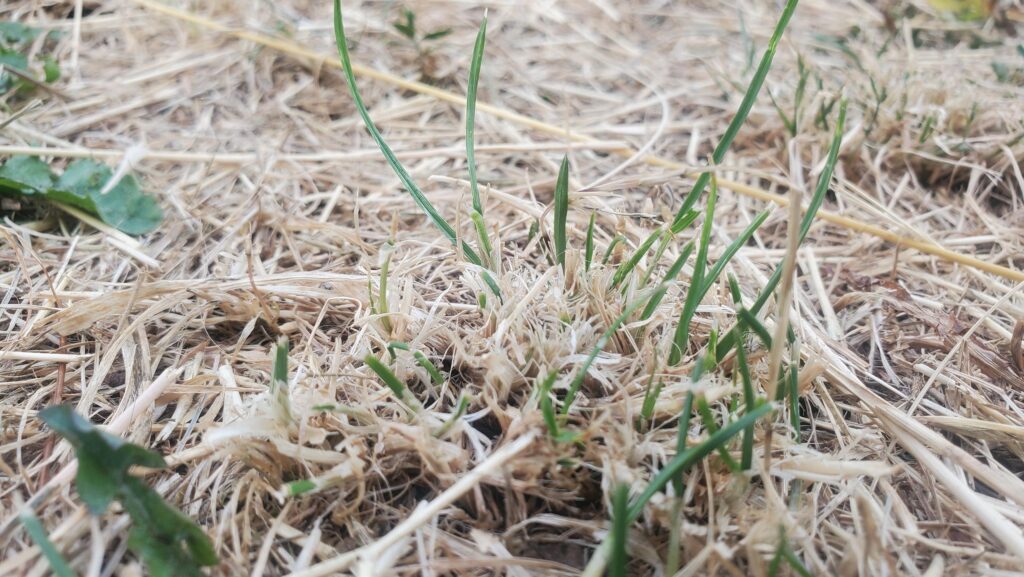
Grass regrowth © Luppo Diepenbroek
“When you see the new leaf emerge, you will notice it being pale yellow/green.
“It becomes greener over time, indicating more chlorophyll content. So delaying grazing by at least five to seven days will allow grass to grow to its potential.”
Frothy bloat warning
Clovers and dandelions are still green, he says, albeit a bit discoloured due to drought stress.
Yet there are potential nutritional issues when grazing rejuvenated grass-clover swards or herbal leys after rain.
The key risk is frothy bloat. “Especially at the end of the season, when [such plants] are more abundant.
“Standing behind the cow, the rumen will be distended on the left-hand side.”
Frothy bloat from clovers is caused by excess nitrogen uptake, aided by high potassium levels (an index of 2 or more) in soils.
“There will be excess protein from legumes, which forms frothy bloat in the rumen soon after cows graze, especially if it has rained the day before, and during, grazing.”
Cows that have been held back in a yard and go out hungry, or that move from a grass-only sward into one with a high proportion of clover – more than 40% ground cover – are more susceptible, says Luppo.
Measures to reduce risk
“Feeding the right transition diet, such as hay, ensures cows do not go out hungry.
This will slow down and dilute intakes until nitrate levels are safe and the rumen has adapted to properly digest proteins from the clovers.
Preventative measures include an application of 100kg/ha of salt (sodium chloride) as soon as grass starts to regrow.
Luppo explains that sodium displaces potassium in the plant, limiting luxury nitrogen uptake.
“Another way to prevent frothy bloat is to slow down the gas formation in the rumen by causing an oil slick.
“Using 100ml of vegetable oil in the drinking water reduces the activity of microbes in the rumen that form the frothy bloat,” he says.