

How planting wide boundary hedges tightened farm’s biosecurity
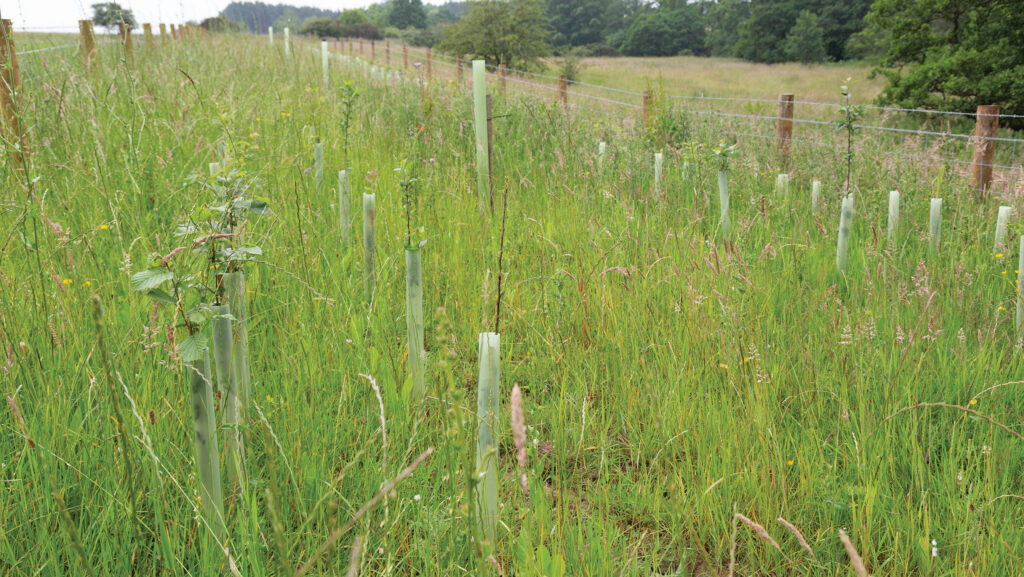
New 5m-wide, double-fenced hedges are helping protect stock from infectious disease as well as enhancing biodiversity on a Northumberland beef and sheep farm.
“It’s good biosecurity before the trees have even grown,” says Duncan Nelless. Fat hedges, as he calls them, are a new feature at Thistleyhaugh Farm, near Morpeth, though he had seen them previously on a farm in Cumbria and liked the idea.
See also: 5 ways to improve biosecurity on dairy farms
They prevent any risk of nose-to-nose contact with stock on neighbouring farms. “Our responsibility is biosecurity: our sheep flock and cattle herd are high-health status, and we need to maintain that,” says Duncan.
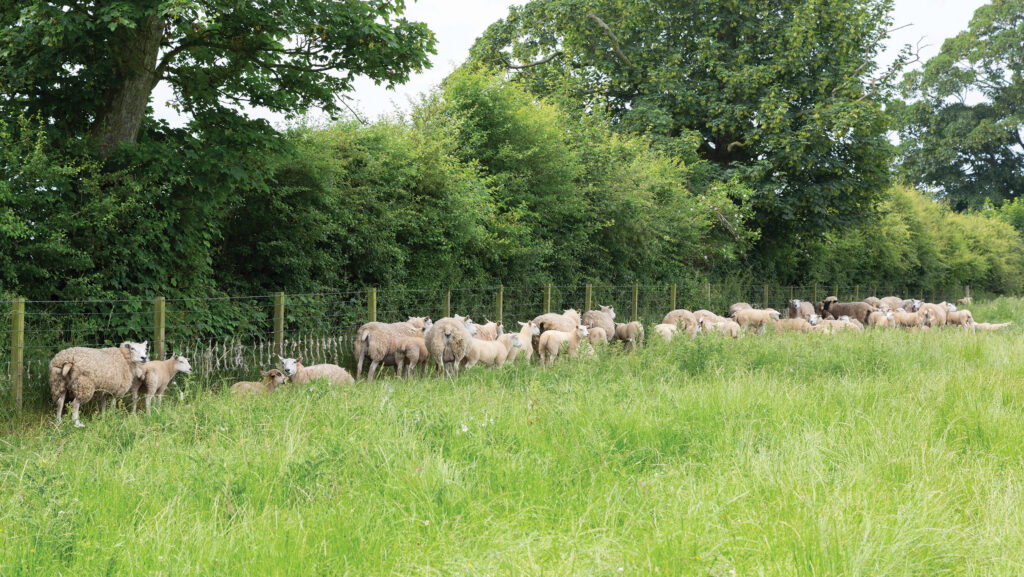
“Not that our neighbours are a problem,” he hastens to add. “We also want shade and shelter for the stock – we see the value in our existing hedges.”
Farm facts
© MAG/Judith Tooth
Thistleyhaugh Farm, Morpeth, Northumberland
- Farming 809ha organically, half owned
- All grass, with 75% permanent pasture
- Closed herd of 280 Angus-Hereford criss-cross suckler cows, with progeny sold as stores or finished for Dovecote Park
- Closed, performance-recorded flock of 2,000 mainly Lleyn ewes
- Finished lambs supplied to Pilgrim’s Europe and rams sold for breeding
- Countryside Stewardship and Sustainable Farming Incentive
Forest funding
The 1,600m (1 mile) of new boundary hedging was planted as part of the Great Northumberland Forest, an initiative by Northumberland County Council to increase tree cover in the county.
“It’s not about creating a forest – planting can be on an area as small as 0.2ha [0.5 acre],” he explains. Having already worked with the council on some riparian projects on his farm, Duncan approached the forest team to consider including wide hedges in the scheme, and a plan was agreed.
The funding, part front-ended, paid for all the stock fencing, plants and two contractors to carry out the work, in February this year. It also covers maintenance for 15 years.
© MAG/Judith Tooth
The hedges are planted in five rows. In the centre row, oak and silver birch – the taller trees – are planted one every 10m.
On either side of these is a row of species including rowan and crab apple, planted every 1m. The two outer rows are willow (for browsing), dogrose and hazel, at three every 1m.
As with previous planting schemes, Duncan opted for cell-grown plants, rather than bare-rooted ones, to enhance survival rates. In June, almost every tree and shrub was growing well.
Links with existing habitats
Existing hedges total 56km across the three holdings that make up the farming business. These are laid in rotation and then maintained on a three-yearly cycle.
As well as ensuring shade and shelter, this management promotes biodiversity – another priority for the Nellesses.
The hedges act as wildlife corridors, connecting other habitats such as the River Coquet, a site of special scientific interest, which runs through the farm and is the focus of their riparian work.
There is also a practical benefit: “We’re looking after tributaries that feed into the river, including gulleys, which are a real pain to manage, so fencing them off [with council funding] is really useful.
“For example, there were fields we couldn’t lamb on as the lambs would fall into the gulleys. These were low-value areas [for farming] that were a struggle to manage and hard to check.
“Now we can lamb and calve in these fields, and we can key off the fencing for subdivision of fields, which is a big part of our grazing management.”
© MAG/Judith Tooth