

How timely bluetongue vaccine prevents dummy calves
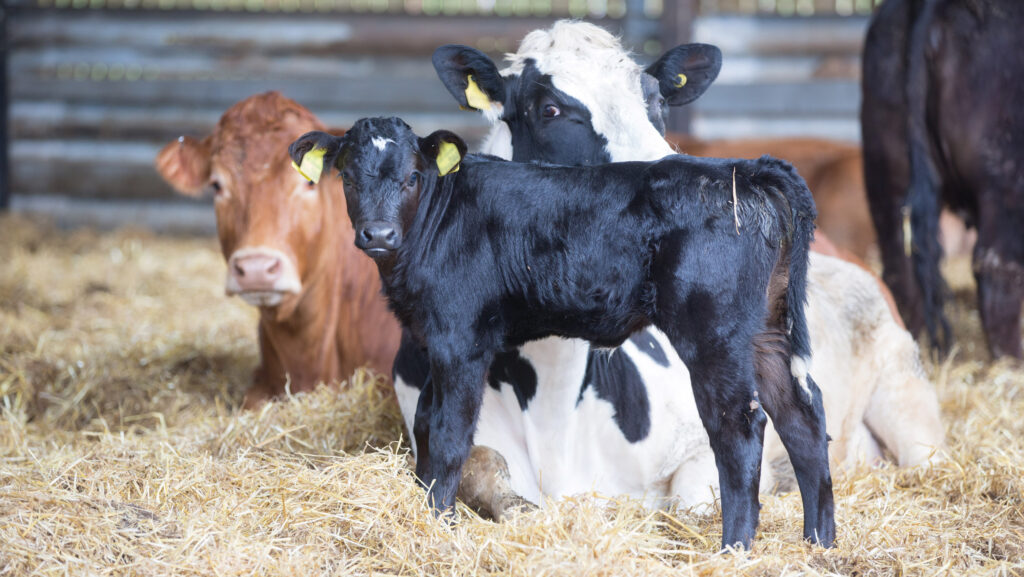 © Tim Scrivener
 A bluetongue vaccination uptake of only 50% among the suckler herd clients of a South East vet practice has been followed by several cases of dummy calves in unprotected herds.
Vet Maarten Boers of The Livestock Partnership, covering West Sussex, Surrey and Hampshire, first saw cows affected with the midge-born virus last summer.
See also: How a vaccine transformed crypto control for one beef system
They had swollen faces and were very sick, he says, but all recovered – unlike the impact reported by friends in the Netherlands.
“It was horrendous there – sheep dying left, right and centre, huge milk drops [in dairy cows]. We haven’t seen those severe symptoms – it’s been far more subtle here,” he says.
What he saw in Kent (where he also works testing bull fertility), however, were cases of dummy calves: born looking normal but without a sucking reflex, no awareness of their surroundings and no ability to bond with the dam.
Vaccination drive
“We then had a real push in our practice to vaccinate. Most of our dairy clients vaccinated [along with some sheep flocks], and we haven’t seen dummy calves born on dairy farms.
“But uptake in suckler herds was more like 50:50, and we are now seeing dummy calves exclusively in the herds that didn’t vaccinate,” says Maarten.
One farm had five cases of dummy calves in a week, another testing positive for bluetongue had two, another had three, he says.
These herds had not experienced any bluetongue-related symptoms while the cows were pregnant.
“These are suckler herds of 50-100 cows, so we’re looking at 2-4% of calves affected. With beef prices as they are, that represents a big loss.
“I’d advise vaccination for cattle keepers across England and Wales,” he says, adding that cases have now also been confirmed in Northern Ireland, though none yet in Scotland.
Poor scanning results
Reports of “really awful” scanning results in sheep flocks have set alarm bells ringing for another vet, Sophie Cranfield of Mid Downs Farm Vets.
“If a farmer reports a poor scanning result, there are other things we’d investigate for, but bluetongue does cause early pregnancy loss,” she says.
A delayed calving period can also be a warning sign.
“For one beef farmer, who doesn’t scan his cows, calving started a month late. That could be down to a bull with an infection causing transient infertility.
“Or, the cow could have got pregnant, lost that pregnancy early [from bluetongue infection] and later got in-calf again.”
Sophie, whose practice covers East and West Sussex, Surrey and north Kent, also says that while most of her dairy clients have now vaccinated, only a few beef clients have opted to do so.
Bluetongue vaccination
- Cattle Two injections, three weeks apart
- Sheep One injection
- Timing Ideally before breeding but can be given at any stage
- Cost £2.50-£3/injection
Vaccine action
- Bluevac-3 reduces viraemia (virus in bloodstream), mortality and clinical signs in sheep, and reduces viraemia in cattle, caused by serotype 3 of the bluetongue virus (BTV-3)
- Syvazul As above, plus reduction in lesions in sheep
- Bultavo 3 reduces viraemia and prevents clinical signs in sheep and cattle
The Defra website has more details on the BTV-3 vaccines
Lack of clinical signs
She has carried out surveillance blood tests for the Animal and Plant Health Authority (Apha), mostly last autumn.
These are random samples from herds with no clinical signs. “We had three tests in a row [in suckler herds] where 50% of the animals sampled had bluetongue,” she points out.
Despite sharing the bluetongue surveillance results with clients, convincing some farmers to vaccinate remains a challenge.
“Testing is expensive: if you’ve got a suspicion, you need to report it to Apha, which funds three virus tests.
“But if you just want to screen your herd for previous exposure, it’s £26.50/test. By contrast, the vaccine is £2.50/dose.”
Risk of further losses
A further concern is that some farmers are assuming their herds will by now be immune to bluetongue, says Sophie.
Some immunity is likely if an animal has previously been infected, though how long it lasts is unknown.
“There’s no guarantee a significant number of your animals have had it. And without testing, you don’t know, so it’s quite a risky game.
“Even if 50% of your herd has had it, that still leaves 50% that might get it next year – that’s another year of devastating losses if you’re losing pregnancies and losing calves.”
Case study: Drungewick Hill Farm, West Sussex
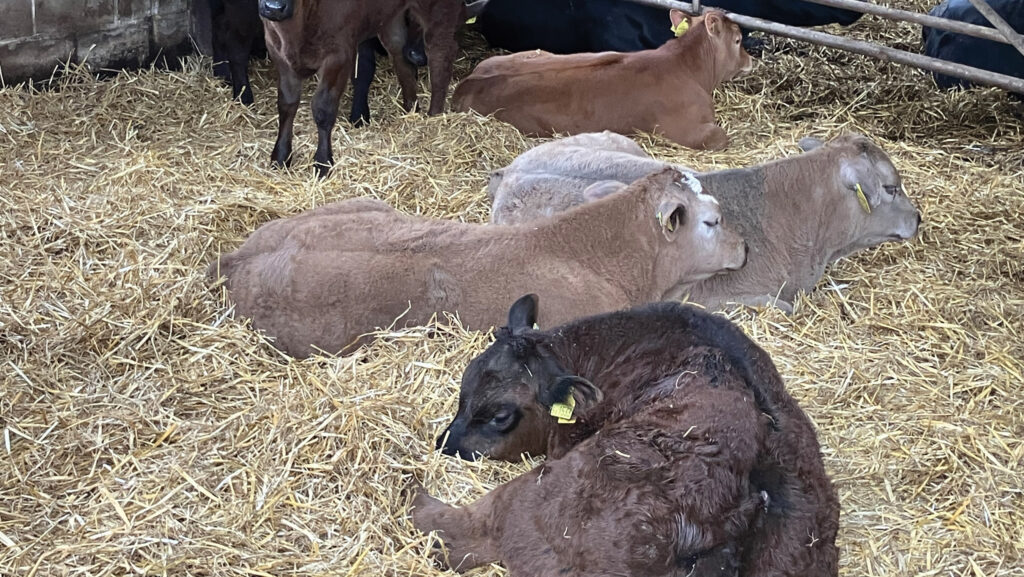
Calves at Drungewick Hill Farm © Michael Minto
Autumn calving at Drungewick Hill Farm went “swimmingly” until the last cow, says farm manager Michael Minto.
One of the remaining few Charolais of the farm’s historic pedigree herd, she was a big cow at 900kg, yet she had a “runty” calf.
“The calf was a bit slow, but I got it sucking. There was nothing ‘wrong’, yet it wasn’t right – but I never really thought much more about it,” he recalls.
“When I told the story to a friend at Christmas, he immediately said: ‘That’s a bluetongue cow.’”
Michael admits he saw bluetongue as a problem brought on the wind to Kent and East Anglia, not West Sussex, and buried his head in the sand.
Dummy calves
When the next block started calving in January, a calf was born one night seemingly unaware of its surroundings.
“Next morning, it was the same: calf still on its feet, but hadn’t a clue where its mother was.
“We got the calf to suck, but then it just started walking in circles. I called the vet and when he saw it, straight away he said bluetongue.”
The second affected calf was then easy to spot, he says, while the third (though less extreme in its symptoms) was still “pretty clueless” and would walk into walls.
“I persevered with that third one for a couple of days – we have good cattle here and it was a seriously good calf – and it broke my heart when I had to dispatch it.”
Blood tests confirmed all three calves were bluetongue positive. The herd’s in-calf cows, bulling heifers and stock bull have since been vaccinated.
“I’ve left the yearling heifers, which will come into the herd next spring, as the vet said it wouldn’t be a bad thing for them to have the exposure [to the midge],” says Michael.
“I didn’t need any persuading – I wouldn’t want to go through that again; I really struggled.”
Vaccine worth the cost
He thinks the sooner farmers get their cattle vaccinated, the better, particularly as “the midges are on the go”.
“In the end, I think losing only three calves, I got away lightly. I think it’s a generational thing – older farmers like me, who are 55 or 60 and above, are less likely to have vaccinated.
“But it’s a small cost, and if it’s saving a calf it’s worth it.”
Farm facts: Drungewick Hill Farm, Loxwood, West Sussex
- 202ha mixed farm
- Additional 20ha grassland rented
- Closed, high-health herd of 65 mainly crossbred suckler cows
- Artificial insemination plus home-bred sweeper bull
- Calving indoors in two nine-week blocks
- Cattle finished by 18 months, all supplied to ABP Guildford