

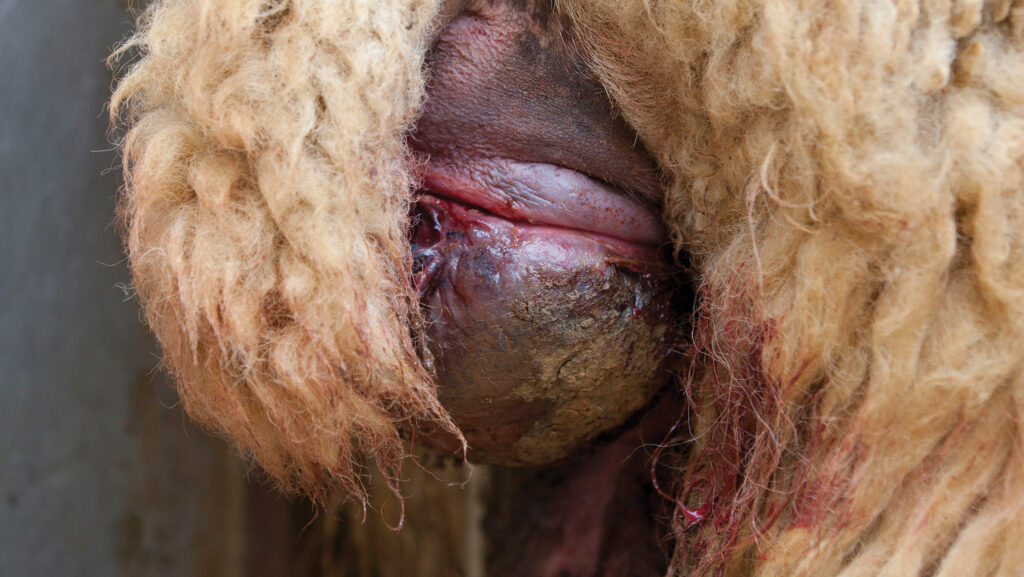
Vaginal prolapse in ewes: How big an issue is it?
 © Tim Scrivener
 Vaginal prolapse is well managed on many sheep farms, but vets should give guidance on the use of antibiotics, pain relief and retention methods to improve animal welfare and antimicrobial stewardship.
Kent-based vet Sharminda Lockwood’s national survey of farmers in the 2024-25 lambing season found almost 70% gave painkillers when replacing a prolapse, and 80%% used a harness to keep it in place.
Yet 6.5% were stitching up vulvas without local anaesthetic.
See also: Advice on treatment for vaginal prolapse in ewes
Sharminda, who works for Westpoint Farm Vets, Ashford, was largely encouraged by the results. They were certainly an improvement on findings from research gathered by vet students in 1995 during their work experience in the lambing shed.
That study found the main methods of managing vaginal prolapse were plastic intravaginal devices (“ewe spoons”) and, most commonly, sutures to close the vulval lips.
In 55.6% of cases, the sutures were done without pain relief, while other techniques such as using ear tags and safety pins were not unheard of, she says.
Sharminda Lockwood © MAG/Judith Tooth
Changing practices
At Springfield Farm, near Petham, where Sharminda runs 350 Lleyn-cross breeding ewes on an 81ha (200-acre) grass farm with her husband, Ian, managing prolapses has progressed to more welfare-friendly procedures.
“We would have used spoons, but they don’t stay in, they’re uncomfortable for the ewe, and there is a risk of infection. We started using prolapse harnesses five years ago, as they are not invasive and appear to be more comfortable,” she says.
Sharminda could find little data since the 1995 study to determine whether wider on-farm practice had similarly evolved.
Because the condition is commonly dealt with on farm without veterinary intervention, she needed to gather information directly from farmers and shepherds.
She shared the survey via vets’ WhatsApp groups for distribution to their clients, along with posts on social media. A total of 127 respondents, 63% on lowland farms, answered questions about their in-lamb ewes.
Overall, incidence of prolapse varied between 0% and 20%, though the interquartile range (which excludes outliers) was 0.7-3.6%. When treating a ewe, most farmers (87%) washed the prolapse before replacing it.
The earlier it is treated, the better, she says. “As one farmer noted: ‘Catch it when it’s pale pink, not red and angry’. But clean, warm water is fine – don’t irritate it with disinfectant,” she adds.
Ewe prolapses key survey findings
- Median prevalence of vaginal prolapse: 1.7%
- Always/usually wash prolapse before replacing it: 87.1%
- Give non-steroidal anti-inflammatory drugs: 69.9%
- Give antimicrobials: 62.4%
- Use intravaginal device (spoons) to secure replaced prolapse: 36%
- Suture vulva without local anaesthetic: 6.5%
- Call vet for treatment of vaginal prolapse: 10.2%
The survey
- Respondents 127
- Median flock size 200 ewes
- Average lambing percentage 165%
- Breeds own replacements 88%
- Tail-docking 81.1%
- Lambs indoors 57.1%; outdoors 31.8%; 11.1% mix
- Most common breeds Texel or Texel-cross 39.8%; Mules 30.5%; Suffolks 19.5%; Lleyns 13.6%
Source: Sharminda Lockwood, Westpoint Farm Vets
How painful is a prolapse?
When asked to rate how painful they thought a prolapse was for a ewe (given a range of 1 to 5), most farmers selected 3 or higher, equating to “moderately or severely painful”.
However, while most were using pain relief in the form of non-steroidal anti-inflammatories, 13% reported that they rarely or never administered them.
“Some 62% also gave antibiotics, but a mild prolapse doesn’t need them, so more education is needed [about modern practice],” says Sharminda.
“If the prolapse is clean and not infected, there’s no need; if it’s dirty or traumatised, then yes, use antibiotics. Speak to your vet for advice.”
The ongoing use of sutures by farmers is a cause for concern: they should only be placed under local anaesthetic by a vet, she stresses. If not performed correctly, there is a risk of trauma to the vaginal tissue and increased chance of infection, as well as pain and discomfort.
“A ewe with stitches needs close observation to ensure the stitches are removed when she starts lambing,” she adds.
In addition, failure to use local anaesthesia contravenes the Animal Welfare Act. VetPartners’ Sheep Clinical Interest Group, on which Sharminda sits, has determined that ewe harnesses are the preferred method of retention, with sutures used only when other methods have failed.
Furthermore, the suture should be performed by a vet using a caudal epidural to ensure the procedure is pain free.
Prolapse main risk factors
Asked to describe the tail-docking length they used from a series of simple drawings, most respondents indicated that they left an appropriate length of tail.
Yet docking was too short to cover the vulva in 13% of responses. Those farmers who reported short docking also reported a significantly higher prevalence of vaginal prolapse than those leaving a longer tail: nearly 4%, compared with 1.6%.
This finding is consistent with previous anecdotal evidence, she says.
Tail length is one of the main risk factors for prolapse, says Sharminda. Exactly why docking too short makes this more likely isn’t fully understood, but it is thought it affects the muscles and nerves at the top of the tail.
The vulva should remain covered – roughly the width of three fingers from the top of the tail in a newborn lamb. But this isn’t always followed. “Sometimes it’s habit, sometimes error,” she says.
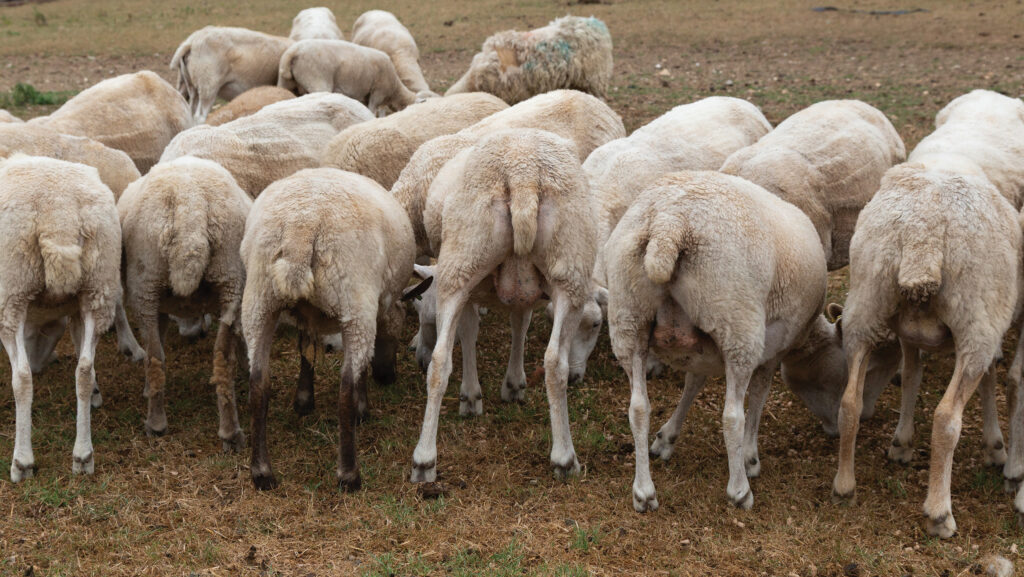
Sheep with tails docked to correct length © MAG/Judith Tooth
Twin- and triplet-bearing ewes tend to be at greater risk, compared with single births.
Previous studies have found variable evidence on the effect of ewe body condition and nutrition. Sharminda’s research found body condition at lambing averaged score 3.5 for 34% of respondents, score 3 for 45%, and 2.5 for 16.5%, but no significantly different prevalence of prolapse between flocks.
“We find that feeding straw is better than hay, as the ewes will gorge on hay. Some farms blow straw into the lambing shed for bedding and feed and have very low prolapse incidence,” she notes, adding that anecdotal evidence suggests feeding management at lambing time can also have an effect.
If ewes are trough fed and there is not enough feed space, they will “bundle in”, increasing the risk of prolapse, she says.
Culling decisions
Previous evidence points to affected ewes being at a relatively high risk of recurring prolapse, and most farmers in Sharminda’s study reported culling ewes that had had a vaginal prolapse.
“I’d recommend that, especially if the ewe has a short tail,” she says. One farmer commented that bought-in flock replacements with short tails were their biggest risk factor.
However, while some said they also wouldn’t keep ewe lambs for breeding from ewes that had prolapsed, heritability of the condition hasn’t been established.
Even if the vet isn’t needed to attend a ewe with a vaginal prolapse, a discussion about causes can be helpful, she says.
“A farmer might call and say they are getting more prolapses one year, and that presents a good opportunity to talk through [risk factors, management and treatment options].”