

Heat-detection tags for beef herds: do they work?
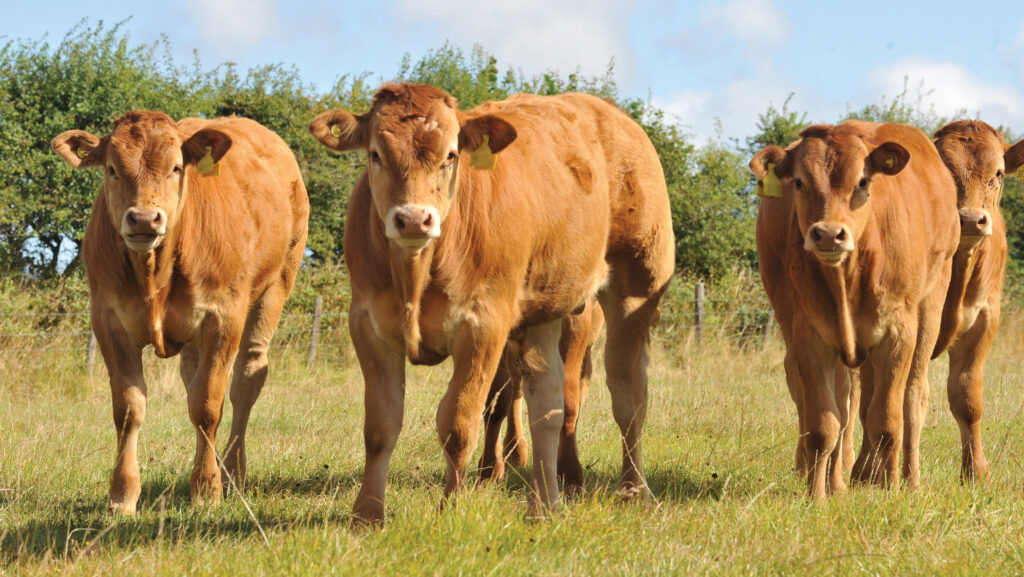 Ear tags flagged heifers in heat and optimum timing for insemination © Debbie James
 Heat-detection technology in combination with artificial insemination is helping fast-track genetic improvement in a Pembrokeshire suckler herd by unlocking access to top-ranking bulls.
Mark and Catherine Davies and their daughters Caryl, Sara and Lowri farm 121ha (300 acres) across three holdings on the fringes of the Preseli Hills.
See also: Tips for ensuring cattle semen is stored safely and cleanly
Their beef business revolves around the Glencross herd of pedigree Limousins (the prefix reflecting Catherine’s Scottish roots), and a proportion of the cows are crossbreds.
Investment decision
The goal is to make herd management as simple and efficient as possible, while maintaining healthy margins.
To achieve this, they have invested in bulls from well-proven lines and adopted measures such as pelvic scoring to improve genetics and breed “hands-free” cattle.
Outcrossing, by mating animals from distinctly different families or bloodlines, is used to increase performance levels.
The 2026 breeding season saw the Davies family switch from natural mating on heifers and second calvers to artificial insemination (AI). The alternative was to invest in a new bull to avoid inbreeding in those animals.
Farm facts
Glanyfer Farm, Pembrokeshire
- 121ha across three holdings
- 80 pedigree Limousin and crossbred suckler cows
- Four Limousin and Belgian Blue stock bulls
- Indoor calving
- Most progeny sold as stores with some bulls marketed for breeding
- 750 Aberfield and improved Tregaron-type Welsh ewes and 250 replacements
- Outdoor lambing
- Lambs creep fed for sale in May and June, mostly through Whitland mart
- Grazing rights on the Preseli Hills
They had used AI a few years ago, but breeding reverted to natural mating because of issues with detecting heats and timing of inseminations – principal reasons why AI is not more widely used in the UK beef herd.
Technology trial
The opportunity to trial a heat detection and health tag with a beef-specific algorithm gave the family the confidence to give it another go in their 80-cow herd.
To monitor the animals’ activity, they fitted their 10 heifers and 10 of their best second calvers with the Tru-Test Active Ear Tag on 13 May, six weeks after the end of the 2026 calving period. (The algorithm requires a minimum of 20 animals to activate.)
This compares each individual cow to her normal self, and to the group, to identify if she is in heat or showing early signs of sickness.
The tag connects to a unit known as a gateway, which is based at Home Farm, an outlying farm to the main holding, Glanyfer, near Eglwyswrw. Data is passed to the cloud for processing and fed back to a mobile phone app.
Optimal timing
Caryl says the ear tag not only picked up heats but provided the key times when inseminations could be optimised.
“Without the tags, we would have served a cow as soon as we saw she was bulling. Judging by the data we received, that would have been too early: she actually needed to be inseminated a couple of hours later to have her the best chance of conceiving.
“We would get a heat notification that might advise us that she needed to be served between 6-10pm, for example, but just from looking at her, we would have thought that she needed to be served right there and then.”
A bull is likely to have served her straight away too, Caryl adds. “This is where we can see that AI in conjunction with the tags has an advantage over a stock bull.”
Logistics
During the breeding period, the animals were run from the field into handling facilities in the yard, where an independent AI technician inseminated those on heat.
AI was used for one cycle only because the family had a limited number of semen straws, which had been in storage at the breeding centre since AI was last used.
In addition, grazing challenges caused by prolonged hot and dry weather required animals to be moved to fields distant from the gateway unit.
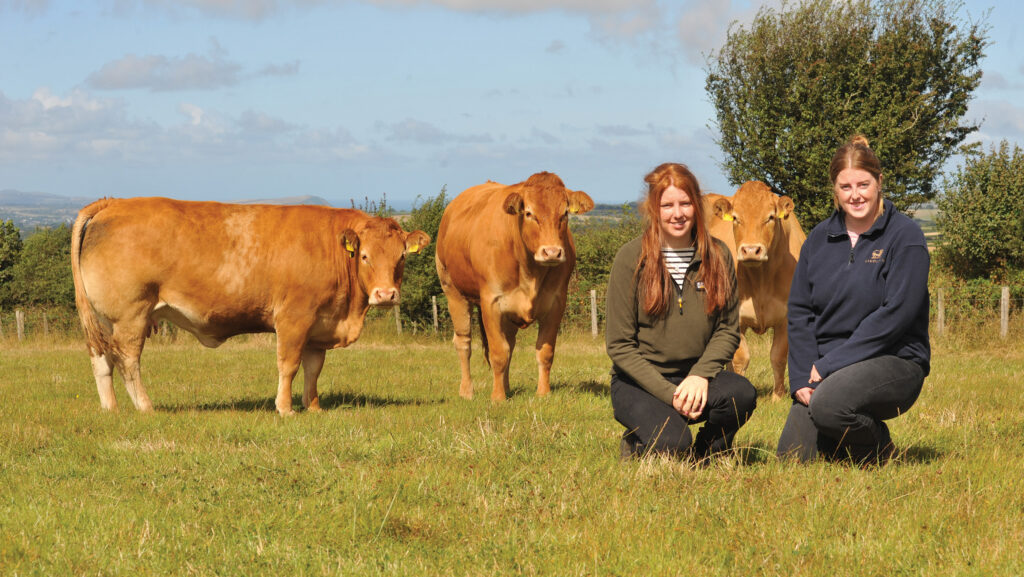
Lowri (left) and Caryl Davies © Debbie James
Five animals had repeat heats two months after the start of the breeding season, which confirmed they were not in-calf.
However, Caryl says she is confident they had been in-calf but had reabsorbed their embryos, probably because of the stress induced by the succession of heatwaves.
“I am sure those repeats weren’t the fault of the tags, the straws or the technician, it has just been a very challenging breeding season. In any other year, I don’t think it would have been a problem because three-quarters held to their first service.”
A Belgian Blue stock bull was used as a sweeper, and scanning in the autumn will confirm how many pregnancies have held.
The ear tag gave Caryl the advantage of knowing the status of those animals – she would otherwise have assumed they were in-calf.
“We have other groups of cows that ran with a bull for the entire breeding period, and there will likely have been lost pregnancies in those too. But I will only know that if, and when, they are later calving.”
Access to top genetics
For her, one of the key advantages of using AI is that she can select sires with desirable traits specific to the herd without the financial outlay and health considerations of buying a top-quality bull.
The Limousin bull that had until this year been used on heifers set the business back £12,000.
AI sires are selected for ease of calving, milk production and good conformation at an early age.
“When we turn a bull out with the cows, it is just blanket treatment and not every one of them might click with the genetics of that bull. With the straws, we can match the genetics to the outcome we want,” says Caryl.
With the aid of funding from a Welsh government grant due to be rolled out soon, the family plan to invest in their own set of tags and to use them on greater numbers of animals.
Caryl competed a DIY AI course a few years ago and, with the benefit of a refresher course, she will be able to carry out the inseminations.
The tags, she says, allow beef producers to share the same advantages of AI experienced in dairy herds.
“AI can be tricky when animals aren’t coming into the yard twice a day for milking, making it logistically difficult to observe them and catch them at the right time in their cycle, but the tags remove that restriction.”
Pros and cons of artificial insemination
Advantages
- Access to a range of proven, genetically superior sires of different breeds
- Allows selective mating of cows or heifers to improve specific traits within the herd – proven easy-calving bulls on replacement heifers, for example
- Higher reliability
- Risk of bull infertility eliminated
Disadvantages
- Time consuming
- Without heat detection technology, close monitoring of animals is required
- Good handling facilities needed for insemination
- Cows and heifers must be gathered when bulling
Source: The Davies family