

How two farmers improved handling facilities for TB testing
TB testing can be one of the most demanding and dangerous jobs on a cattle farm, particularly in high-risk areas where frequent testing is required.
Well-designed handling facilities can transform the process, improving cow flow, reducing stress and improving safety for animals and handlers.
See also: How cattle handling upgrade improved safety and work rate
Farmers Weekly visited one dairy and one beef farm to see how investment in practical handling systems has streamlined TB testing, minimised stress and improved efficiency.
Gorsty Hill Farm, Upper Tean, Staffordshire
Investing in a modern handling system has reduced labour and cut time spent sorting stock for Staffordshire beef farmer Rob Stevenson. But the biggest benefit, he says, has been improved safety.
Rob buys weaned calves and sells about 40 a year as large store cattle, while also running a logging business from his 26ha (64-acre) smallholding near Upper Tean.
The investment formed part of a wider redevelopment at Gorsty Hill Farm, where Rob and his wife, Heidi, replaced old brick buildings with two purpose-built structures, including an eight-bay cattle shed measuring 39.6×36.6m.
Farm facts
Gorsty Hill Farm, Upper Tean, Staffordshire
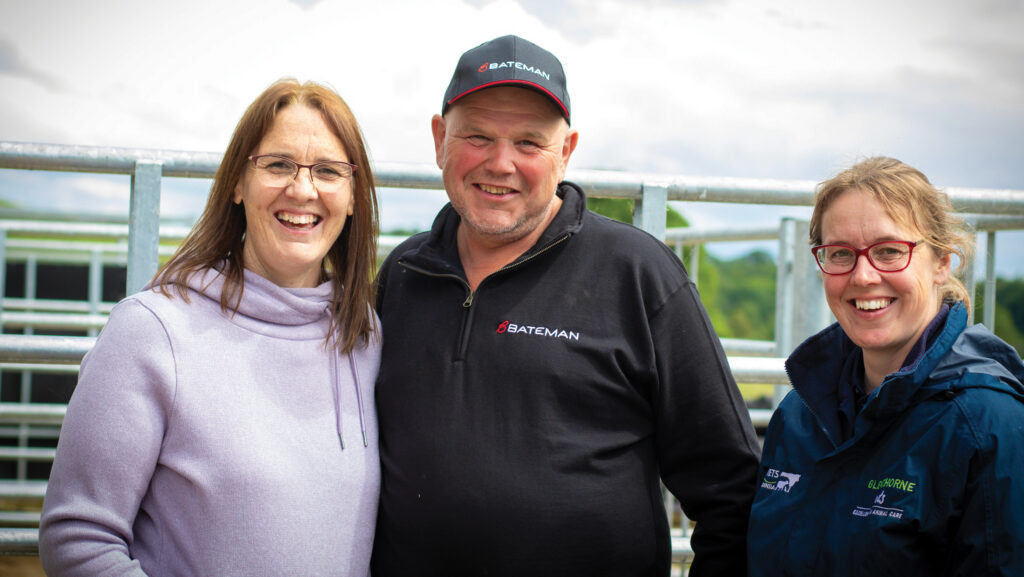
From left: Heidi and Rob Stevenson and Emma Crust © Rhian Price
- 26ha owned
- 70 head of beef cattle
- Buys Aberdeen-Angus and Hereford heifers and steers at six to eight months
- Sells 40 annually to Meadow Quality at about 22 months (550- 650kg)
The old buildings were so low that most jobs had to be done by hand. Mucking out was carried out with a wheelbarrow and fork.
The new shed has reduced labour from 40 hours a week to just three, but it is the handling system that has made the biggest difference to safety.
Previously, TB testing took place outside using a crush and some gates tied together.
“It was a nightmare,” recalls Rob. “We had nowhere to hold animals, and it was really stressful.”
Testing could take up to three hours and often required three people plus the vet.
“The previous setup wasn’t efficient or as safe as it could have been because people were in pens with animals, and there were no quick exits in case animals turned,” explains his vet, Emma Crust of Glenthorne Farm Vets.
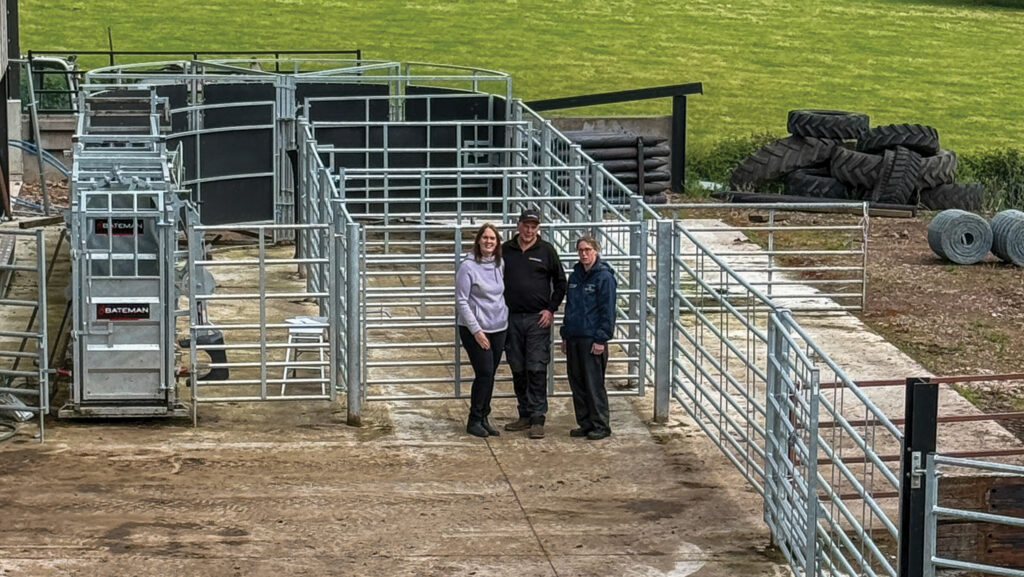
Bird’s eye view of the race at Gorsty Hill Farm © Rhian Price
Grant-aided investment
The £26,000 handling facility, including a concrete base, was supported by the Farming Equipment and Technology Fund, which covered 40% of the cost, reducing the Stevensons’ investment by £10,000.
The couple sought advice from Emma and James Heath of LM Bateman. The U-shaped system operates anticlockwise, taking advantage of cattle’s natural tendency to turn left.
Two holding pens feed into a forcing pen, which then leads into a race. The forcing pen and race feature sheeted sides to encourage cattle to move forward by limiting distractions.
Meanwhile, a safety mechanism on the forcing pen gate prevents it from being pushed back onto the handler. The race includes sliding doors at both ends, while the crush incorporates a vet access kiosk.
This allows the animal to be safely handled at its rear, while the animal behind it remains securely restrained inside the race.
The squeeze crush can be adjusted for cattle of different sizes and includes a manual head yoke, a scoop neck and a side access door, allowing Emma to safely administer injections and examine the neck during TB testing.
For Heidi, the scoop neck also makes reading ear tags much easier.
© Rhian Price
Less stress with safer handling
The farm is currently under a six-month testing regime caused by a TB breakdown on a neighbouring farm, and they can face up to six tests in one year at short intervals. Routine tests are government-funded, but the Stevensons must pay for pre-movement tests.
TB testing now takes just 45 minutes and can be done by Rob and the vet alone. “It is more cost-effective for Rob and Heidi, and time-efficient for us,” says Emma. “And it’s more enjoyable because it is safer. In the old setup, we were taking risks we didn’t want to.”
Although Rob acknowledges that investing £16,000 after grant support can be difficult for smaller farms like his own to justify, he believes the safety benefits outweigh the cost. “What value do you put on someone staying safe or animals not getting injured? You can’t put a price on safety.”
High House Farm, Warminster, Wiltshire
Replacing a herringbone parlour with a 70-point rotary dramatically increased milking throughput to 300 cows an hour at High House Farm, but it created a new challenge for TB testing.
To keep pace, Wiltshire dairy farmer David Helliar designed purpose-built handling facilities to cope with faster parlour throughput.
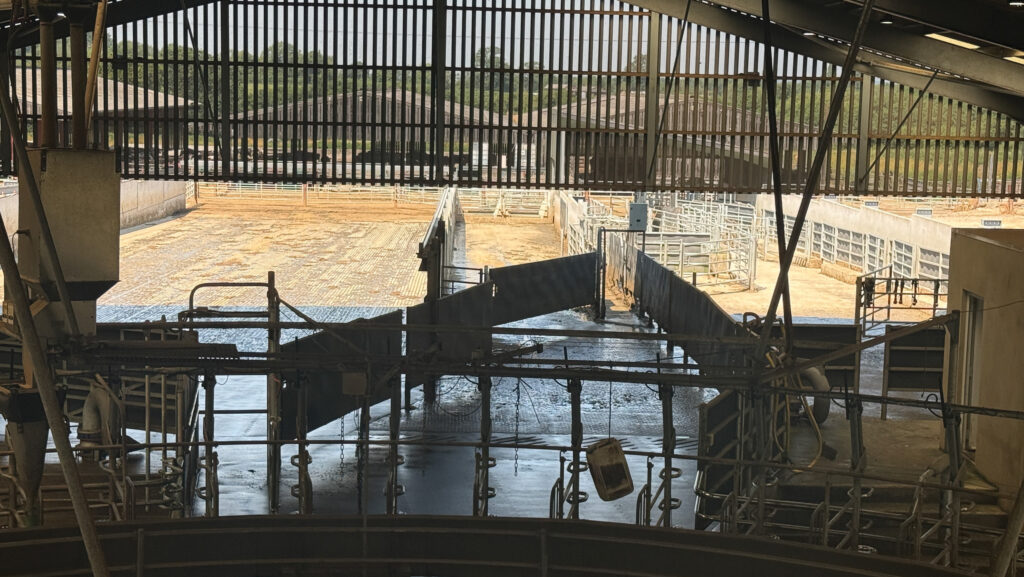
Bird’s-eye view of the rotary and handling area at High House Farm © Rhian Price
The split-block herd, based near Warminster, has gradually expanded from 300 cows to 900, and milking was taking six hours twice daily in the 20/40 parlour. David invested £1.25m in a new parlour and handling facilities three years ago.
Located in a high-risk area, the farm is required to test for TB every six months; however, they had a breakdown at the last test and are now testing at 60-day intervals.
Farm facts
High House Farm, Warminster, Wiltshire
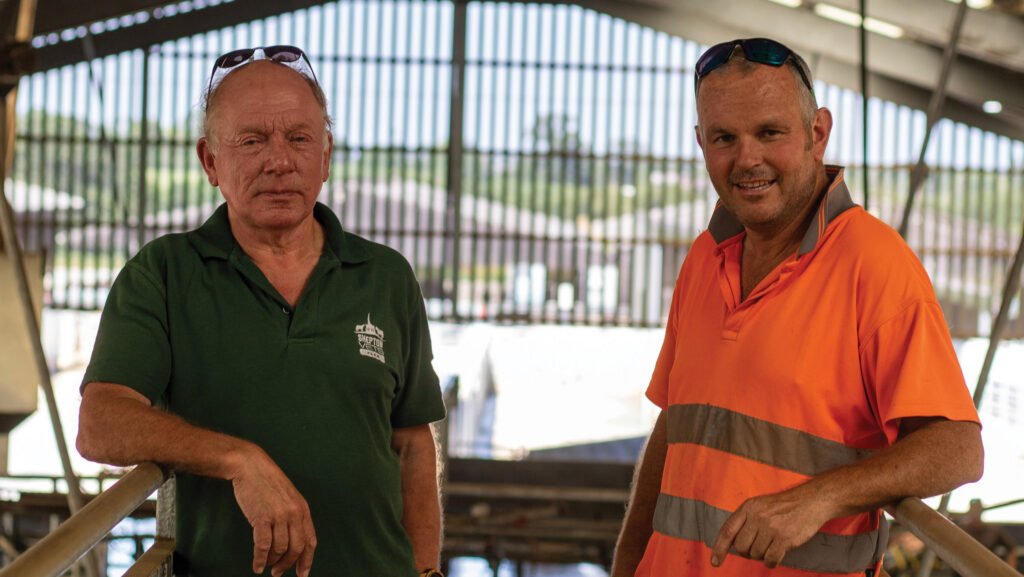
Ralph Drouin (left) and David Helliar © Rhian Price
- 486ha on the Longleat Estate on a farm business tenancy
- Milks 900 cows, split block
- Average yield 7,700 litres at 4.4% butterfat and 3.6% protein
- Milk sold to First Milk/Yeo Valley on a regenerative contract
Design for increased throughput
David visited 15-20 farms before finalising his design. Cows exit the parlour and enter a race, which splits into one of two hydraulic, remote-controlled crushes.
Semi-retired vet Ralph Drouin from Shepton Vets has been TB testing at High House Farm for a decade and says it is one of the most efficient systems he has experienced.
Testing the herd takes two days, with a further two days required to read the results. About 250 cows an hour are processed: two vets inject while two handlers operate the crushes and record ear tag numbers simultaneously.
Parlour rotations are slowed from 10 minutes to 12 minutes to allow testers sufficient time to process animals, although David notes it would slow milking down even more without the current setup.
The system has been refined over time. Defra requires TB testers to read the same cows they inject, so the solution has been for one reader to spray-mark their cows.
Both testers now inject on the left-hand side, allowing them to measure skin test reactions simultaneously from the accessible side of the race (the other side is against a concrete wall). This reduces handling through the crush.
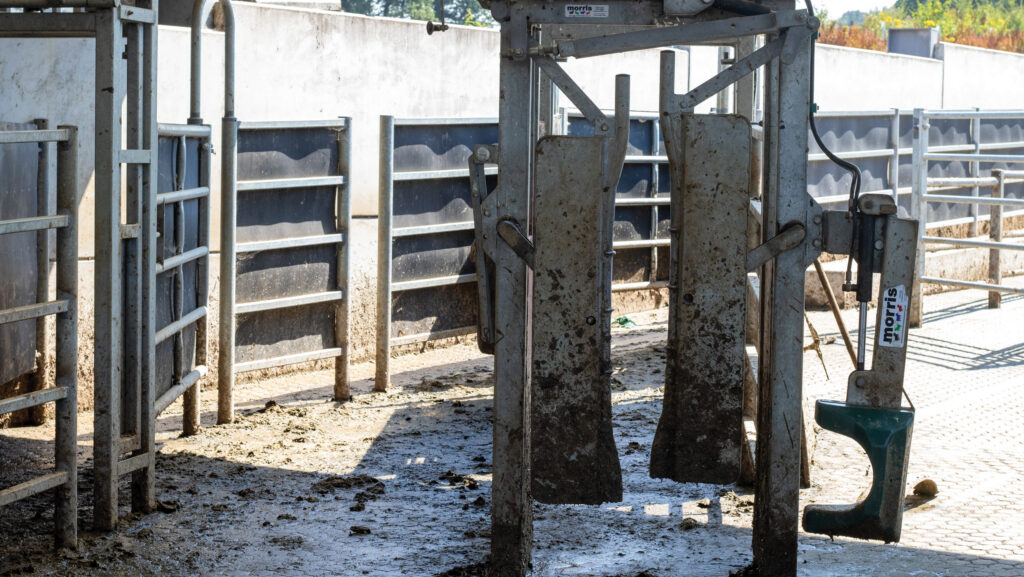
Cattle are sorted into one of two hydraulic crushes © Rhian Price
Labour savings
At High House Farm, cows graze from March to November, so tests are often complicated by the need to test youngstock and dry cows at grass. To mitigate this, David has also invested in mobile handling.
Labour demand is high during testing – David still drafts in an additional three to four people to help – but the handling system makes testing more efficient, reducing hourly charges.
“We don’t dread TB testing anymore, other than finding reactors, because it is safe and efficient,” says David, who has put a great deal of thought into making it safe for animals and people.
Quick exits run the length of the race, and a 33cm concrete step has been built along the side of the race so handlers can lean over to move cows safely without getting inside.
The crush area is roofed to protect people from the weather – which Ralph notes has been much more comfortable in the recent hot temperatures.
The farm has been required to gamma test twice in the past two years. This is carried out in one of two vet races adjacent to the crush.
Electronic ID next step
While investment at farm level has made TB testing as straightforward as possible, Ralph says wider industry changes are still needed.
Having tested cattle for TB for more than 40 years, he believes electronic identification (EID) would significantly reduce human error when reading and recording tag numbers.
“Defra should have required EID at the start of the 25-year eradication plan.
It has been a missed opportunity to reduce human error. With cattle vaccination now coming, it will be important to identify vaccinated animals from non-vaccinated, and electronic tags are a fail-safe way of doing this,” he adds.