

How drying poultry manure can deliver for the bottom line
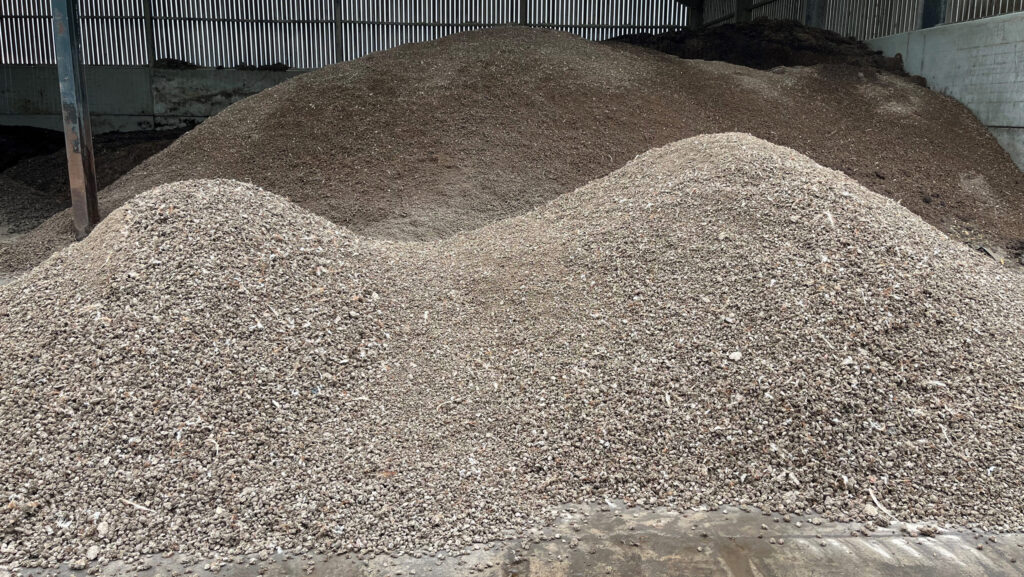 © Hugh Carter
 Chicken manure does not always receive the best press – blamed to varying degrees for water pollution, obnoxious smells and general unpleasantness.
But for north-east egg producer and regenerative arable farmer Hugh Carter it is pure gold – all the more so since he invested about £150,000 in a simple yet effective manure-drying system on his East House Farm at Trimdon, County Durham.
See also: Farmers Weekly Awards 2025 – Poultry Farmer of the Year
Hugh, Farmers Weekly’s 2025 Poultry Farmer of the Year, says the main motivation was to reduce the sheer volume of muck his free-range flock was producing.
With four new sheds going up in 2024, each one housing 16,000 layers and effectively doubling the farm’s hen population, Hugh decided a manure dryer was the way forward.
Farm facts: East House Farm, Trimdon, County Durham

Hugh Carter © Richard Lee
- Free-range egg producer with three sites
- 124,000 layers depleted at 84 weeks old
- Focus on regenerative farming across 450ha of arable
- All grains and pulses home-mixed to feed the hens
- All eggs sold at Morrison’s
- Supplier of “Better For Our Planet” zero-carbon eggs
Part of the research involved a trip to the Netherlands, where he looked at two options, including a Dorset Green Machine dryer attached to a barn egg unit – necessary to meet strict Dutch emissions standards.
“The farm we visited was not the tidiest, but the dryer seemed to work very well – at least the farmer told me it hadn’t broken down once in 10 years,” he says.
Having decided on the make and model, the big question was how to integrate it into the new-build.
“Being free-range, I didn’t want it taking up space on the range, and I didn’t want it at the gable ends of the sheds, as they are needed for access,” says Hugh.
The solution was to locate it in a wide central corridor in between the sheds – two on each side – so that it could easily receive the manure from all four new flocks.
How it works
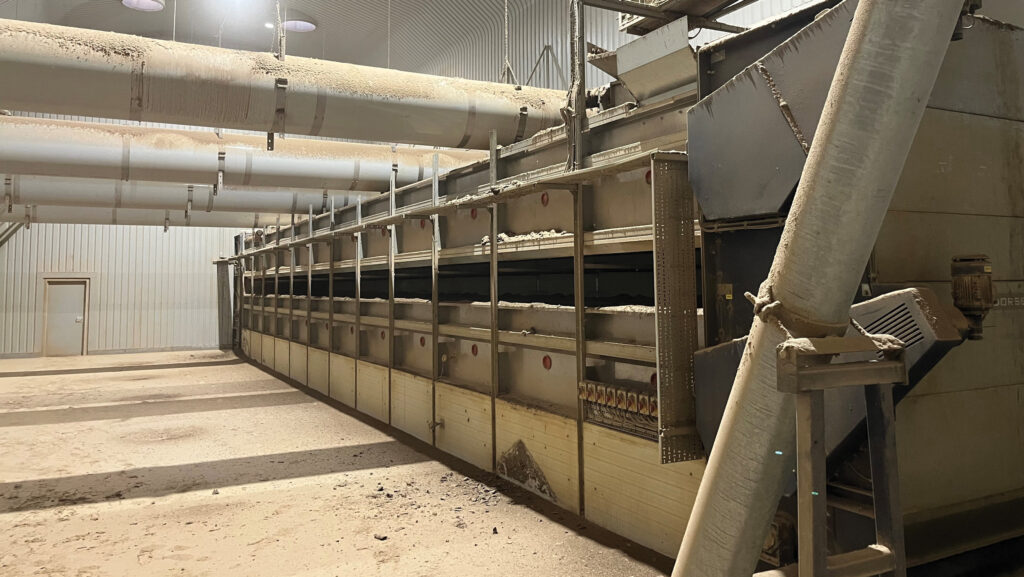
The Dorset Green Machines dryer at East House Farm has revolutionised poultry manure management and storage © Hugh Carter
The mechanics of manure drying could hardly be simpler.
The manure belts in the four multi-tier sheds are run twice daily – at 8.15am and 8.15pm – taking wet manure out of the system and transferring it to the top shelf of the dryer.
Warm air is drawn from the four sheds by eight side fans and is directed into a pressure chamber, and then blown through the system.
There are four levels to the dryer, with enough manure arriving to fill the top level when the belts are run, then descending by one layer every 12 hours until it is properly dried out after 48 hours.
It is then augured into a trailer and transported to a manure store elsewhere on the farm.
The system produces about 11t of dried manure a week, instead of the 30t the 64,000 birds produce as wet litter.
The only maintenance required is to grease the system once every six months, check the belts in the sheds and in the dryer are properly aligned and tensioned, and ensure the scraper system underneath the unit is working properly to extract dust and debris.
“We originally intended to run the system just once a day, but have found it works better with a bit less weight on the belts if we run it twice,” says Hugh.
“That also reduces ammonia in the sheds, which is good for the staff and the birds.”
Mixing and nutrients
Once at the store, the dried manure from the new sheds (89% dry matter, 60% nitrogen) is mixed with wetter material from the older sheds elsewhere on the farm (35% dry matter, 20% nitrogen), to produce a more user-friendly product.
“One side benefit is that, previously, we had to use a lot of powdered gypsum to dry the wet stuff, which gave rise to excessive calcium once applied to our soil,” says Hugh. “Now we use no gypsum at all.”
The mixed manure, which is spread on 450ha (1,112 acres) of arable ground once or twice a year as part of a regenerative farming system, delivers high levels of nutrients and is good for soil structure.
“We are using about 30% less liquid nitrogen on our crops than we did previously, saving a small fortune in bought-in product,” he says.
“The extras you get in terms of organic matter more than make up for the hassle of applying it, though we do have to watch out for soil compaction with that heavy muck spreader.”
Manure comparison at East House Farm |
||
| Wet poultry manure | Dried poultry manure | |
| Dry matter | 35% | 89% |
| Nitrogen | 20% | 60% |
| Phosphorus | 10% | 25% |
| Potassium | 10% | 25% |
Future plans
So keen is Hugh on the manure drying investment, he is also considering a pelletiser to go with it – both to facilitate application to the land and to produce something that might be more saleable off farm.
With pellets, the manure could be applied using much lighter machinery and so reduce the risk of soil damage.
As it is, he plans to increase applications to three or four times a year on one field – weather permitting – to see if he can get liquid nitrogen application down by 50-60%.
He is also considering mixing the manure with bought-in compost from a nearby farm.
“While this will increase the moisture content, it will also benefit soil carbon, lift microbial activity and improve soil structure, which will be good for our environmental footprint.”
The 2026 Farmers Weekly Awards
 The 2026 Farmers Weekly Poultry Farmer of the Year Award is sponsored by Livetec Systems.