

Advertiser content
How farmers are turning 1 litre of milk into £18+ of profit
With farmgate milk prices volatile and margins under constant pressure, an increasing number of dairy farmers are discovering that the most profitable thing they can do with their milk isn’t to sell it, but scoop it.
One litre of milk yields roughly 1.5 litres of gelato – the equivalent to 15-20 scoops – which consumers readily pay £3+ per scoop for. Independent research, ‘Iced Insight*’ by Carpigiani UK revealed that over half of consumers (57%) spend £3.00-£4.99 on a single purchase of ice cream.
The margin gap between milk sold and milk scooped is, by any measure, extraordinary, with 1 litre of milk easily becoming £18+ worth of profit.
Diversification has long been part of the conversation in dairy, but now more than ever, dairy farmers can – with the right support – add significant value to their milk by turning their high-quality raw commodity into a premium product. From cow to cone, the profit potential is vast.

© Surfing Cow Gelato
Surfing Cow Gelato is one example of a dairy business that has taken that step, with guidance and expertise by Carpigiani – the world leader in frozen dessert equipment.
Gelato production relies on more than just good ingredients, as Zoe Glanville of Surfing Cow Gelato comments: “There are technical elements to the gelato making process and there is a science to getting the final product right and correctly balanced.
“Gelato really champions the flavour of the milk, and once you understand the basics of the science behind gelato, you can use trial and error to get the end product that you want.
“This is something you can take advantage of with Carpigiani because they have the expertise to help you succeed, and their expert Gelato University courses explore the entire process.”
Unlike some diversification routes, making gelato builds directly on what dairy farms already do best.
Approximately 70% of any gelato recipe is good milk, so farms producing high-quality milk already hold the key ingredient to a premium end product.
Knowing how to get started, what’s involved in gelato production, and what the return on investment will be and by when, are often the biggest questions for farmers considering this route.
For Surfing Cow Gelato, support in the early stages played a key role in turning that idea into something practical.
Working with Carpigiani, the focus was not just on installing machinery, but on understanding how much milk could realistically be diverted into production, what level of output was achievable, and how the business could scale over time.
This included guidance on equipment selection, recipe development and the technical side of production, helping to bridge the gap between farming and food manufacturing.
As a working dairy farm, that gap isn’t as wide as some may think, as Zoe explains: “Working dairy farms are actually rather well placed to fall in line with compliance requirements.
“Day-to-day you’re following red tractor rules and will already have pest controls in place which can be easily adapted to food production for EHO purposes.
“Your biosecurity is already rigid and cross contamination between different areas is part of the everyday too.
“There is a lot of paperwork to comply with EHO regulations, however audits are already a big part of working farm life and aren’t a problem if you keep organised.”
One of the most common misconceptions about on-farm gelato production is that it requires culinary expertise, or an intricate menu.
In fact, neither are true, with the recipe and flavour development process being more accessible than it might appear.
Carpigiani operates four development kitchens across the UK, with expert development chefs on hand who work with producers from initial concept through to finished product.
Joe Yates, Training and Development Chef and Gelato Master at Carpigiani UK explains: “It starts with the milk. What are the fat levels so we can craft the perfect recipe?
“Then it’s thinking about what works for each individual based on their time, their set up, how confident they are in creating recipes from scratch.
“It’s also worth considering if there is something on the farm that would be great to add to create a signature flavour, such as herbs, honey, fruits, which builds on the ‘cow to cone’ concept and keeping food miles, well metres, low.
“But vanilla is still globally the most popular flavour, so keeping things simple and making traditional flavours like vanilla, chocolate and strawberry is a great place to start and keep customers coming back for more.
“It’s also worth noting that we work with goat and sheep farmers too. Millennial and Gen Z consumers seek higher protein products and products with higher nutrition, and sheep’s milk give that in abundance, so gelato production doesn’t need to be limited to just bovine milk.”
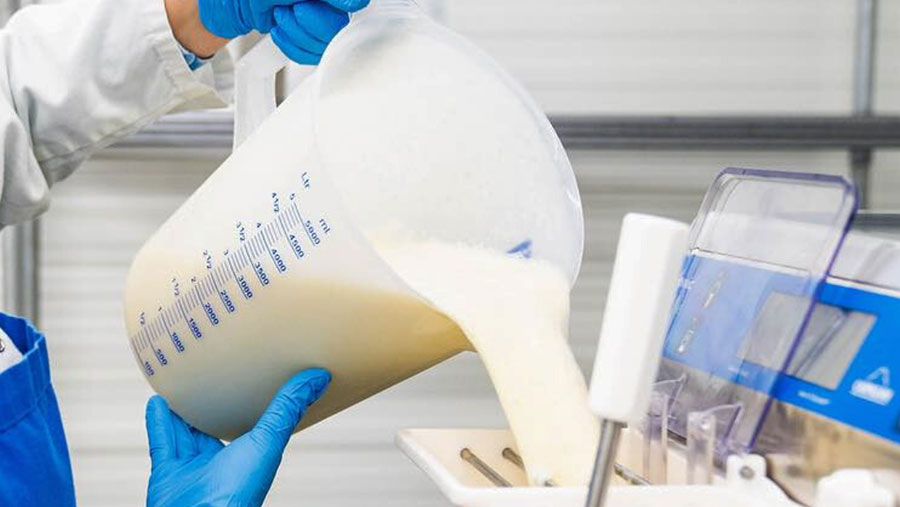
© Surfing Cow Gelato
There is no “one size fits all” when it comes to set up. The equipment required depends on a wide range of factors, but ultimately, a good starting point is to establish the excess milk volume and the space and time available to commit to gelato production.
A small-batch operation will naturally require less equipment, and therefore space, for gelato production and could consider the essentials, such as a pasteuriser, a batch freezer and a blast chiller.
The key is to get the specification right from day one, so the business has room to scale without requiring a full reinvestment further down the line.
Zoe’s experience at Surfing Cow Gelato gives a frank picture of what the journey actually looks like from the farm side: “Once we decided to go for it, it took around 12-18 months to get everything in place – the unit set up, compliance sorted, recipes developed, the team trained.
“Day-to-day, production needs someone’s full attention. You can’t do it as an afterthought alongside everything else the farm demands, the commitment and passion to produce gelato needs to be there.
“But once it’s running and the product is right, the return is there. You can see it very quickly in what a litre of your milk is actually worth compared to what you were getting for it before.”
Paul Richards, Sales Director at Carpigiani UK, explains how the company works with farmers to take the guesswork out of the investment decision: “We start with the business, not the machinery.
“How much milk is available, what does the farmer want to achieve, and where do they want to be in three to five years?
“From there we can model the right equipment spec, the likely output, and what a realistic return looks like before any purchase decision is made.
“We also have a dedicated customer support centre and out-of-hours service, so the support doesn’t stop once the machines are on site.
“For most of the farms we work with, average return on investment comes within six to twelve months. But some get there much sooner.
“It really does depend on the scale of investment and how quickly the market responds.”
The farms that have made the move into gelato production are not looking back.
The margin gap between milk and a finished, scoopable product is too significant to ignore, and the infrastructure, expertise, and support to make it work have never been more accessible.
Diversification can feel like a risk but staying still in a market where farmgate prices remain under pressure carries a risk of its own.
For dairy farmers with good milk, some space, and the appetite to do something more with what they already produce, the question is no longer really whether on-farm gelato works.
It is whether you can afford to wait any longer to find out.
Zoe Glanville’s top tips for getting started
Surfing Cow Gelato, South Devon
- Speak to your milk buyer before you do anything else. Check your supply contract and confirm that diverting milk into your own production is not in breach.
- Get EHO involved early, and where possible, work with an independent food hygiene consultant to help you with layout, requirements and regulations.
- Think carefully about your route to market before you invest in equipment.
- Ask other farmers questions who have diversified into gelato already. If they won’t support close to home, ask further afield.
Carpigiani’s top tips for getting started
Carpigiani UK, Hereford
- Do your research before spending anything. Attend our Gelato University, visit existing producers and speak to people who have already done what you’re hoping to do.
- Start with the right scale for your business. We spec equipment to match excess milk volume and expectations on production and returns. The goal is to invest in an operation that grows with your business.
- Use the support that is available. From business modelling and ROI planning to recipe consultancy.
Ready to take the next step?
Carpigiani are offering you a free place* on their Introduction to Gelato course!
You’ll learn everything you need to know about gelato from their experts, including how to get started, techniques and menu development. Don’t forget to use the voucher code GUFW2026 when booking!
*Free place offered to verified farming businesses. Book your course before the end of May 2026.
Carpigiani UK Ltd supplies gelato and soft-serve equipment to dairy producers across the UK. For more information about on-farm gelato production and to arrange a demonstration, visit carpigiani.co.uk or contact the UK team directly on 01432 346 018.
Provided by
Carpigiani UK is a direct trading subsidiary of Carpigiani Group - Ali Group S.r.l. the undisputed world leader in the manufacture of gelato, ice cream and pastry equipment for over 60 years. From our centrally located head office in Hereford, we co- ordinate a nationwide team of sales and service experts, while our passion, experience and dedication ensures smooth delivery, installation and on-going training as standard.