

Labour efficiency reduces production costs
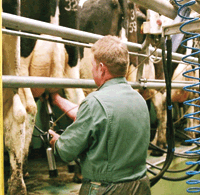
Labour is a big issue not just because of cost but also because of the difficulty in attracting and keeping good staff, according to Ian Powell, director of The Dairy Group. “If your systems are efficient, work will be more enjoyable, existing staff will be happier and your business will be able to attract good, new recruits,” he says.
An alternative approach measures labour efficiency in number of labour hours for every cow a year and this can help identify areas for improvement.
“It’s a good starting point so you can look at what’s behind the figure, identifying strengths and weaknesses and where to focus attention. This exercise provides a useful benchmark to help understand labour efficiency and can be done in just a few minutes,” says Mr Powell.
In a group of 14 south west dairy herds, average labour input was 39 hours a cow a year, ranging from 24 to 73 hours a cow. Average milk sales for every labour unit (2500 hours) was 609,000 litres, ranging from 309,000 to 964,000 litres.
Milking time averaged 11.3 hours a cow a year (33% of total labour input) with a range from zero for a herd milked through a robotic parlour to 19.7 hours a cow a year at the other end of the scale. Average labour cost was 4.5p/litre ranging from 2.6 to 8.1p/litre.
“Average labour costs per litre for this group is relatively low at 4.5p/litre, compared with our accounts analysis for 2007/08 of 5.4p/litre. At 222 cows, herd size in this group is higher than average,” says Mr Powell.
“To arrive at the figures, you need to make an assessment of the total hours used in the dairy operation over a year. Unless you keep detailed records this will only be an estimate.”
- Write down each person doing dairy work.
- Estimate typical number of hours they work each day, number of days they work each week and how many weeks they work each year, distinguishing between winter and summer.
- Include family members, exclude management time.
- This will provide total number of hours worked, which divided by number of cows gives labour hours per cow.
- Multiply total hours by a typical labour cost of £10/hour and divide by annual milk sales to give labour cost per litre.
- Milking time can also be calculated by multiplying typical hours per day including wash down time by 365 days to give annual labour use.
Next, compare your figures with comparable data (see table). Improvements in labour efficiency will come from:
- Removing tasks by changing systems or automation.
- Carrying out tasks faster through automation.
- Reducing labour cost in £/hour through cheaper (often family) labour.
- Relocation.
While capital investment might be the obvious route to reducing labour hours, taking time to analyse routines can spark ideas, says Mr Powell.
“Standing back and analysing what you are doing can really pay off. Producers need to focus on why tasks are done in a certain way, could they be done at a different time or in a different order and are the right people and the right machines doing the tasks?
“Saving just a few seconds for every cow a day will add up. For example, for a 150 cow dairy herd, saving 10 seconds a cow for every milking equates to 300 hours saved a year, worth about £3000,” says Mr Powell.
“A good first step is to look at the milking routine in detail – how long do you spend on letting cows in, teat preparation, attaching the cluster, cluster removal, teat disinfection and letting cows out.
“If the routine takes 80 seconds, the fastest milking speed that can be achieved is 45 cows for every man an hour. It’s possible to save up to 30 seconds a cow and increase milking speed to 72 cows an hour by improvements to cow flow, better cow cleanliness and the introduction of a backing gate. This does not necessarily involve spending much money and is certainly cheaper than a new milking parlour,” says Mr Powell
Labour analysis summary – 14 south west farms (average)
- Sales – total litres a year – 1,994,607
- Employee hours a year – 6,099
- Family hours a year – 2,093
- Total hours a year – 8,192
- Labour units a year – 3.3
- Milk sales per labour unit – 608,722
- Average herd size – 222
- Hours a cow a year – 39
- Labour cost £/year – 81,918
- Labour cost p/litre – 4.5
- Milking time per year – hours – 2,510
- Milking time (hours a cow a year) – 11.3
- % of total hours spent milking – 33