

How NZ genetics added hybrid vigour to wool-shedding flock
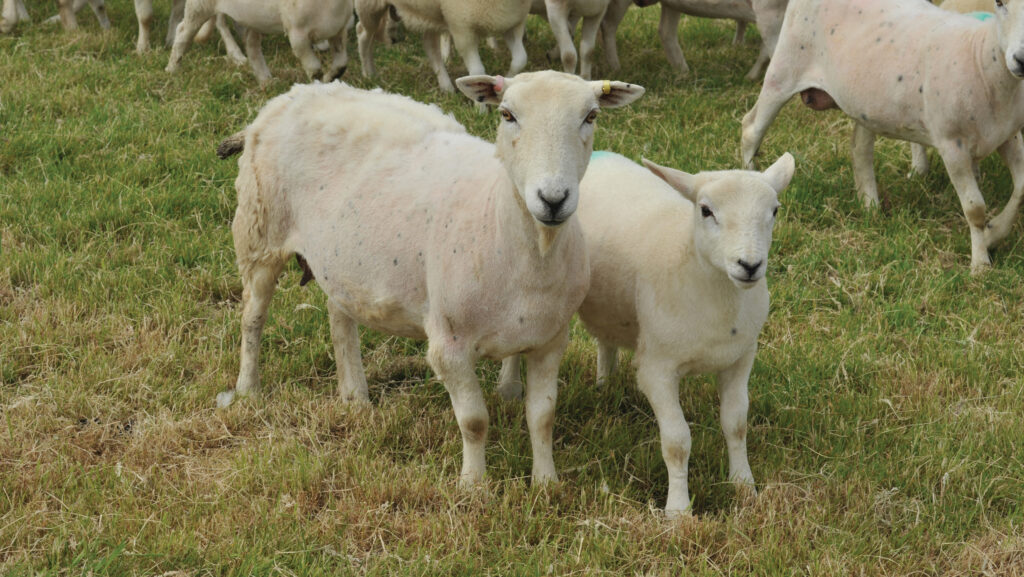 Yearling Polled Wiltshore cross EasyCare ewe with lamb © Debbie James
 As direct subsidies are phased out and significant changes made to agricultural support, sheep farmers are thinking outside the box by adjusting their systems to become more resilient.
For John Davies, breeding some of his EasyCare flock to a New Zealand Polled Wiltshire has added to his gene pool and provided a greater degree of hybrid vigour.
Third-generation farmer John, who farms at Cefncoch, Llanilar, with his son, Hedd, used semen from rams imported to the UK by sheep farmer Hayden Woolley and vet Ian McDougall to inseminate 110 ewes over a two-year period.
See also: How breeders are using methane test in wool-shedding project
Farm facts
Cefncoch, Llanilar, Ceredigion
- 170ha owned, 61ha rented
- 800 breeding ewes and 250 replacements
- Replacements tupped as yearlings
- Outdoor lambing from 1 April
- Finished lambs sold at Llanybydder market
- Cull ewes sold at Aberystwyth market
- Annual concentrate use of 2t across the flock
- 35 suckler cows, mostly Stabilisers, plus Welsh Blacks
Of the 60 ewes inseminated in the first year (2022), 70% held to service, achieving a 150% scanning rate; similar figures were recorded the following year.
The lambs were everything John had hoped they would be, and more.
“They were vigorous, they had their heads up searching for the teat as soon as they were born,” he says.
Breeding goals with new genetics
John runs a flock of 800 EasyCares, having transitioned to that breed from the Tregaron-type Welsh Mountain and Lleyn 21 years ago.
This was done principally to remove the need to shear and dag the sheep.
In 2023, he explored the possibility of introducing new genetics, to add size and other characteristics to the EasyCare while retaining the many traits the breed is valued for.
He got together with two other sheep farmers – Huw Thomas, of Fferm Pentre, near Aberaeron, and Dafydd Evans, of Dolau Brics, Llanwrin – to consider the options.
Their initial list included the Australian White, but this breed was discounted.
“Australia is very arid and we get a lot of rain in Wales, so we thought that could present challenges to foot health,” John recalls.
They also looked at the Ultrawhite, but plumped for the New Zealand Polled Wiltshire, a deep-bodied and prolific breed crossed with wool-shedding sheep to add size and carcass.
Like the EasyCare, it is also valued for ease of lambing, lamb survival and a low worm burden.
For some farmers, producing a bigger sheep from crossing an EasyCare with a Polled Wiltshire is an ambition, but it was not an overriding goal for John.
“I’m not sure that having bigger animals is always a good thing because the bigger they are, the more food they need.
“For me, using the Polled Wiltshire was mostly about getting some new genetics into some of our EasyCares.”
The cross they have bred will achieve lamb liveweights of up to 50kg, compared with the EasyCare, which is closer to 40kg. However, John mostly markets his crosses at 40kg.
“It all depends on the market, but they usually average 40kg when they leave the farm.
“I tend to sell when the price is good to get them off the farm, because I like to have everything sold by the end of the year.”
Lambs are finished off grass, with some grazing 8ha (20 acres) brassicas for six weeks in October and November.
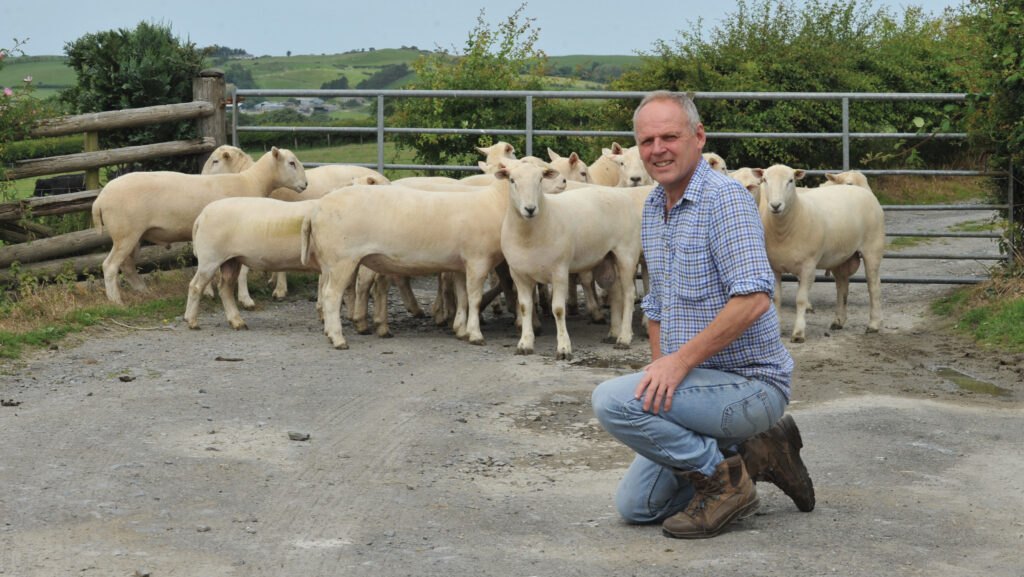
John Davies with EasyCare sheep © Debbie James
Ewe lambs and ram lambs retained for breeding
The ewe lambs from the breeding programme were retained.
In addition, by introducing a new gene pool, John and Hedd have been able to retain ram lambs to tup with their EasyCares – they currently have seven.
“We use those rams on a proportion of the flock; on the rest, we use EasyCare tups bought from the breed sales in Worcester and Scotland,” John explains.
He also has a Polled Wiltshire ram purchased from Hayden and Ian, which he has used for tupping in the two most recent breeding seasons.
Sales of embryos and rams
As well as using imported semen, John is involved in overseas sales.
Some 20 embryos from his EasyCares are destined for New Zealand this summer, and breeders who have sourced rams from him at breed sales have shipped their semen to buyers in other countries, too.
All his EasyCares are carriers of the myostatin gene, and the embryos are from sheep that are most resistant to scrapie (ARR/ARR genotype).
He has commanded high prices at sales – in 2025, one of his rams sold for 2,600 guineas at Worcester, a record until the following year when it was surpassed by a ram that sold for 2,800 guineas at Carlisle.
At the Worcester sale, the eight rams that John presented averaged 1,500 guineas.
EasyCares still make up three-quarters of his flock and, although the Polled Wiltshire is adding a point of difference, John plans to keep numbers at that level.
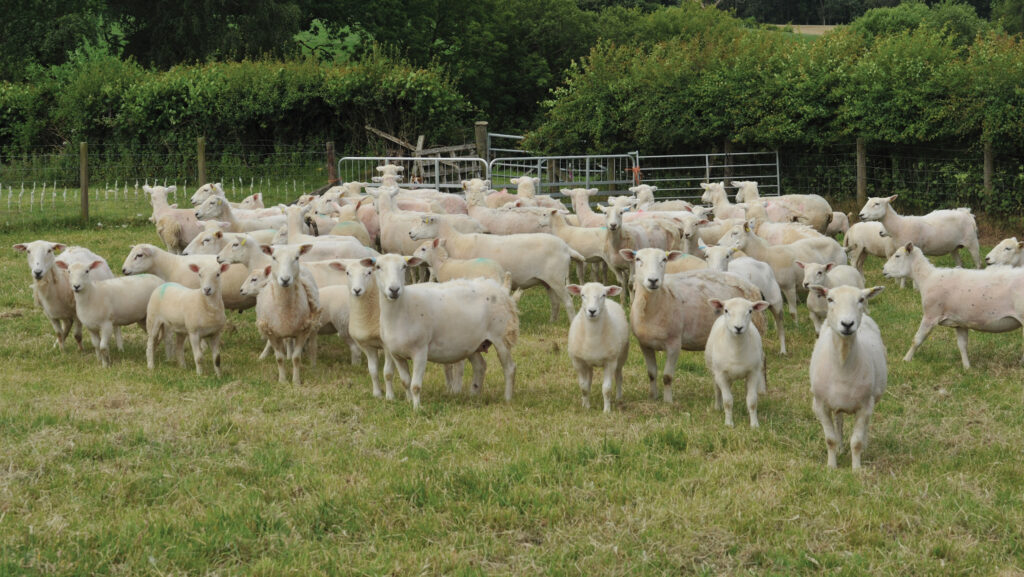
Yearling Polled Wiltshore cross EasyCare ewes with lambs © Debbie James
“The EasyCare works well for us but, as with anything, there is always room for improvement.
“Whatever the breed, it is important to look at the opportunities for how that can be achieved.”
Type is the principal trait he aims for when selecting tups and replacements – a mature adult weight of no more than 100kg and a stocky, compact animal.
“I have always liked sheep that look smart, and this is as true of the sheep we keep today as it was when we had the Welsh Mountains and Lleyns, but without the wool,” he says.
Insemination cost offset by prolificacy
At about £100 a head, the cost involved in inseminating 110 ewes with frozen semen was not cheap, says John Davies.
But some of that cost was offset by the high scanning and conception rates.
“We had a lot of twins and triplets, and we weren’t anticipating getting so many in-lamb through AI [artificial insemination], so we were really pleased to get 70%,” he says.
Preparation and timing
The programme for laparoscopic AI was administered by Harry Williams of Ystwyth Vets, Aberystwyth.
Ewes were sponged, then the sponges removed on day 12 and the animals injected with pregnancy hormone (400iu of pregnant mare gonadotrophin serum).
Vasectomised tups were turned in with the ewes as teasers the following day.
Food and water removed in the afternoon to allow clear access to the uterus and reduce the risk of the ewes sustaining an internal injury. (If the weather conditions had been very warm, water would only have been withdrawn 12 hours in advance of the procedure.)
John’s ewes were inseminated the following afternoon.
If he had used fresh semen, the ewes would have been inseminated 48-58 hours after the sponges were removed, instead of the 52-58 recommended with frozen semen.
Rams used in a semen collection programme must be rested for at least two days beforehand.
However, guidance states that allowing them to serve two to three ewes five to seven days prior to that does improve the chances of good-quality semen being collected.