

Farmer Focus: Beef herd assessment rewards longevity
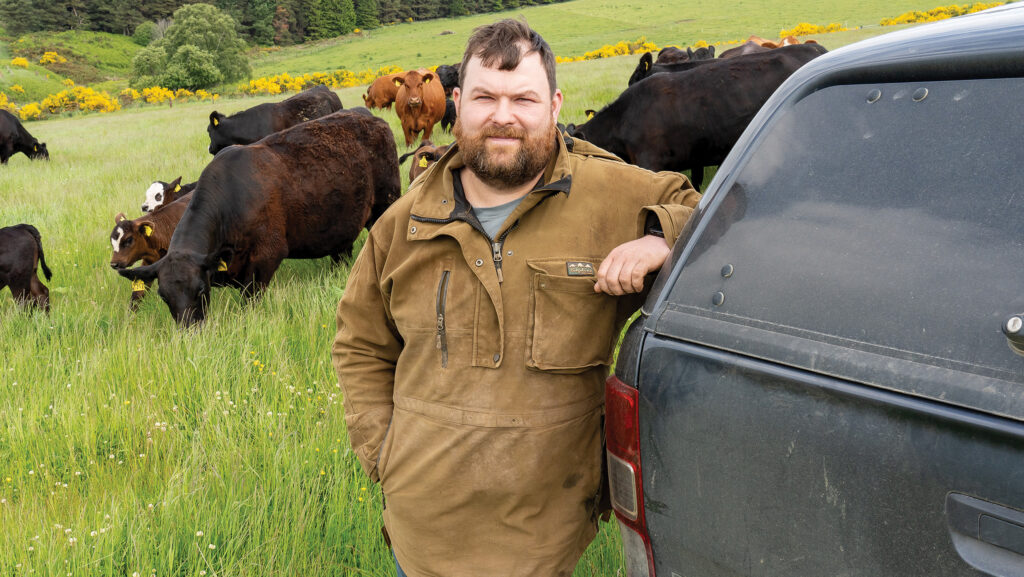 Duncan Morrison © Angus Findlay
This October, we hosted our final Monitor Farm meeting and drew the four-year programme to a close. It has been an enjoyable time, during which our business has undergone considerable changes.
It has also been a fairly pivotal period where we became parents, moved from sole trader to partnership, took on a new tenancy, added a sheep enterprise and expanded our suckler herd.
The programme has been a great experience, made all the better by all those involved: the management group, staff, guest speakers and attendees.
See also: Beef breeding index combines efficiency and environmental gains
About the author
I hope that the people who have come along have got something from the meetings, whether they agree with what we do or not.
My main hope is that somehow we instigated some discussion and helped inspire some enthusiasm back into the beef and sheep sector.
It is encouraging to see that cattle numbers rose in Scotland in 2026 – the first increase since 2021.
Recently, we had an independent structural assessment of our entire pedigree Aberdeen Angus herd.
Cows were judged on their teats, udders, feet, legs, locomotion, stature and breed character. It was an interesting exercise to get a fresh pair of eyes on the herd.
Scores for individual characteristics are added up alongside a consideration for the number of calves reared, giving an overall rating.
Young cows, who are yet to prove their longevity, are prevented from entering the top band of scores.
Therefore, the scores favour older cows who are still structurally sound and productive, which I believe is something the pedigree world often overlooks in the constant pursuit of the next big thing.
We have since harvested IVF embryos from two of our most structurally sound, mature cows in order to multiply those favourable traits.
We have recruited an independent nutritionist to help us keep on top of all nutritional matters. We recently took silage samples and measured yields of our forage crops.
A particularly strong crop of kale yielded 12.48t dry matter/ha, considerably more than we’d budgeted for.
This has opened up the option of feeding a group of finishing cows post-weaning, for two months, before the intended batch of in-calf heifers begin grazing.
This adds value to a stock class that for us, with limited housing, tends to get in the way, and the opportunity wouldn’t have been identified as easily without taking the yield measurements.