

Farmer Focus: Cell counts and mastitis up in heatwave
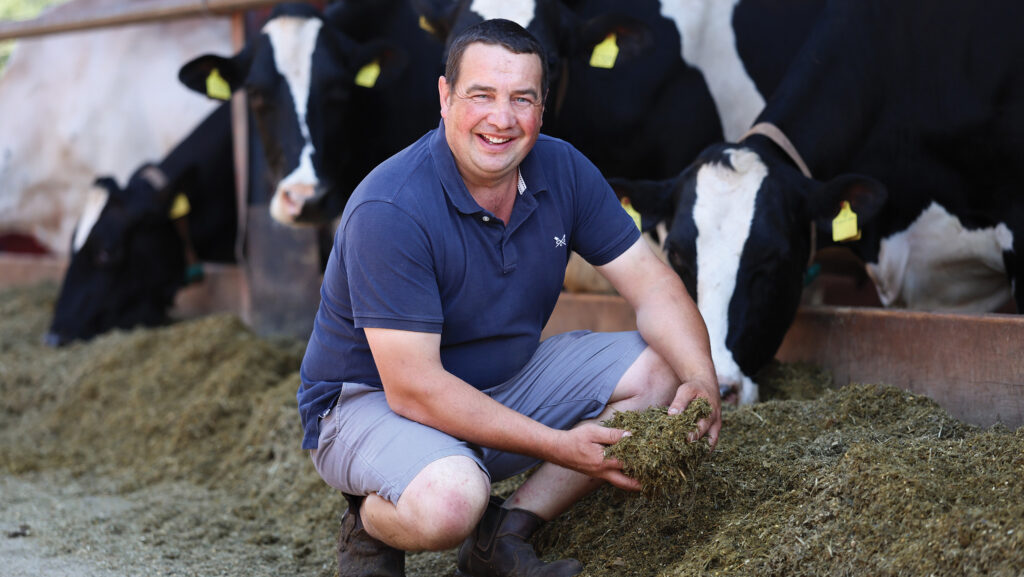 Rob Goodwin © Nathan Stirk
 Rain is still nowhere to be seen. We’ve had barely a drop since mid-June, and the second-cut aftermaths haven’t come back at all.
The forecast doesn’t show much hope for the next few weeks either.
The dry spell did at least mean we finished the wheat harvest in July, with variable yields but plenty of straw.
See also: 8 ways calf clubs are transforming rearing efficiency
About the author

Cow yields remain steady at about 40 litres, even through the recent heatwave.
Opening the 50% dry matter second cut has helped lift butterfats, which are now back near 4%.
However, the hot weather has pushed cell counts up and we’ve seen a few more mastitis cases than usual.
We have had issues with a couple of mid-lactation cows that have suddenly stopped ruminating and gone off their legs very quickly.
Despite multiple vet visits, blood tests and rumen pH checks, we’re still narrowing down the cause.
Some bloods showed low calcium so, after discussions with the vets and nutritionists, we’ve increased limestone flour and magnesium in the ration.
We’re monitoring rumination and behaviour closely through the sensor collars and any cow that flags is having bloods taken for review by the vets.
We installed a new calf shed with automatic feeders in 2023. The feeders have proved to be a very worthwhile investment, giving us total consistency in feeding times, quantities and weaning curves.
But while calves took to the machines well, having been moved into the shed after their four colostrum feeds, we continued to struggle with crypto-related scours at about seven to 10 days.
Earlier this year, we completely changed our approach and the results have been really encouraging.
Calves now stay in the nursery pen for 14 days before moving to the main shed.
This seems to avoid the worst of the crypto risk. In the nursery, after their colostrum feeds, they’re fed milk powder and muesli; then, in the main shed, they quickly reach 8 litres of milk across four feeds.
This is supplemented with chopped straw, whole straw and a starter pellet.
We’ve trialled a few pellets and recently switched to a much smaller, more fibrous pellet that the calves seem to consume more readily.
It will be interesting to see how this additional tweak to their diet affects performance over the next couple of months.