

Farmer Focus: Extreme weather prompts grassland rethink
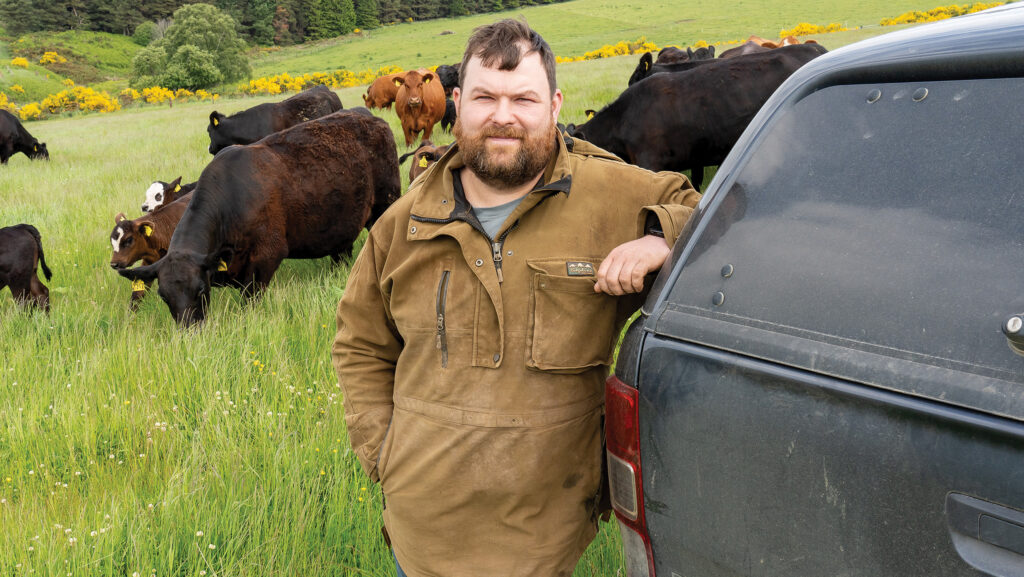 Duncan Morrison © Angus Findlay
 We have seen a return to what is a more typical weather pattern in north-east Scotland in late summer: a real mix of sunshine and rain. Grass growth has found a second wind and we are now enjoying some lush, fresh growth.
Average farm covers across the three units are behind 2024 levels, but similar to 2025. Second-cut silage was done more in hope than expectation, and we sneaked enough to see us through in the end.
See also: New breeding tools target flock efficiency and methane output
About the author
This summer has really made me think about our business and how we can move the chess pieces of our farming system around to suit. Some of the predictions surrounding the El Nino weather system suggest 2027 will have a very similar pattern to this year.
For us, that meant a cold, late winter with lots of snow, a mild spring with lots of growth, and a hot, dry midsummer.
That equates to an abundance of spring grass that may be hard to control, followed by a period of very little growth at all.
Of course, this could all be completely wrong, but it prompted me to build some scenarios on Farmax and see what effect they have on feed supply/demand and the bottom line.
One scenario was to cut almost all of our silage in the first cut when we have the most supply, then benefit from the extra scope of the aftermaths during midsummer. It could also make the topper a bit more redundant than it was this year.
In the past fortnight, we have cleared the decks of our 18-month-old store cattle and this year’s store lambs, and we were glad to receive good trade.
Attention is now moving towards next year. We’re on the lookout for some more tups and potentially a new stock bull.
We have taken the decision to move the whole herd towards Aberdeen Angus sires from now on, so some shopping is required to bolster the bull team for next year.
In a month’s time, we will draw to a close our Monitor Farm experience with a final open meeting focusing on what we have done in the past four years and where we plan to steer the business in the future.
Shortly after that, I will be attending the week-long Planning for Profit course. There is always more to learn.