

Farmer Focus: Farm does worryingly well in my absence
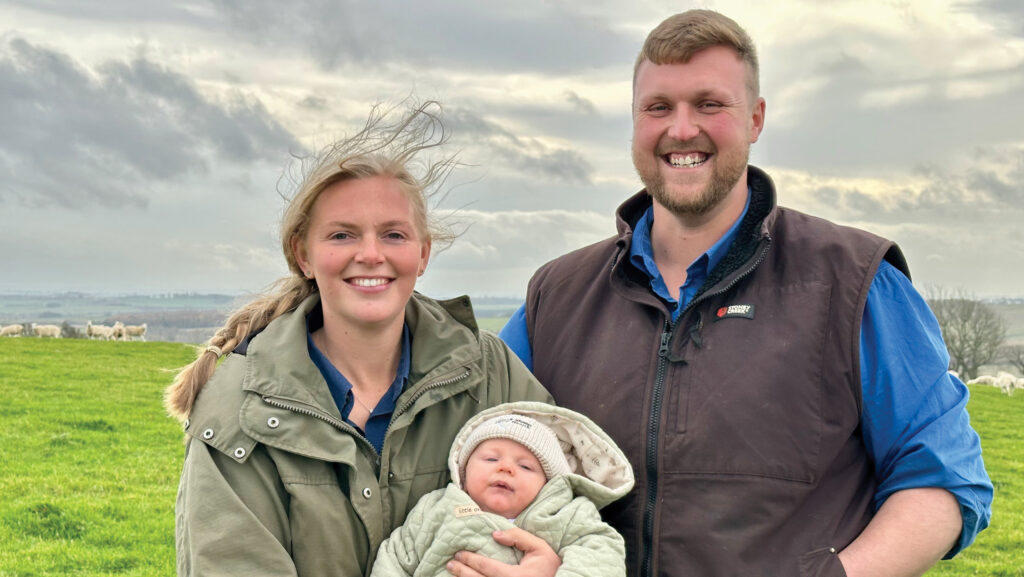 Jen and Rich Oglesby © MAG/Judith-Tooth
 They say you should be able to leave your business without worrying for it to be successful. I’m recently back from 19 days in Australia and New Zealand, and things have never looked better.
We’ve had our best weaning weights yet, with an average of 30.4kg at 91 days and 226 lambs straight to the abattoir at weaning. Worryingly, Jen might realise she doesn’t need me at all.
See also: Advice on managing mobile water troughs for sheep flocks
About the author

I was honoured to represent the UK as part of the Global Sheep Producers Forum. Two sheep producers from the UK, Canada, the US, New Zealand and Australia formed the group.
We were shown farms, feedlots, an abattoir and wool processing facility, and attended the LambEx conference in Adelaide.
After the trip finished, I spent some time visiting farms across both countries, mainly wool-shedding sheep and Hereford studs, plus some commercial farms.
Something farmers in New Zealand and Australia have always impressed me with is their investment in infrastructure: fencing, paddock segregation, tracks, wide laneways, handling facilities and especially water systems and irrigation.
Tanks are spread around the farm at high points, some taken up high by helicopter, pumped and then gravity fed. This is how they use grass effectively and run large stock units per labour unit.
We have been at Coltpark Farm for three years, and it still seems quite an overwhelming task and investment to get up to this standard.
A highlight for me was the LambEx conference. Particularly inspiring was a talk on the first day by Gus Balbontin about business development.
He spoke about structuring business innovation and where you should be focusing your time.
He suggested focusing a larger proportion of your time on “business as usual”, and a falling, sliding scale of your time, ending in a small percentage, looking for the next innovation to progress your business.
With little experience, this can be high risk, but is something most successful businesses have in common. This really resonated with me and one of my biggest take-homes was to embrace technology more positively.
Since returning home, we have artificially inseminated our Hereford stud cows with semen from one of the farms I visited in Australia, and we have hired an Optiweigh in-field weighing system to go with a mob of 700 lambs of 30-38kg.
I am looking forward to seeing what we can learn and how worm burdens, paddock covers and other factors are affecting growth.