

Advice on forage intakes for pregnant ewes
 © Tim Scrivener
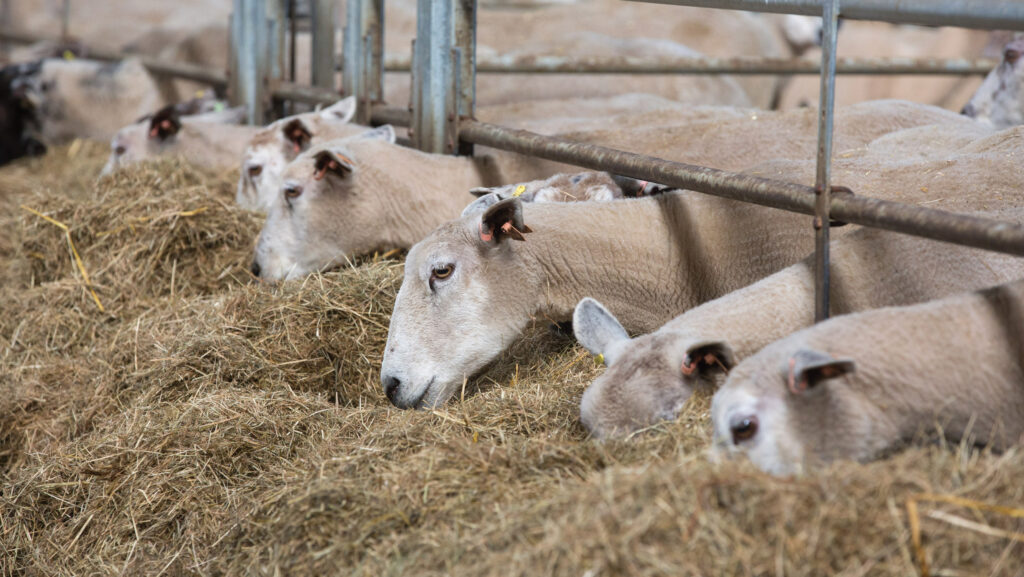
 With lambing time approaching for many, we have started to see a few cases of twin lamb disease in early lambers.
This has prompted a more in-depth review of nutrition on these farms.
See also: 3 myths around feeding ewes debunked
About the author

Knowing the nutritional value of forage fed to ewes in the run-up to lambing is essential to calculate any supplementation needed. Kirby Dobson of Tyndale Vets offers practical tips.
Forage analysis is vital to ensure stock are receiving adequate energy and protein, as well as trace elements.
Knowing the energy and protein levels in forage allows the farmer or vet to calculate how much concentrate feed, if any, is required in late gestation.
Trace element content of forage is a good indicator of whether to supplement ewes. And if that forage is home-grown, it allows a picture to be built of the trace element status of each field on the farm.
Forage-sampling technique
© Tim Scrivener
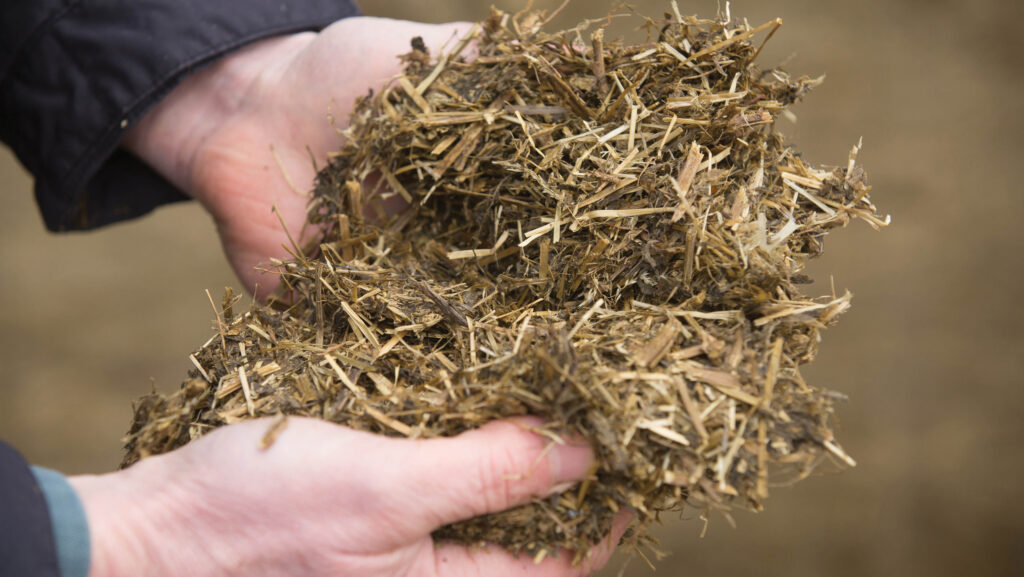
Use a bale corer to collect samples 20-30cm deep from six to 10 large bales (repair holes in wrapped bales with silage tape to avoid spoilage), or 12-20 small bales, from each field.
About 200-300g of forage is usually required. Thoroughly mix the samples in a bag, then squeeze the air out, seal, and send to the vet or feed laboratory for analysis. Ensure the bag is labelled appropriately.
If possible, take a selection of bales to a weighbridge to get an average bale weight, to help calculate a more accurate feed plan.
If sampling fresh grass, use scissors to cut a couple of handfuls of grass 2cm above the ground, from six to 10 sites in a field.
To choose site locations, follow a “W” pattern, avoiding hedgerows, gateways, and troughs.
Healthy rumen
Sheep nutrition aims to feed the rumen microbes the correct balance of energy, fibre and protein.
These microbes then produce nutrients for the animal. Rumen microbes need a near-neutral pH of 5.5-6.5 to function and survive.
A high-energy diet lowers the pH, destroying the microbes. A high-fibre diet can help neutralise the pH, thanks to saliva produced during chewing.
To maintain a steady pH, avoid feeding more than 500g a head of concentrate in a single feed. Instead, it can be split across two or three feeds a day.
The protein available to the ewe comes from protein made by the rumen microbes, plus protein that passes through the rumen unchanged.
Calculating protein intakes is complex; the farm vet can help with tailored protein analysis.
When to supplement
Feeding concentrates ensures each ewe gets the extra energy and protein it needs. Allow 45cm a ewe of trough space when feeding concentrates.
The feed supplier can provide the energy and protein content of the feed – sometimes, buying a higher-quality feed works out cheaper.
Poor protein intakes in the four to six weeks pre-lambing will result in poor colostrum.
Consider feeding all ewes some concentrate in the last three weeks of pregnancy, especially if planning to adopt lambs onto single-bearing ewes.
Topping up energy requirements with energy buckets can be expensive and ineffective.
What tends to happen is that one-third of animals use them a lot, one-third use them sometimes, and one-third never use them.
The cost, on an ME/MJ basis, can also be three times that of concentrates.
Blood tests for energy and protein
Ask your vet to perform metabolic profiles on five ewes in each management group at three to four weeks pre-lambing.
These blood samples will check ketones (beta-hydroxybutyrate) to assess energy levels for warning of twin-lamb disease, and urea and albumin to check protein intakes for colostrum quality.
Twin lamb disease
Twin lamb disease can affect thin ewes, because they have no bodily reserves and are not receiving sufficient energy in the diet.
Fat ewes are also at risk, as they have lower feed intakes because excess fat means less space in the abdomen.
Checking ketone levels is a good indication for at-risk ewes. The clinical signs are weakness, depression, blindness and recumbency.
Successful treatment relies upon catching the disease quickly and providing a good-quality energy source, as well as a non-steroidal anti-inflammatory injection.
Supplementing calcium is also useful, as hypocalcaemia can show similar signs. A good oral drench with propylene glycol, glycerol, and calcium will give your ewe some “go”.
Energy requirements
Dry matter intake
To work out the requirements of the ewe, the dry matter intake (DMI) needs to be calculated. The maximum total DMI of a dry ewe is 1.5% of her bodyweight; this increases to 2-2.5% for late-pregnancy and 3-3.5% during lactation.
Example: A 70kg ewe will eat 1.4-1.75kg in late pregnancy. DMI is affected by many factors, including the type and quality of forage and the stage of production.
Sufficient feed space is also important: allow 15cm a ewe for the best forage intakes.
Energy
Metabolisable energy (ME) is the energy available to an animal from the diet.
To work out how much ME/day a ewe is getting, multiply DMI by the ME of your forage.
Example: A 70kg ewe on average hay, two weeks pre-lambing, and eating 1.5kg/day of hay at 8.5ME, is consuming 12.75MJ of ME a day. But this ewe needs 15.3ME, so the ration falls short by 2.6ME. (The deficit is ME required minus ME provided from the forage: 15.3ME – 12.75ME = 2.6ME.)
Concentrate feed for ewes is usually about 12.5MJ of ME/kg. To calculate how much is needed, divide the deficit ME by the concentrate ME/kg to see how many kg of concentrate to feed each ewe.
So, in this example, 2.6ME divided by 12.5ME = 0.2kg.
A more detailed look at protein and energy requirements can be found in the AHDB Feeding the Ewe guide, available online.
Ewe demand for metabolisable energy |
|||||
|
Metabolisable energy (MJ/day) requirements of housed* pregnant ewes (based on a diet of 11MJ/kg dry matter, assuming no ewe weight loss**) |
|||||
|
Ewe liveweight (kg) |
Number of lambs |
Weeks to lambing
|
|||
|
|
|
7 |
5 |
3 |
1 |
|
50 |
1 |
7.9 |
8.7 |
9.8 |
11.2 |
|
|
2 |
8.8 |
10.1 |
11.9 |
14.2 |
|
60 |
1 |
9.1 |
10 |
11.2 |
12.8 |
|
|
2 |
10.1 |
11.6 |
13.7 |
16.3 |
|
70 |
1 |
10.2 |
11.2 |
12.6 |
14.4 |
|
|
2 |
11.4 |
13.1 |
15.3 |
18.3 |
|
|
3 |
12 |
14 |
16.7 |
20.3 |
|
80 |
1 |
11.3 |
12.4 |
13.9 |
15.9 |
|
|
2 |
12.6 |
14.4 |
17 |
20.2 |
|
|
3 |
13.3 |
15.5 |
18.5 |
22.5 |
|
Notes *For ewes outdoors, increase metabolisable energy (ME) requirements by 0.11MJ for each 10kg bodyweight for lowland ewes, and by 0.24MJ for each 10kg bodyweight for hill ewes. **For ewes gaining 50g/day gain, add 2.5MJ of ME. Source: AFRC, 1993; AHDB Feeding the Ewe |
|||||