

Foliar feed boosts forage maize in drought, farm trial shows
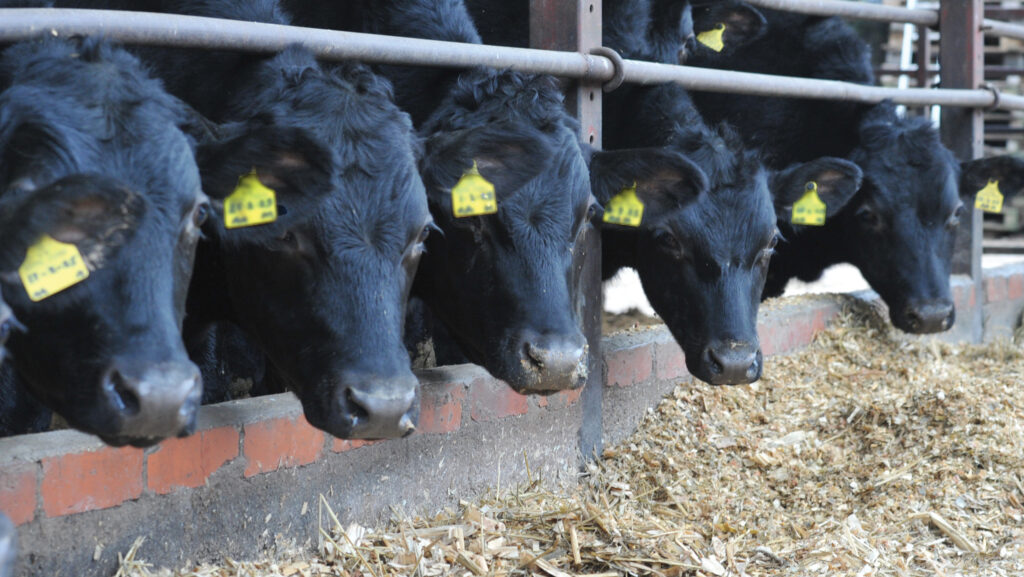 Nigel Bowyer's store cattle © Debbie James
 Using foliar feeds on maize challenged by soil nutrient deficiencies and drought increased yield by 36t/ha on a Welsh livestock farm.
Nigel Bowyer and his family grow 8ha (20 acres) of maize at Ty Coch, Llanbadoc, near Usk.
They feed it alongside grass silage in the winter ration for the dairy-beef calves they source from Meadow Quality at 12-16 weeks of age.
See also: How foliar feeding maintained grass growth at half N rate
Farm facts
Ty Coch, Llanbadoc, near Usk
- 81ha farmed
- 80 dairy cross Aberdeen Angus store cattle finished annually for Meadow Quality at 21 months
- 270 Aberfield and Lleyn ewes
- Indoor lambing in February and March
- Finished lambs sold via a supermarket contract
In the 2025 growing season, as part of their work through the Farming Connect Our Farms network, the Bowyers applied foliar feeds to half the maize acreage to test if and how this intervention could enhance performance.
The trial, which included an untreated plot within the trial field to allow variations to be assessed, showed a big increase in maize yield.
Furthermore, analysis post-harvesting confirmed that treating the crop twice during the growing season resulted in a dry matter (DM) of 41.4%, compared with 37.8% in maize that had not been treated.
Feeding quality
Digestibility (D-value) and metabolisable energy (ME) were also significantly up.
AD-value of 72% was recorded, compared with 53% in the untreated acreage, together with an ME of 11.80MJ/kg, in contrast to 8.60MJ/kg in the control plot.
Nigel also believes the treated maize is more palatable from the evidence he has seen at feeding out.
“The cattle do seem to prefer the maize silage this year – they are definitely more interested in it,” he says.
However, he adds, 2025 was a poorer year for producing grass silage “so that could also explain why they are showing a preference for maize this winter”.
Maize has been part of his system for 30 years.
He feeds it with home-grown barley and grass silage, as well as bought-in protein, which is mostly in the form of beans sourced from a local grower.
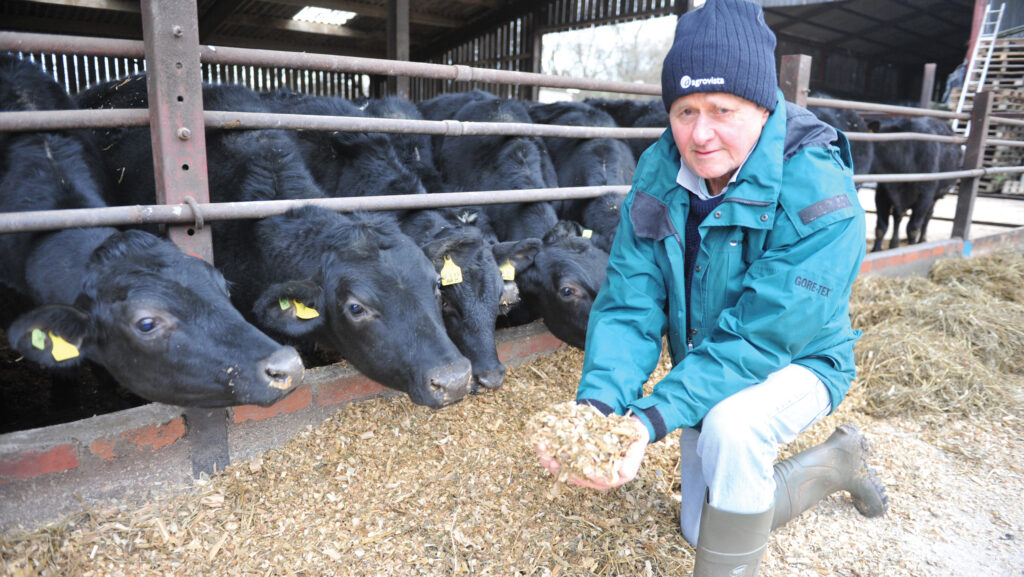
Nigel Bowyer © Debbie James
Soil nutrient analysis
In 2025, he grew the early maturing maize variety Portabello, drilling it on 10 May in a field with sandy, silty loam soil.
Soil sampling pre-establishment showed that pH and phosphate indexes were on target, but levels of potassium and sulphur were low.
There was also a deficiency of boron, which can result in maize producing small cobs with missing kernels.
Monmouthshire-based independent agronomist Juliet Anderson, who advised on the project, says applying foliar feed can be an effective means of addressing trace element deficiencies like these.
Soil sampling ahead of establishment is always good as it will give a clear picture of what the grower is dealing with.
However, it can be very tricky to improve soil trace element status, Juliet says.
“It all depends on soil type and the ability of the soil to hold onto those nutrients, but it can be quite expensive and doesn’t always improve the levels,” she says.
“Foliar feed is the best way of getting these nutrients to the plant because you are applying it directly to the plant that is growing at that time.”
Nigel applied di-ammonium phosphate (DAP) at 124kg/ha when the seed was drilled.
No rain fell in the weeks post-establishment and this resulted in slow growth and a yellowing of the maize plants.
Tissue samples
To determine if nutrient shortfalls were a contributory factor, a tissue sample was taken a month after establishment, when the crop was at its four true leaf stage.
That test flagged up low magnesium and boron levels, although there were good amounts of other nutrients.
To address this, the maize in the trial field was sprayed with Croplift Pro, a foliar fertiliser combining nitrogen, phosphate, potash, sulphur, magnesium, manganese, copper, zinc, boron, iron and molybdenum; it was applied at a rate of 5kg/ha.
Two weeks later, and informed by the result of a second tissue sample, a more targeted nitrogen foliar feed, MZ28, was applied, together with a manganese and zinc product and magnesium sulphate.
A third and final analysis of a tissue sample taken a month before harvesting showed similarities in the nutrient levels of the treated and untreated plots, but with subtle differences.
Nitrogen levels in the treated crop were only slightly below the guideline, says Juliet, while they were very low in the untreated crop.
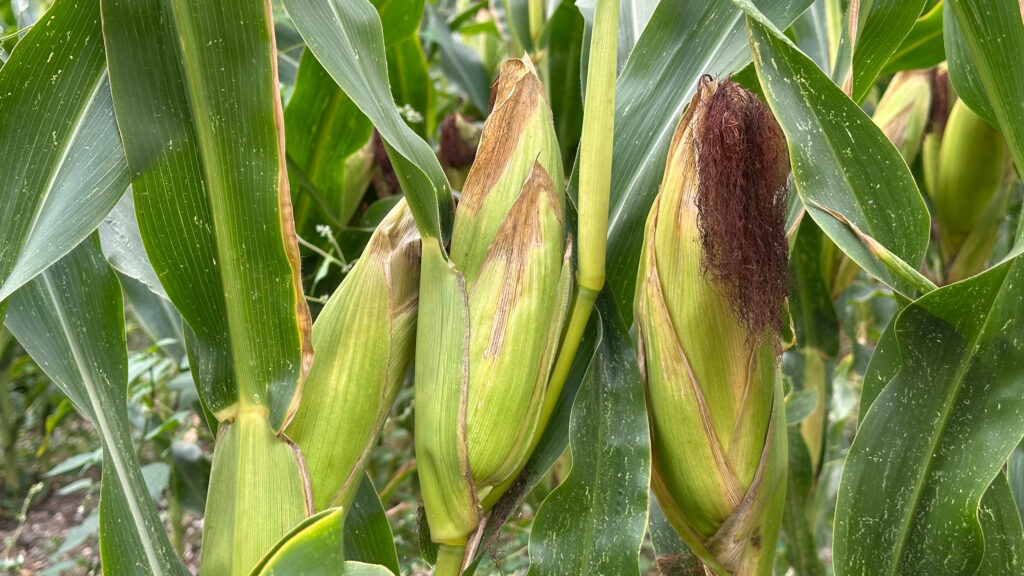
Maize cobs © MAG/Judith Tooth
“Surprisingly, key nutrients like magnesium, manganese and zinc were up to guideline levels in both plots, suggesting the untreated plot had improved its uptake.
“This unexpected result is assumed to be because a small amount of rain fell in August.
“And maturing plants have deeper root growth, which would have improved the plant’s ability to scavenge for nutrients from the soil.”
Harvest
The crop was harvested on 13 September when, despite the subtle tissue results, harvest data showed vast differences in yield, DM, ME and D-value.
The treated maize yielded 59t/ha, more than double the crop harvested from the control plot, at just 23t/ha.
As the untreated plot was only about 0.08ha, compared with 3.4ha of treated maize, this higher performance could in part be explained by differences in soil type within the field, as well as other factors, Juliet reasons.
But she points out that the visual difference at harvesting clearly supported the yield data.
“The maize in the untreated plot was distinctly brown, light and dead, while the treated crop remained green,” she says, adding that differences in the rates of maturity were also notable.
“As the trial wasn’t replicated, it is hard to draw a conclusion that it was all down to the foliar feeds, but I am sure that they played a part.”
Farmer verdict
Nigel plans to follow a similar treatment programme in his 2026 maize crop.
His one reservation about the 2025 trial is to what extent the extreme dry conditions influenced the results.
It stands to reason, he says, that it will be beneficial to apply a foliar feed (as opposed to a granular product) to replace what a plant cannot get from the soil in such conditions.
“It might not necessarily be due to what is in the product itself.
“But I am going to give the treatments another go this year, with perhaps a few changes on what nutrients we might apply to the land according to what the soil analysis shows,” he says.
Maize has been integral to Nigel’s system for three decades due to its high starch content.
He believes it will only become more important if summers follow the current trajectory of lengthy hot and dry spells.
“If we hadn’t grown maize in 2025 and relied only on grass and barley, we would have been in a real mess,” he admits.
Costings for application of foliar feed
- First foliar feed application of MZ28 – £50/ha
- Croplift Pro – £17.91/ha (applied at the same time as a herbicide)
- Mancazin and magnesium sulphate – £17.56/ha
- Contractor cost of applying each feed – £12-£15/ha
- Tissue testing – about £40/test