

Forage maize yield more than double under film, trial shows
 © AdobeStock
 The impact on a farm’s cost of production from more than doubling forage maize yield, from 7t dry matter/ha to 18t, is significant.
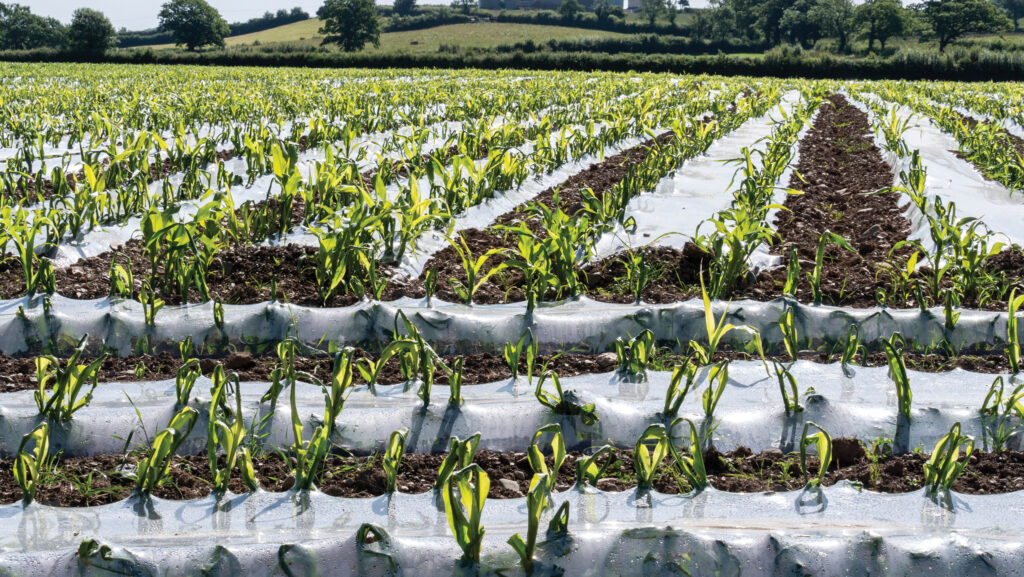
This yield benefit was seen when the same maize variety was grown under plastic film – producing the higher yield – compared with no covering, in a trial at a Bangor University research farm.
See also: 8 things to consider before sowing maize
Debalto KXB9004I was grown in a field previously in a grass and wheat rotation, in freely draining sandy clay loam soil, at Henfaes in Gwynedd.
The crop yielding 18t dry matter (DM)/ha was cultivated under low-density polyethylene film (the material most commonly used in farm plastics).
Soil moisture
Although the yield difference was greatest in 2025, when conditions were exceptionally hot and dry, it was evident in the previous two growing seasons too.
In 2023, the yield in the film-covered crop was 6t DM/ha higher, at 26t DM/ha, and in 2024 it was 3t DM/ha higher, at 13t DM/ha, than the uncovered crop.
Yields were also bigger in the maize grown under biodegradable film – 22t DM/ha in 2023, 12t DM/ha in 2024, and 13.5t DM/ha in 2025 – though the difference was not as significant as under plastic film (thought to be a result of better nitrogen use efficiency).
A scientist involved in the research, Prof David Chadwick, says that although yield increase is the principal reason why farmers use films, the extent of that benefit in 2025 highlights their potential should hot, dry summers become more commonplace in the UK.
“Mulch films retain soil moisture. They also automatically check weeds and therefore reduce the volume of herbicides needed to suppress them,” he says.
Environmental impact
Microplastics from agricultural mulch films are a cause for concern, yet the study at Henfaes showed levels to be “relatively small”.
“The major contribution of microplastics to soils is probably coming from atmospheric deposition – some of this is from roads and use of compost on land,” he adds.
The study, supported by the UKRI Global Challenges Research Fund and the Natural Environment Research Council, and which extended beyond the UK to countries including China, and to other crop types, recorded typical levels in agricultural soils at about 0.0001% of total soil volume.
This is much lower than the concentrations used in many laboratory studies that test the effect of films.
It is not uncommon for microplastic levels in these studies to be thousands of times higher than those present in agricultural soils, says David.
The trial at Henfaes based concentration levels on those present in farm soils where plastic film has been used for multiple years.
Prof Davey Jones of Bangor University, who was also involved in the trial, says there was little evidence of damage to soil and crop health from agricultural plastics compared with other environmental threats such as climate change.
“Indeed, plastic film mulching is helping to minimise the effects of many problems in agriculture such as pesticide use, water shortages and overuse of fertilisers,” he says, adding that use of film had a “negligible” effect on bacteria and fungi present in the soil.
Based on the trial results, the researchers suggest policymakers should not ban films in crop production.
They advocate the use of thicker, more durable plastics that resist fragmentation and are easier to recover from fields, using mechanical removal equipment to maximise retrieval.
They also believe that biodegradable films can be further developed to deliver micro-nutrients and other crop growth enhancers as they degrade, replenishing what is removed in the crop.
Advice on use of mulch films from Procam agronomist Rhys Owen
Why use film?
It generates more heat units to drive early growth and root development. Depending on farm location and soil type, it can enable earlier sowing to maximise heat units to increase dry matter (DM) and starch yields, and metabolisable energy values/ha.
This means that higher yielding, later-maturing hybrids can be used in locations where they would not be grown conventionally.
In areas with high rainfall, film is used to shorten the growing season for early maturing varieties, leading to harvesting two-and-a-half to three weeks earlier than same variety grown in the open.
Later-sown maize has rotational and environmental benefits, as there is typically less soil damage from machinery at harvesting.
The earlier cutting window ensures successful establishment of the next crop before winter
Varieties
A proven variety with early vigour is essential, as not all will respond positively.
It is always better to look for consistent performance over several years and across a range of seasons.
In more marginal areas or at altitude, a variety with a good cold tolerance is required.
Establishment
Grow in light to medium free-draining soils. Avoid very exposed sites with high winds and fields with a history of high weed burdens, especially charlock or couch grass.
When planting from early April, the ability to prepare a good seed-bed in late March is key for good film edge burial and soil coverage.
This will aid film retention and maximise the residual coverage and effectiveness of the pre-emergence herbicide. Drill setup and an experienced operator are also crucial.
Herbicide use
A pre-emergence herbicide application is paramount. Pendimethalin alone or a product that combines dimethenamid-P and pendimethalin are recommended.
A post-emergence herbicide may be required and film may need to be split, depending on its rate of degradation, weed numbers and their growth stage and density.
By the four- to six-leaf stage, maize will have received most of the benefit from film; high weed populations will have more impact on yield potential than splitting the film.
Nutrient inputs
As the film quickly increases the soil temperature, phosphate (P) and nitrogen (N) are more readily available for early development, so there is no need for a placed starter fertiliser.
N should be front-loaded into the seed-bed with rates appropriate to the site, cropping history and organic manures previously applied.
Factor in the higher yields achieved compared with growing conventionally: aim for total N of 130-150kg/ha from organic and inorganic fertiliser placed in the seed-bed.
Another option is to apply additional N in foliar form just before tasseling.
Costings
Conventional maize Growing costs including harvesting: £1,200/ha
Maize grown under film Growing costs including harvesting: £1,600/ha.
This includes additional cultivation, splitting the film before any required post-emergent herbicides are applied, and possibly higher herbicide inputs.
Cost benefit
Based on a cost difference of £400/ha and a potential yield increase of 6-8t/ha (2-2.64t DM/ha at 33% DM), if maize is valued at an average of £65/t, maize grown under film can produce yield worth £390-£520/ha over and above a conventionally grown crop.
Note: Figures exclude rent; all machinery operations based on the National Association of Agricultural Contractors (NAAC) 2025 charges.