

Why poor water management limits dairy herd potential
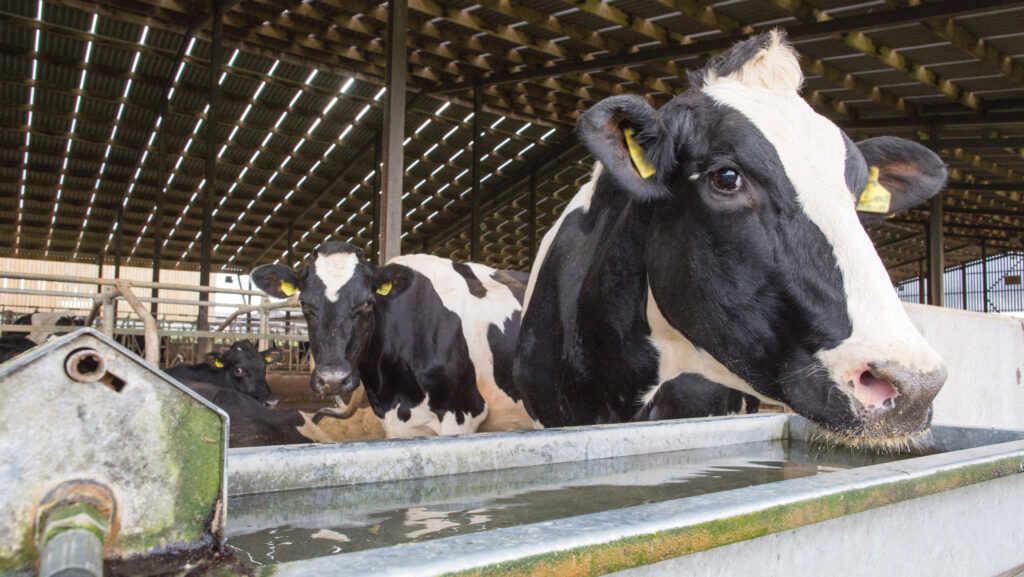 Water does not stay clean and palatable unless troughs are emptied and cleaned weekly © Tim Scrivener
 How much water can a lactating dairy cow drink if she has access to ad-lib, fresh, clean and palatable water?
The answer is unknown on many dairy farms, because of poor water management, according to Zinpro’s senior dairy technical specialist Dr Huw McConochie.
See also: 6 tips on delivering water for dairy cows
He told the recent British & Irish Society of Animal Science (Bisas) dairy nutrition conference that a herd’s water requirements should be based on target – not actual – milk production.
But he said farmers, vets and nutritionists must work on developing “smart water management” to realise a herd’s production potential.
“Water is the forgotten nutrient because it’s free; it falls from the sky, and it comes from boreholes. But it is the most limiting nutrient in dairy cows,” he said.
“We all know the dry matter intakes of dairy cows – we might be obsessed with them – but we don’t know how much a cow drinks.
“We look at water intake in proportion to litres of milk, but if there are no restrictions, how much could she drink?”
Smart water management opportunities
- Prioritise water flow to specific zones
- Understand daily water flow rate requirements
- Favourite troughs and times of day
- Store water for specific peak demand during low demand periods
- Auto purging of troughs
- Prioritise water quality
- Mains supplementation during peak demand
- Recycling of water
- Auto quality sensing
- Trough temperature
Source: Dr Huw McConochie, Zinpro
Insufficient access to water
He said that water access on farms was a bigger problem than water quality and that dirty troughs were a people management issue.
Farms need standard operating procedures to supply clean, palatable water – but then must ensure it stays clean.
Research shows that restricting water supplies by 10-20% impacts milk production by 5-15% within 24-48 hours, he said.
With 75% of a cow’s source of water via drinking, water intake is considered the most sensitive limiting factor for milk production.
However, Huw pointed out that water calculations still use the rough guide of 1 litre of water for every 1 litre of milk produced.
This does not consider maintenance and pregnancy – let alone drinking water for dry cows and youngstock, or farm cleaning purposes.
Furthermore, drinking water requirements jump in summer to 1.5 times the winter level for cows in periods of heat stress, he said.
Using what he called “accepted calculations” for water requirements, he said that a 40kg/day herd average yield needed 148kg of water.
This meant the total water requirement for a 300-cow herd would be 44,400kg/day.
As 30-50% of a herd’s daily water intake is drunk after milking, this calls for a flow rate of 63kg/minute – in addition to water for youngstock, milking and cooling.
Peak demand
Yet Huw said he regularly found dairy farmers who did not know what their farm’s water capacity could deliver on a daily basis.
The biggest issue was not being able to meet peak demand for water flow rates – usually after milking.
A visit he made to a 250-cow herd revealed that troughs were dry at 10.30am because all the farm’s water was being diverted to the volume washer.
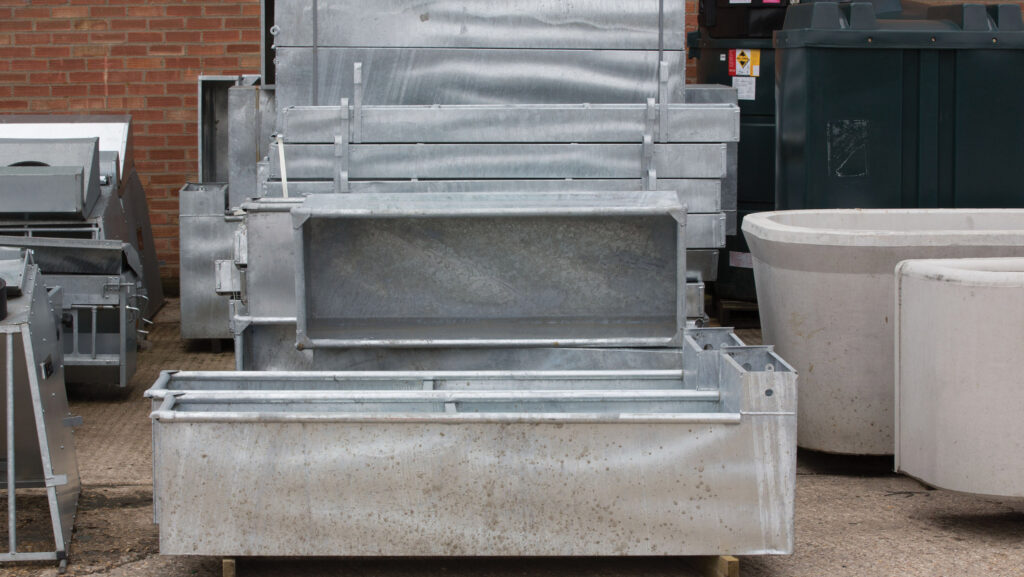
Many farms have too few troughs because shed design favours more cubicles © Tim Scrivener
He suggested it would have been better to store water during off-peak hours to supply the washer, leaving drinking troughs full for cows.
“You could even use mains water to supplement a poor supply for cows to drink,” he added.
“You could divert water to post-milking troughs and [temporarily] not fill youngstock ones, and also divert supplies to troughs favoured by cows. Every cow needs the opportunity to drink post milking.”
Cow preferences
“Provide 60cm a cow drinking space on exit from the parlour.
“You need to understand cow preferences – are troughs favoured because of good water quality or easy access? – to target resources and achieve optimal production,” he said.
He had even seen cows offered water instead of concentrates on the rotary platform in hot countries.
Although he acknowledged water intakes could fall in lame cows (they spend more time lying), Huw said there was a range of causes physically preventing cows from drinking their fill, starting with not enough water coming onto farm.
Many farms have too few troughs because shed design favours more cubicles, which creates a lack of room to drink.
Cows need 9-10cm of drinking space without congestion around the trough, so there needs to be at least 4m to allow cow traffic past while she drinks.
Even where water starts out clean and palatable, because farms have no protocols for routine emptying and cleaning, it quickly becomes contaminated in troughs, he pointed out.
“Empty and clean troughs weekly and use a weak chlorine solution.”
Focus on investment not cost in heifer rearing
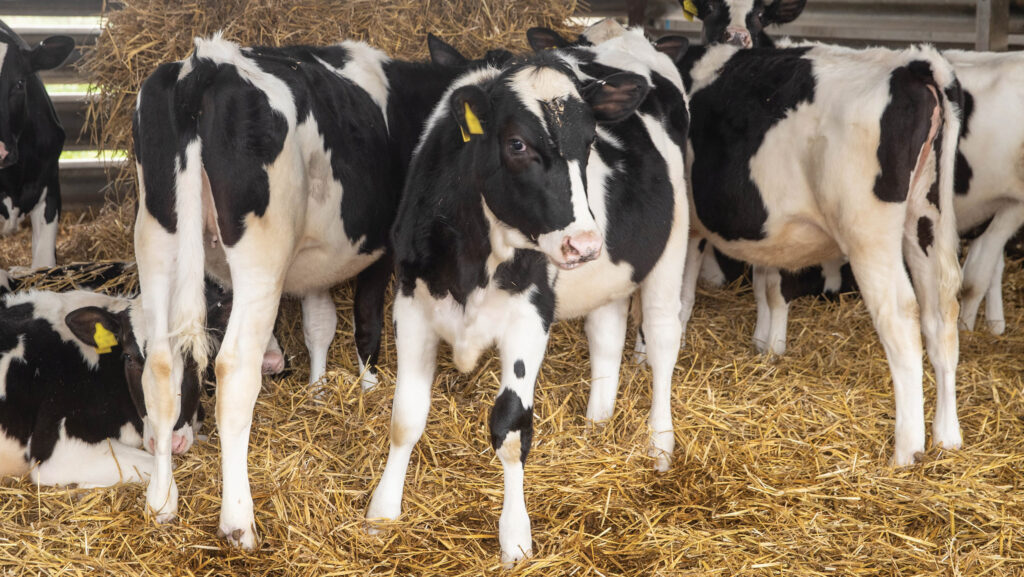
Cutting out concentrates at weaning to save money is a mistake according to Alex Bach © Tim Scrivener
Rearing dairy heifers is an investment in a herd’s future, not a cost. This means it is important to look at feed efficiency to measure return on investment.
Prof Alex Bach of the Catalan Institution for Research and Advanced Studies pointed out that feed efficiency in heifer replacements was higher in their early life: 55.2% before 60 days of age and costing €1.54/kg (£1.34/kg) of growth.
This drops to 7.4% when heifers reach 650 days, costing €1.72/kg (£1.50/kg) of liveweight gain. It means that the “cost of building an animal” is cheaper when they are younger, he said.
Alex said a common problem at weaning was that farmers think the job is done and cut out the starter feed, replacing it with a lot of forage because it is cheaper.
“We give calves high-energy, very digestible milk, then suddenly stop and they go onto straw. But it’s a mistake, as the rumen is not yet ready to digest the fibre,” he said.
“If the forage is good quality, calves will eat a lot of it, but they can’t digest it. You won’t grow at 1.2kg/day with a diet of 80% forage – it’s not possible.”
More starter concentrate, less forage
Instead of being cost oriented, Alex said that farms should be led by return on investment and feed more starter concentrate and limit forage post weaning.
Calves offered ad-lib hay, in trials, were shown to eat 3.5kg dry matter (DM)/day at eight weeks of age, yet when hay was restricted, they ate 4.5kg DM/day.
Alex said this was because when offered lots of forage, calves will eat it but get tired because it is hard work for them, and not all the forage is not digested.
“Do not feed dairy cow leftovers to calves, as it contains too much energy and too little protein, and it’s wet – and if calf feed bunks are not cleaned out [regularly], it puts them off food,” he stressed.
Assuming that a good job has been done pre-weaning, Alex said that grouping calves was important to increase solid feed intake and social facilitation, as they eat more than individually housed calves.
This means at least six calves in a pen of adequate space. Grouped animals are also better able to cope with novel feeds such as silage.
Other areas to consider included:
- Vitamin A Lack of vitamin A at puberty leads growing heifers to be prone to fatness, especially when they are fed excess energy.
- Conception rates At puberty, heifers should be moved into the breeding pen at 385 days of age to give them time to settle. Research showed conception rates dropped to 65% for heifers served within five days of moving, compared with 72% for those served after five days.
- Starch Oocyte growth requires glucose so 12-15% starch should be provided in the diet.