

3 ways artificial intelligence can improve pig health
 © Matthew Wilkin
 Artificial intelligence is being used to improve management of health, welfare and performance on both individual pig farms and across the sector.
As well as generating greater value from existing data sets, the technology can, for example, process audio or visual data captured automatically on farm.
See also: Why lung scoring could improve pig health and welfare
The aim, however, is not for artificial intelligence (AI) to replace human expertise, but to provide valuable additional insights that can help improve management decisions on farm.
Here, we look at how AI is delivering an early warning system for respiratory distress, analysing multiple health and welfare data streams, and monitoring pig facial expressions to flag health and welfare issues.
1. SoundTalks: Monitoring coughs with alerts
Sound-monitoring technology is being used on pig farms to “listen” continuously and record any respiratory distress symptoms that are signs of ill health or discomfort.
The software and AI system developed by Belgian company SoundTalks has built up a global database of respiratory data, from which the AI system continues to learn.
A respiratory score is generated for each in-pen monitor in real time.
Any significant anomalies or shifts away from normal cough patterns are flagged using a colour-coded traffic-light system.
Stockpeople walking through the pigs have a clear visual alert if a monitor’s green light has changed to amber or red. Producers can also view the data remotely online.
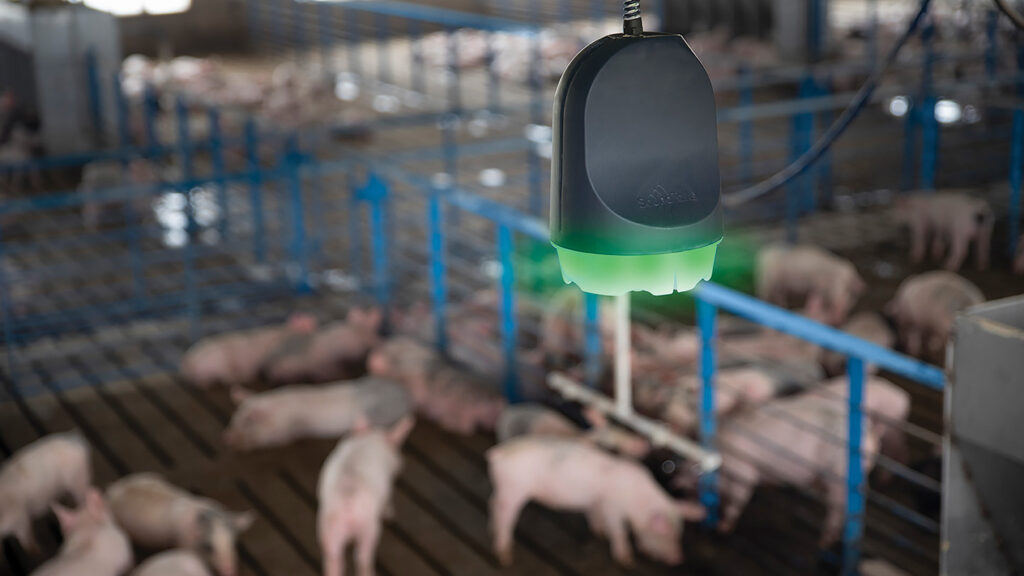
SoundTalks monitor © SoundTalks
The monitors are simple and robust, having been developed to withstand the challenges of a pig building environment, including washing and cleaning.
Each one is secured 2m above the pigs and records sound across an area 20m in diameter, typically covering 250-350 finishing pigs or 500-550 weaner piglets.
A gateway device uses a wired internet connection to upload data to the Cloud.
Early warning of disease or ventilation issue
“The strength of this technology comes from collaboration between the machine and humans,” says Zhao Ying Cui, SoundTalks head of operations.
“Humans have other senses and knowledge that are vital in identifying health challenges.
“But respiratory distress data can help provide an early warning of disease or highlight a ventilation issue or other managerial issues.”
Richard Riley, managing director of Yorkwold PigPro, has found SoundTalks to be an excellent tool that works alongside the team to help identify potential health issues before they are picked up by staff.
“The traffic-light system is particularly useful, supporting even the most inexperienced team members to respond quickly and effectively,” he says.
The potential return on investment in the technology can be up to £7.30 a pig, with improved health and reduced costs resulting from earlier intervention.
“If farms want to integrate SoundTalks’ respiratory data with other on-farm data sources such as feed or water intakes, this can be done via an API [application programming interface],” adds Zhao Ying.
2. Pig Insights: Collating valuable pig data
Farmer-owned co-operative Scottish Pigs has led a successful pilot project using AI to analyse and present multiple health and welfare data streams in one place.
The aim of the Pig Insights project is to generate full value from the extensive data already collected.
So far, it brings together Wholesome Pigs data from abattoir carcass inspections, information from on-farm quarterly vet reports (QVRs) and farm biosecurity data.
The six-month pilot brought together farming and veterinary partners, including SRUC, Quality Meat Scotland, Food Standards Scotland, United Pig Cooperative and ScotEID.
It was funded through the Scottish government’s Knowledge Transfer and Innovation Fund (KTIF).
“In the past, we were missing the resource to cross-reference these hugely valuable but disparate datasets,” says Andy McGowan, director of Scottish Pigs.
“Artificial intelligence will allow us to extract more meaningful insights, both to improve individual herd health management and to modernise national level disease surveillance.
“It should help us to catch any emerging issues or diseases early.”
Rapid in-depth analysis for decision-making
The co-op has worked closely with Sandy Carmichael at SRUC, who led development of the AI techniques and provided proof of concept that the industry’s multiple datasets could be integrated.
Large-scale language models were used to analyse the large quantities of structured data and veterinary notes.
A new digital platform, ViewQVRs, presents all the insights clearly, allowing timely monitoring and benchmarking of health and welfare data.
“The power of these datasets is in demonstrating significant outliers in the data, which help inform and encourage management changes on farm.
“We do not want to take the vet’s specialist knowledge out of pig management,” Andy says.
“The aim is that AI provides rapid in-depth analysis so that vets and producers can review it and act on it.”
A key aspect of the project is local sourcing of AI analysis and the required computing power in Scotland, rather than through a third party, to ensure security of farm data.
Now the system is established, there is potential to extend it to include further data sources.
3. IntelliPig: Health indicator through facial expression
A research study is using AI to monitor individual pigs’ facial expressions and relate them to their emotional state.
The IntelliPig system being developed aims to help improve pig management and provide early warnings of health and welfare issues.
The project is a three-year collaboration between agri-tech company Agsenze, machine vision experts at the University of West England’s Centre for Machine Vision, and animal behaviour and welfare specialists at SRUC.
They are testing the system on a commercial pig farm.
“Pigs are very visually expressive,” says SRUC’s Dr Emma Baxter.
“We know subtle facial changes are part of how they communicate with each other, along with body posture.
“The IntelliPig system is able to pick up signs of pain or distress through changes such as tightening or widening of the eyes.
“However, AI will always be a tool to support and alert stockpeople – not replace them.”
Camera technology has been designed by Agsenze to be “farm-proof”.
Each camera automatically captures images of the sow’s face as they exit their feeding station.
There are also overhead cameras monitoring body condition.
Meanwhile, machine-learning algorithms have been developed that can:
- Identify individual pigs using facial biometrics
- Detect changes in facial expression that indicate whether a pig is stressed
- Estimate body condition score and weight.
These techniques will enable ongoing learning about individual animals, more prompt intervention where needed and tailored treatments.
Stress detected with more than 90% accuracy
“Our trials have found the system can detect whether gilts are stressed or unstressed at over 90% accuracy,” says Emma.
“We compared pre- and post-stress faces in gilts, with temporary introduction of older sows to the group being the source of stress.”
The next step is to correlate feeder visit and feed intake data with facial image data on emotional state, comparing submissive versus dominant sows.
The technology could also be used in rearing pig systems and work is under way to integrate camera-based AI technology with existing on-farm technology, such as ventilation and automatic feeding systems, to optimise its value for commercial farms.
The full research paper is available on the Multidisciplinary Digital Publishing Institute’s website