

Stunning: An established practice at Blackwe’lls Farm Produce
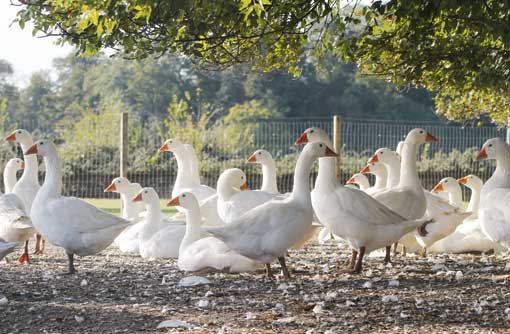
Like most large goose producers, stunning is very much an established practice for Howard Blackwell of Blackwell’s Farm Produce based at Herons Farm in Essex.
Mr Blackwell fattens about 1,900 geese a year, grown in two separate batches to ensure a range of weights and sufficient numbers for both the Michaelmas and the Christmas markets.
The birds are reared on a free-range systems for most of their lives, though some are brought indoors at night six or seven weeks before slaughter to help them put on extra weight, up to about 7-8kg.
When it comes to slaughter, the geese are taken into the killing room in batches of 30. They enter a wooden race 10 at a time and are held there for several minutes until they calm down.
Once quiet, they are taken one at a time, quickly shackled and suspended upside down for stunning. “The regulations say they can be suspended for up to 90 seconds before stunning, but it happens far quicker than that.”
Mr Blackwell, who has been rearing geese since 1983, says he used to “stun to incapacitate”, using a 120v electric stunner, with the birds then bled out while their hearts were still pumping.
But now he operates a “stun to kill” method, using a hefty 600v charge applied to the eye of the goose to ensure maximum effectiveness.
“The first time we used this system, we restrained the wings, but the shock was so great the wing actually broke and we got blood spots in the meat,” says Mr Blackwell. “Now someone just holds the wings close.”
Stunning to kill is far quicker and easier than both neck dislocation and stunning to incapacitate, he adds. “There is far less blood loss and it is more humane. I’d never go back to the old ways. With this amount of electric power, you do have to be careful. All the staff wear rubber gloves and rubber boots.”
Once electrocuted, the geese are then bled out into a metal trough before passing on to the feather pulling and waxing areas. In total, the slaughter team of eight (four in the slaughter/flight pulling area, six in the waxing area), handle up to 300 birds a day.
Pre-mixed wax is applied at about 60C and left to set for five-to-ten minutes before it is stripped off, to remove all remaining down and feathers.
The birds then go to a barn for hanging for about 10 days, before they move to the processing room for evisceration, cleaning, wing clipping, feet pulling, bagging up, weighing and boxing, prior to dispatch.
FARM FACTS: HERONS FARM
• Family farm near Coggeshall, Essex, run by Howard Blackwell, with son George fully involved in the business
• 400 acres, mostly arable land rented from Marks Hall Estate
• 1,900 goslings bought each April and May from Norfolk Geese – a 50% expansion over six years
• Geese sold through award-winning farm shop, as well as to butchers, pubs and restaurants
• Also rears 5,250 Christmas turkeys, 400 large table chickens and Gloucester Old Spot pigs
• Home to the Rare Breeds Meat Company, selling a range of locally-sourced meat and meat products, mostly into London