

How performance recording helped lift profit by £3.46 a ewe
Improving flock performance while maintaining breed traits that best match a ewe to its environment and farm system can be a tricky balance.
But a range of strategies is helping a family farm in Powys to achieve exactly this in their 1,100-ewe flock of Brecknock Hill Cheviots.
It is six years since performance recording began at Caerllwyn, Trecastle, with about a quarter of the sheep in the nucleus flock.
See also: New breeding tools target flock efficiency and methane output
Farm facts
Caerllwyn, Trecastle, Powys
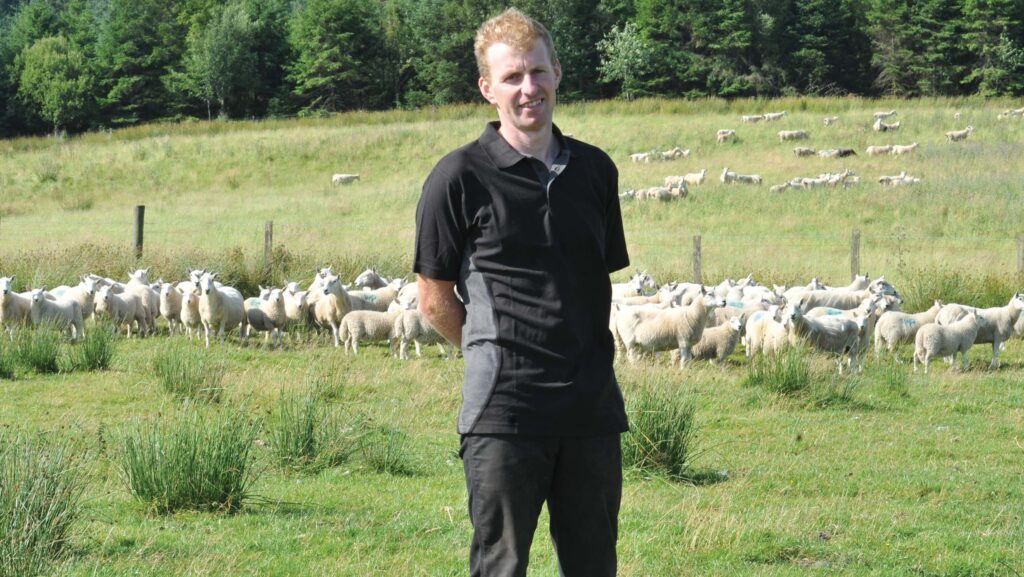
Carwyn Pugh © Debbie James
- 162ha farmed
- Finished lambs sold direct to Kepak at Merthyr Tydfil
- Yearling rams sold at the annual Brecknock Hill Cheviot Society Sale at Sennybridge
- 30 Limousin-cross and British Blue-cross suckler cows
- 30 dairy-beef cattle reared on ABP Gamechanger scheme to supply Sainsbury’s Taste the Difference brand
- Grazing rights for 1,400 sheep on the Great Forest commons
Improvements made since the first progeny were born in 2021 are reflected in the latest datasets.
These show muscle depth has increased by 0.42mm and weight at backfat scanning by 0.5kg, and lambs going for slaughter at an average liveweight of 44.5kg – up to 0.5kg heavier. This translates into an uplift in profit of £3.46 a ewe.
Ram power
Gains that are being made at the top end are filtering down through the wider flock at Caerllwyn.
This is being achieved by using rams produced by the nucleus flock to sire the unrecorded stock to lift performance, but with unrecorded rams used also to maintain type.
“Our type of ewe is very well suited to the hill land that we graze and to the farm itself, and we don’t want to move away from that. We know this sheep works for us and our system,” says Carwyn Pugh.
“If we could see that our breeding decisions were shifting type away from the kind of ewe that works here, we would need to make some adjustment.
“But because we are continually monitoring, we can see that we still have an animal that does well on our land and in this environment.
“We are also gaining financially by improving our sheep through recording.”
Rams are bought at the annual Brecknock Hill Cheviot Society sale at Sennybridge.
The Pughs joined the Hybu Cig Cymru (HCC) Hill Ram Scheme in 2020, using the Hill Index to combine maternal and carcass traits.
That scheme later became part of the Farming Connect Welsh Sheep Genetics Programme.
Now in its third iteration, as the Welsh Sheep Genetic Hill Scheme as of spring 2026, oversight has reverted to HCC.
Better ewe performance
Carwyn says the reason this initiative was instigated was to encourage more hill producers to record – the idea was that those farmers could then sell performance recorded rams to others to improve hill breeds in general.
But it wasn’t necessarily the reason the flock at Caerllwyn was enlisted in the scheme, he points out.
“For us, it was about gaining a greater understanding of what we were doing and to help improve our ewe performance in general,” he says.
This can be more challenging in hill ewes, Carwyn suggests, as there are many different types of Cheviot and Welsh ewes.
“This makes it difficult to select off figures – farmers tend to base their breeding decisions in these breeds more on type.”
Single-sire mating
Lambing at Caerllwyn gets under way from 25 March, with twin-bearing ewes lambed indoors and singles outdoors.
The business maximises what it can from grazed grass and grows swedes as winter feed for the pregnant singles.
At housing (two weeks before lambing), twins receive an 18% protein concentrate feed at a rate of 0.5kg/day.
Lambs from the performance-recorded flock are tagged at birth using electronic identification (EID).
The Pughs initially used the tissue sampling unit (TSU) system to record parentage.
This technology allows larger numbers of sheep to be easily recorded in their natural environment, as DNA analysis is matched to that of the ewes and allows parentage to be assigned.
When financial support for TSU started to taper, from being fully funded to farmers being asked to contribute £8/sample (half the total cost), they took a different approach.
“Without funding, it wasn’t economically viable for us to continue with DNA testing.
“It is a lot of money if you are not selling a lot of rams,” says Carwyn, who sells up to 10 rams a year.
Instead, they reverted to single-sire mating to allow accurate and easier identification of a lamb’s parentage – Carwyn’s grandfather had performance recorded in the 1980s and 1990s, and this is the system he’d used. There are advantages to single siring mating, says Carwyn.
“We can match the ram to the group of ewes to best suit the traits we want to improve.”
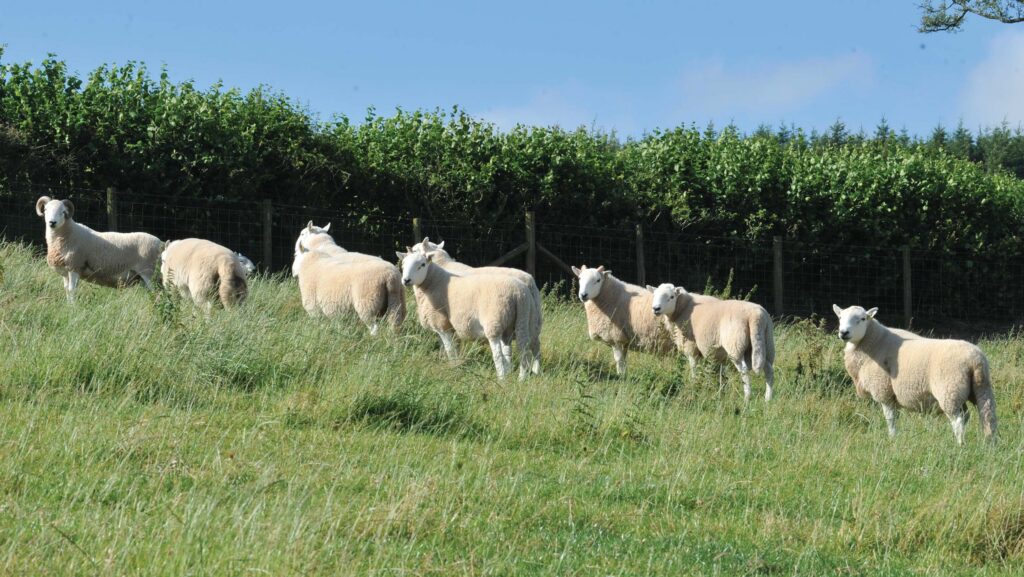
Brecknock Cheviot tups © Debbie James
Management for finishing lambs
Later-finishing lambs are creep fed in late autumn when grass growth starts to drop off.
“The winters here are very long and wet, so it is more effective to creep feed before we get to a point where we have to house the lambs or sell them as stores.
“We want to get everything sold before Christmas,” he explains.
Performance recording has also helped with earlier finishing – a KPI for maintaining cost of production.
“Because we have been able to identify the better animals, finishing takes much less work, lambs are easier fleshed and quicker to finish,” says Carwyn.
Using estimated breeding values (EBVs), which indicate exactly where an animal ranks within the breed for specific traits of economic importance, can play an important role in flock profitability.
Although Carwyn only sells a small number of rams, he says having those EBVs shows potential customers how his rams compare with the rest of the breed, helping them make better breeding decisions.
It is a much more reliable way to assess the potential of sheep than visual appearance alone, although they still need to look the type.
Informed culling decisions
Since recording, the flock has a more even spread of performance as the data has been used to inform culling decisions.
This has given them a greater confidence to remove poorer-performing animals.
“We have been able to cull ewes that aren’t performing, because the data is not just about seeing the gains in our best ewes, it’s about getting rid of the bottom end as well,” says Carwyn.
“We are culling harder and culling on more information, not just on what we can see.
“It means we have a more even flock, not the extremes of some exceptional animals and some that are very poor.”
The above-average ewes in the nucleus flock produce 5kg more lamb a year than the poorer performers.
Although the Welsh Sheep Genetic Hill Scheme provides financial support for performance recording, the labour involved is a direct cost to the business.
But the dividends it delivers has significant financial benefits too, says Carwyn.
“We now have a clear picture of how individual ewes are performing, not just the flock overall.”