

How running two flocks helps farm optimise lamb market potential
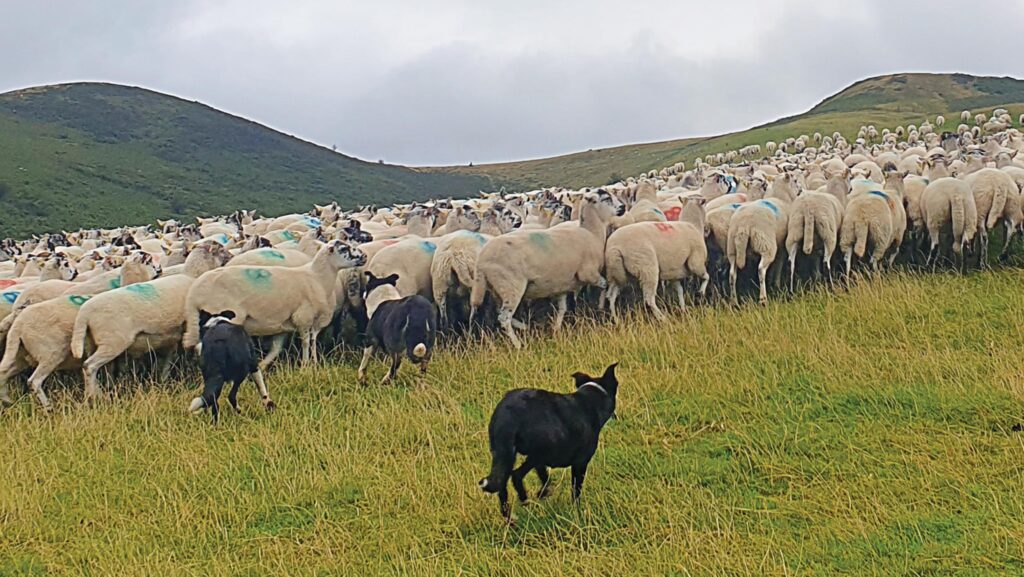 © Neil Davies
 A Powys sheep farmer is maximising his flock’s potential by working with the natural landscape and running two distinct production systems tailored to different markets.
Neil Davies runs 3,500 Epynt Hardy Speckled ewes at Cefnllan, Llangammarch Wells, just north of the Brecon Beacons.
To maximise output and resilience, 2,500 ewes are in a hill-based system producing smaller lambs for export.
The remaining 1,000 are on lower ground, producing heavier, premium lambs for Sainsbury’s Taste the Difference range.
See also: More lambs hit carcass spec for information exchange group
Farm facts
Cefnllan, Llangammarch Wells, Powys
- 600ha common land and 550ha lowland grazing
- 3,500 Epynt Hardy Speckled ewes, sired by Epynt Hardy Speckled or Texel rams
- Flock replacements bred on hill ground
- Finished lambs sold to Dunbia
- Outdoor lambing for six weeks from mid-March
- 40ha stubble turnips
- 400 Angus dairy-beef cattle sold as heavy stores
- New dairy-beef calf-rearing unit, rearing four blocks of 140 calves a year for 12-14 weeks
The hefted hill flock grazes a military training range and is outwintered on the Epynt, a mountain that rises to 440m above sea level.
Conditions at this altitude are suitable only for rearing single lambs, says Neil, so, after scanning, ewes carrying twins are brought down to lower ground.
After two lambing seasons, hill ewes are drafted to join the 1,000-strong lowland flock and are crossed with a Texel tup to produce premium lambs.
Scanning percentage for the hill flock averages 110%, while the lowland flock scans at 130%.
Hill ewes are fed 100g of cake/day through the winter until lambing concludes at the end of April.
This helps maintain ewe condition and is used as a management tool to ensure that sheep maintain their heft.
Low-input hill flock
The hill flock is gathered again in August, when lambs are weaned and moved to lower grassland.
They reach finishing weight in about 10 weeks – typically 32-36kg liveweight.
They kill out at 12-14kg, with an average O3L grade.
Carcasses are exported, and payment is made at a flat rate on a kg basis.
Prices for these small lambs have been strong, says Neil.
“In autumn 2025, they ranged from £6.50 to £7/kg – similar to prices paid for the heavier premium lambs.”
All lambs in this system are sold by the end of October regardless of weight, he adds.
Twin lambs from the younger hill ewes, which have joined the lower ground flock, run as one group.
While they can be a bit smaller, he says they usually catch up on the better grazing ground.
The hill ewes are ideally suited to the challenging environment.
“We could easily breed bigger sheep to go up there, but then you’re into higher costs.
And the sheep won’t live up there over winter,” he points out.
Instead, the focus is on maintaining a hardy ewe that can withstand harsh conditions and still rear a lamb that is acceptable to processors.
“As long as Dunbia can provide a market for these smaller lambs, it means we can keep the sheep on the hills,” he says.
Because input costs are relatively low, these lambs are often more profitable, despite their small size, Neil explains.
The hill system relies on hardy genetics, simple infrastructure and carefully managed supplementary feeding rather than intensive finishing.

Neil Davies © NFU Cymru
Higher-input lowland flock
Ewes joining the lowland flock come off the hill in October and strip graze the root crop from early December until mid-March.
At weaning, their lambs graze new grass-clover leys, plus creep feed, and are sold at about 40kg liveweight with a killing-out weight of 15.5-19kg.
Most meet the desired R3L specification, with some reaching a U grade.
Lambs are weighed fortnightly to monitor growth rates and drawn from mid-June.
Texel rams deliver a lamb carcass that meets specification, even at moderate weights, says Neil.
“A Texel lamb always comes out quite a nice lamb.
“Even if he’s 34kg, he’s probably still quite a tidy, square sort of lamb that will meet the spec Sainsbury’s wants.”
However, this system carries higher input costs than the hill flock.
“You’re relying on quantity and quality of grass, as well as the root crop you’re growing to feed those animals, to succeed.
“That comes at a cost, whether you’re renting or own the land.
“To be honest, considering input, the lambs from the hill flock are more profitable as their inputs are lower,” he says.
Target market
For Neil, the starting point for any producer is knowing what lamb market they are targeting and what their land and system can realistically support.
On harsher hill ground, he says, the priority is a small, hardy ewe rearing one lamb reliably.
In higher-cost, lowland systems, the focus is on higher classification grades.
“Pushing a higher grade here is worth it, and it generates a bonus too, which you will need with higher input costs,” he says.
The key is aligning market specification with land type, cost structure and practical management.
On Neil’s farm, that means using the hills to produce smaller lambs efficiently, while using better ground and Texel genetics to hit premium retail slots where inputs justify the bonus.
This, he says, means they benefit from six months of lamb sales in the year.
Understand your system to meet the market it can supply
Paul Edwards, managing director at Dunbia, says there is demand for various lamb carcasses, but producers need to know which markets their stock are best suited for to remain profitable.
Lighter lambs will thrive on hill ground, and because they are born outdoors, input costs are lower.
Lowland lambs will take more to finish but also command a higher price, he explains.
Paul outlines the range of markets for UK lamb:
- Retail market (UK) Seeks medium, consistent lambs (15-22kg), ideally graded 3L or 3H. The retail segment values uniformity in size and quality.
- Restaurant and catering trade Demands heavier, thicker lambs (more than 20kg, sometimes up to 30kg). These markets want larger racks for presentation and often require a lower price/kg as weight increases.
- Southern European market (Spain, Italy, Portugal) Prefers small, lean lambs (8-12kg). These are not over-fat and are marketed on specific days.
- Wider export markets (US, Canada, Middle East, and potentially India and Africa) Require various lamb types depending on the region’s preferences, ranging from light to heavy lambs.
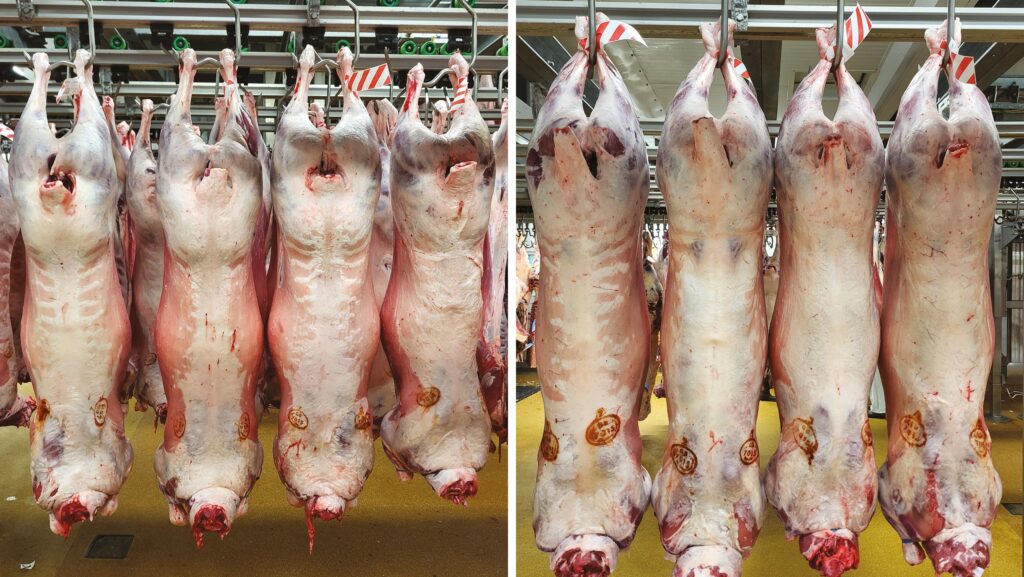
UK and northern Europe cutting lambs (left) and southern Europe and UK small lambs (right)
He encourages farmers to know their main market and finish lambs accordingly.
This means adapting breed and finishing systems to match customer specifications, whether for lighter, hill-bred lambs or heavier, lowland-finished lambs.
Farmers should also follow guidance on scheduling and presentation to ensure they meet the requirements for maximum value and minimal deductions.
Across all markets, cleanliness is vital: animals must be well presented, sheared/clipped as required, and free of excessive dirt or contamination to reduce trimming and weight loss.
For producers like Neil Davies, the message is clear: understand your land, your system and your market, then align specification and management so that both hill and lowland flocks are producing lambs that fit a clearly defined, profitable outlet.