

How targeted selected treatment halved cost of worming lambs
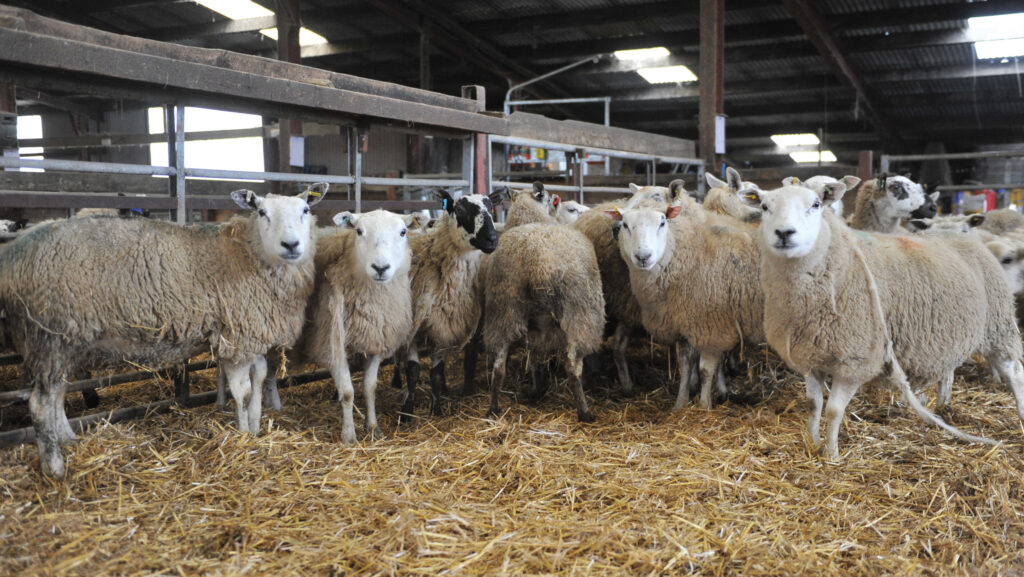 Chris Davies' pregnant ewes © Debbie James
 Treating only underperforming lambs for worm burdens has seen a Welsh sheep farm cut its wormer use by more than 45% while maintaining weights and performance.
Montgomeryshire farmers Glyn and Chris Davies introduced targeted selective treatment (TST) into their system at Awel y Grug, Cefn Coch.
This parasite management approach involves administering treatment solely to lambs failing to meet specific performance benchmarks, primarily daily liveweight gain (DLWG).
Historically, they would have routinely treated all lambs within the affected group if intervention was deemed necessary.
See also: How to use and go beyond worm egg counts in sheep
The Moredun TST protocol was trialled at the farm as part of a Farming Connect Our Farms project.
Independent livestock adviser Matt Blyth, who provided support during the year-long project, alongside sheep consultant Kate Phillips, says that in a TST system, performance targets are based on the minimum DLWG a lamb should be able to achieve between two weighing points.
These targets take into account previous recorded weights, the quality of feed and its availability, feed conversion ratios, weather conditions at that time, and which stage the lambs are at in their production cycle.
Farm facts
Awel y Grug, Cefn Coch, Montgomeryshire
- 129ha owned land farmed
- Land rising to 366m
- Rotational grazing
- 800 Welsh Mules, Texel-cross and Nelson-type Welsh ewes
- Lambs sold through Welshpool livestock market
Baseline for wormer treatment
Matt says the expectation is that when those conditions allow, lambs should exceed the minimum growth rate targets, but even those that only just reach it are unlikely to need a wormer drench.
“Research has shown that lambs consistently achieving at least the minimum target are generally coping with their parasite burden and do not require worm treatment at that time,” he explains.
“By identifying and treating animals that didn’t meet their target weight, Glyn and Chris saved around 52% of the cost of the drench they would normally use if they were blanket treating all animals in a group,” he says.
Lambs in the project’s control group were dosed four times on average; those animals weighed an average of 15.3kg at the start of the trial and 27kg at its conclusion.
In the TST group, doses averaged 2.2, with lambs weighing an average of 16kg initially and 28.4kg when the final weights were recorded.
Target and actual growth rates
Lambs were weighed every three to four weeks and their performance assessed against set growth targets.
Those that were on target or had exceeded it were not drenched.
“Even if there was a parasite burden, it was not significant enough to be limiting growth,” says Matt.
Lambs that failed to hit target weight were flagged for closer investigation, he adds.
“They were more likely to require treatment, as poor growth could have indicated a higher internal parasite burden that could have affected their performance.”
Other possible causes such as lameness, trace element deficiencies, external parasites, poor nutrition, and other health issues were also considered.
For these reasons, TST should not be used in isolation, Matt advises.
“Close collaboration with a veterinary surgeon or a livestock consultant is essential to correctly interpret performance data and understand what is happening within the wider farm system,” he says.
A few lambs were treated consecutively – three had to be treated every time they were weighed, which suggested there was an underlying problem.
These lambs might have been reared by a younger ewe, or their dam was suffering from mastitis or had rejected them, or the lambs may have had other health issues.
“If there had been a higher number of lambs that had to be treated every time, further investigation would have been required to understand why they were not able to meet the minimum target weight throughout the five weighing sessions,” says Matt.
Drench efficacy
During the project, drench efficacy was tested by routine faecal egg counting (FEC) using Fecpak.
This system monitors worm resistance and worm burden and should be used in conjunction with advice from a vet or other animal health professional, Matt recommends.
The timing of samples was dictated by the active ingredient in the specific drench, either seven days after treatment when the yellow wormer 2-LV was used, or 14 days after the clear wormer 3-Ml.
Cost savings are an obvious benefit of using less drench, while other positives are harder to quantify – reduced exposure to anthelmintics and environmental benefits among them.
The uncalculated costs are the labour and time diverted into weighing every animal.
Level of investment
One of the challenges at the start of the project was getting the technology working efficiently, and this required significant support and intervention, Matt says.
Another cost not factored into the savings and other benefits was the financial outlay for handling equipment, software and hardware.
While this equipment would have had additional uses on the farm, the capital investment was “a significant cost to a business”.
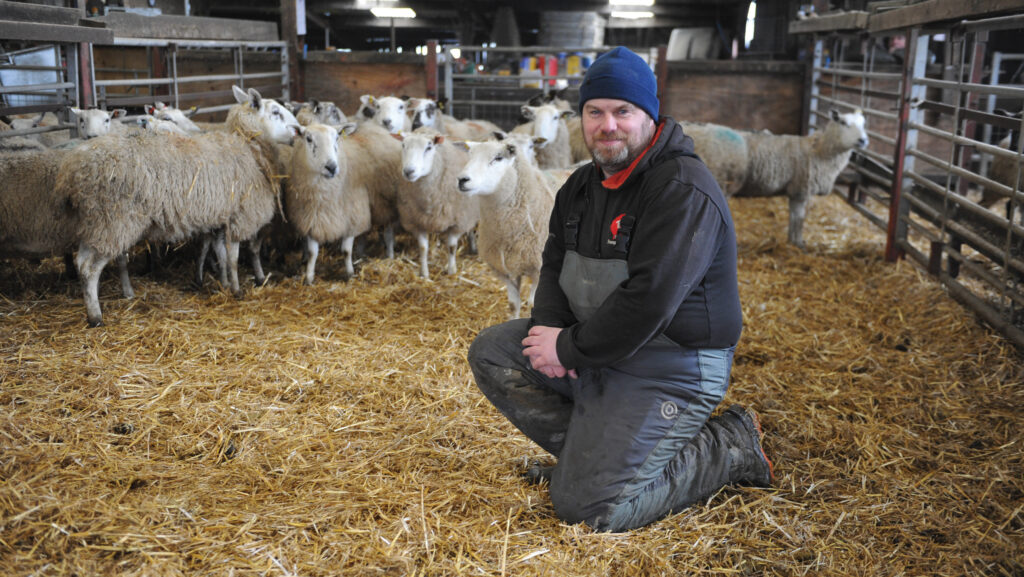
Chris Davies © Debbie James
Glyn and Chris opted to buy a high-spec setup, including a combi clamp, which allowed the process of implementing the TST policy and administering the correct dose for each lamb’s weight to be streamlined.
But for others considering TST, the system is not reliant on top-tier technology, according to Owain Pugh, Farming Connect red meat sector officer for mid-Wales, who supported the Davieses with the project.
“TST can be implemented by using entry-level weigh heads and EID [electronic identification] readers that are compatible with third-party apps, alongside a standard crate weigher,” he says.
“Drafting lambs into groups for treatment is a practical and budget-friendly approach that still allows for accurate recording and handling.”
For Glyn and Chris, the project has been so transformative that they say they will never revert to blanket-treating lambs.
“I plan to use TST for the rest of my farming life,” says Chris.
Establishing the exact weight of each lamb and administering a corresponding dose makes sense in many ways, he adds, recognising that guessing lamb weight by visual assessment is unreliable.
“We have had 52kg lambs recording FECs of 1,000 eggs/g but are gaining 350g/day off grass without drenching, so it looks as if they are building resilience.”
Long-term resilience
One of the reasons Chris was keen to trial TST is that the farm had developed a resistance to white drench, having been the only type of wormer used at Awel y Grug historically.
By avoiding blanket treatments, he hopes to prevent building resistance to other drenches.
TST has also seen Chris closely scrutinise the flock’s breeding, as some ewe lambs that were frequently drenched in 2025 only gained 50-60g/day.
“Lambs from those lines are never going to grow into big, strong ewes, so we don’t want those genetics in the flock,” he states.
TST is just one of the tools available to sheep farmers to help with parasite management.
If using, Matt recommends taking FECs and doing a FEC reduction test to confirm the anthelmintics used on farm are working efficiently.
Farmers should also monitor nematodirus forecasts, visually assess lambs, and get professional guidance from the farm vet or adviser, he adds.