

Benefits of analysing slurry as it’s being spread
 © Kerensa Cobbledick
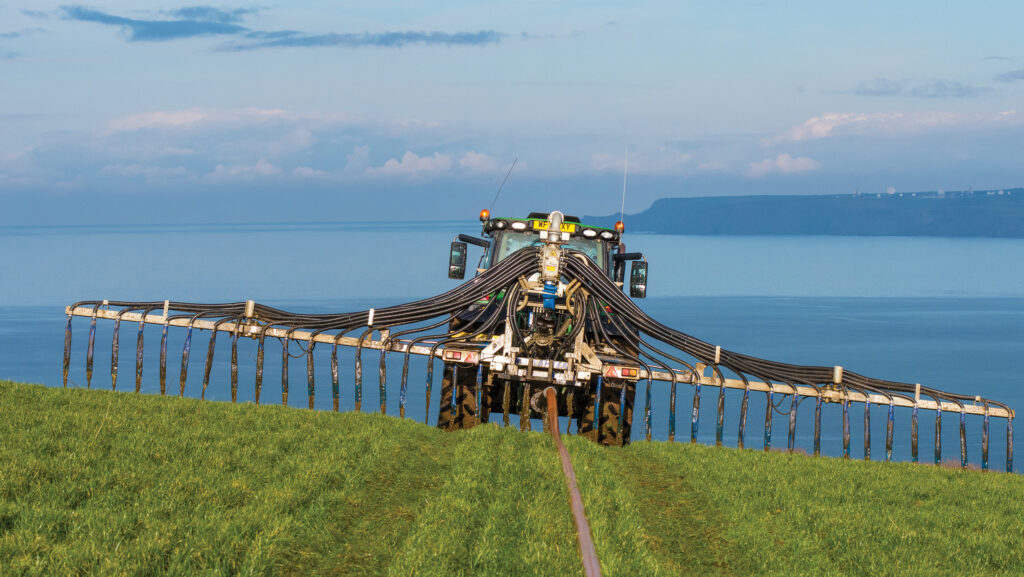
Comprehensive in-field nutrient analysis has turned dairy slurry from “a headache” into a valuable product for Norman Osborne, who farms at Tobarn Farm, near Jacobstow, Cornwall.
Establishing the nitrogen, potassium and phosphorus content in every load as it is spread, then tailoring application rates accordingly, has helped Norman reduce the amount of artificial fertiliser he buys.
See also: How slurry investment will slash dairy unit’s energy bills
Two lorry loads (at 29t each) of 34.5% nitrogen every year have been cut to just half a load this year because slurry is now classed as a valuable fertiliser for his grassland.
Farm Facts Tobarn Farm, Jacobstow, Cornwall
- 210-220 cows comprising Dairy Shorthorn, Holstein Friesians and Friesian crosses
- Calve 50 heifer replacements a year
- Farming 105ha grassland (owned) plus 49ha of maize and grazing (rented)
- Youngstock reared on straw yards
While Norman hasn’t costed it out (“I probably should”), he is convinced of the benefits.
“Silage yield might have dropped 0.5-1t/acre [1-2.5t/ha] but we save on fertiliser. Once I could get my brain around the tech [for analysis], it meant slurry became something useful, not just something to get rid of,” he says.
Cost-cutting incentive
Norman was one of contractor AJ Heywood and Sons’ earliest customers to have slurry analysed using its John Deere Manure Sensor System. Ever since, he has actively pursued a reduction in purchased inputs.
And because of these cost savings, Norman says he wouldn’t return to being without that knowledge of nutrient content.
The farm’s slurry from cow cubicles, bedded on sawdust (between housing in October and turnout in April), is stored in a 4,546cu m lagoon.
Norman sets the nitrogen rate for the silage fields, applying 125kg/ha in the first week of April, as soon as the heavy ground lets him travel.
Slurry is then applied by the contractor’s umbilical system as soon as first cut is taken in the first half of May, when Norman is sure that the grass plant can make use of the nutrients.
More slurry is spread after second cut in June, following third cut in August and sometimes after a fourth cut “if we’re lucky”.
© Kerensa Cobbledick
Impact of slurry consistency on nitrogen content
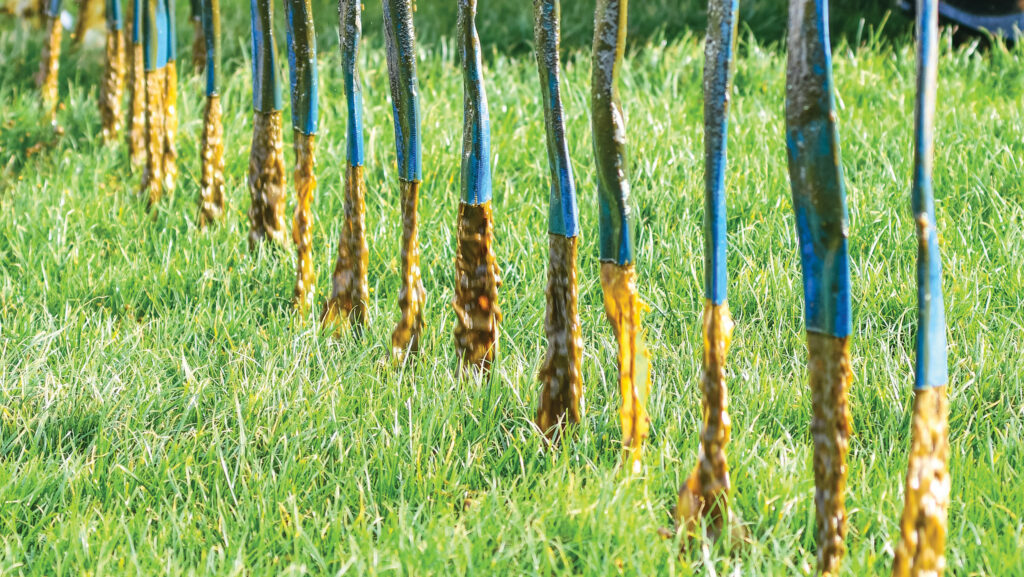
On average, the manure system applies 45cu m/ha of slurry across silage ground. This supplies 100kg N/ha, 30kg P/ha and 75kg K/ha.
However, depending on slurry consistency, which is affected by dilution from rainwater or how effectively the lagoon is stirred, the range in nitrogen content can be from 95-118kg.
The manure sensor alters the volume of slurry as it is being applied, according to the nutrient test results. This ensures the target rate of nitrogen is applied on every hectare.
Data for each field (including application maps), is downloaded to the contractor’s office database and JD operations centre, which Norman can link to via a mobile app or his computer.
“All of our P and K [indexes] were just under where they should be when we had the farm soil sampled in 2025, so we are applying 0.5t/acre [1t/ha] of lime every year to bring them up. Our next lorry load of fertiliser will contain sulphur as well,” he says.
Five years ago, Norman bought a trailing shoe, which allows him to spread slurry on grazing ground.
Dirty water is also tankered onto this grass, so it is grown solely using farm resources, saving money on bought inputs.
“This summer, the main cow block had a bit of a check, but kept growing. Even though we got drought, and we are normally a very wet farm with 50in [1,250mm] of rainfall, we were one of the greenest farms around,” adds Norman.
Finding the nutrient value in slurry
Real-time analysis at the rate of 4,000 times a second has taken nutrient planning to another level for contractor Kevin Heywood’s customers.
By establishing a farm’s specific nitrogen, phosphorus and potassium content in every cubic metre of cattle slurry handled, he says his business can now treat it like an artificial fertiliser.
“Before, slurry’s natural variation and settling in storage left nutrient applications to chance; John Deere’s Manure Sensor system allows us to know exactly what’s in every load of slurry spread,” says Kevin, of AJ Heywood and Sons, near Bude, Cornwall.
“This makes it a resource to be managed properly, not just disposed of – although there are still farmers who just want their pit emptied.
“Slurry goes where it’s needed at the right rate; there’s no over-application, no waste, and a cleaner audit trail for stewardship schemes.”
Instant and comprehensive analysis
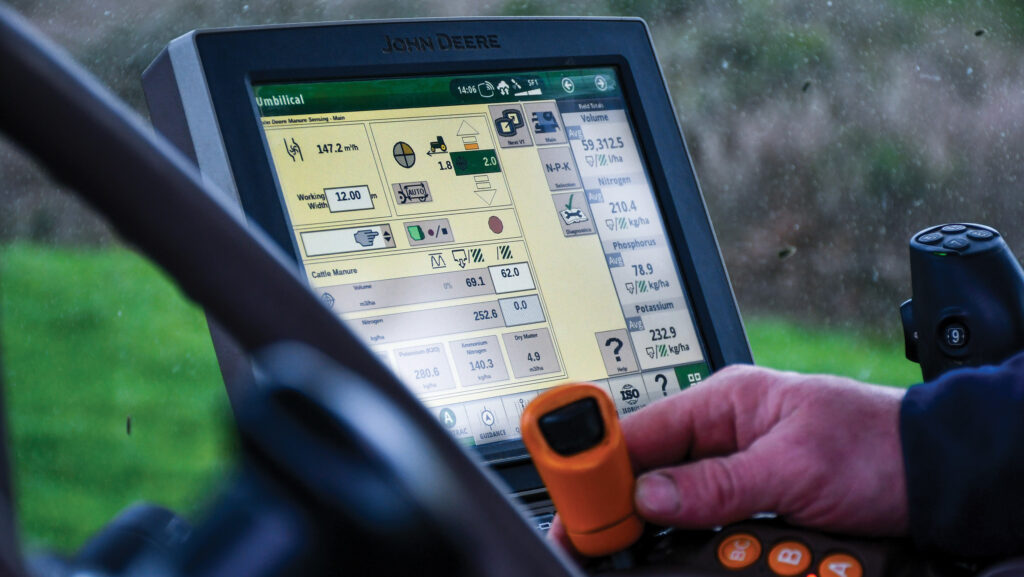
In-cab nutrient analysis and (below) the manure sensor alters forward speed to avoid over-application ©Kerensa Cobbledick
© Kerensa Cobbledick
In-cab technology avoids having to wait for laboratory results or juggle reagents in a farm test kit.
And application rates are no longer based on limited information from one sample: the sensor measures total nitrogen, ammonia nitrogen, phosphorus, potassium and dry matter on the move until a store or lagoon is empty.
Kevin points out that this is because even stirred slurry isn’t uniformly consistent – the analysis can be different at the start of emptying a store to that in the middle or at the end.
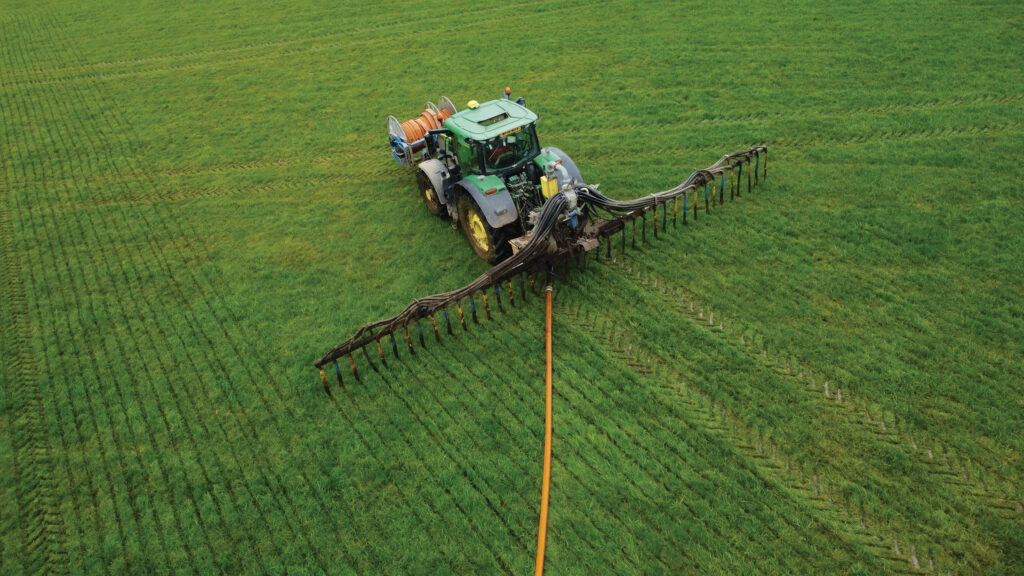
Hence the sensor automatically adjusts the tractor’s forward speed or flow rates to match target nutrient rates through the 12m dribble bar or shallow injector.
He says he realised within one season of using the software how slurry can alter its composition according to the time of year, such as during high amounts of rainfall or on hot days.
“Cow diets also influence the nutrients: if a farm is feeding maize, wholecrop and grass silage, compared with a farm on grass silage only. It was a bit of an eye opener about the variation in nutrients.
“I thought slurry was just slurry and have now realised how different it can be and also how differently it reacts [on spreading].”
Cost control
All field data collected by the sensor is sent through wireless transfer to the operations centre; and farmers have a link to their information for record keeping, compliance and such like, via mobile app or desktop.
Kevin thinks the big benefit has been for farmers to have more control over their granular fertiliser, particularly in a market that has seen very high prices and where product availability has become unreliable.
Farmers are saving money by not simply applying their standard historical amounts of fertiliser, he says.
Because they now know what nutrients have gone on in slurry, artificial fertiliser is applied as a top-up.
By also adjusting slurry volumes to suit crop requirements at the appropriate grass growth stage, the risk of bringing muck back in with the silage crop is reduced.
So far, Kevin can only analyse slurry or dirty water, as the system doesn’t yet have an option for farmyard manure.
However, he can match nutrient application rates to individual field soil samples and thinks this will be the next step for his customers who want to improve precision in applications.