

How farm’s slurry covers meet the challenge of a wet winter
© Debbie James
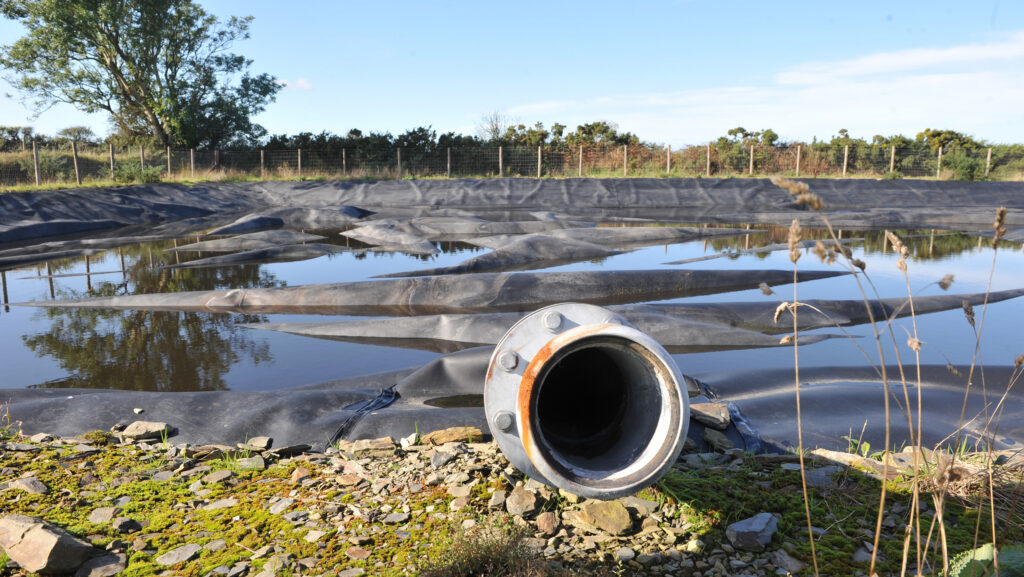
The value in topping a Pembrokeshire dairy farm’s 4,000 cu m (879,877-gallon) slurry lagoon with an impermeable cover was brought into focus last autumn during weeks of heavy rain.
A large volume of water had accumulated on top of the floating cover, but it was prevented from entering the lagoon by this barrier and therefore didn’t put pressure on winter storage or spreading requirements.
See also: Advice on investing in a cover for a slurry lagoon or tank
Farm facts
Trewilym Uchaf, Eglwyswrw, Pembrokeshire
- Farming 384ha including 71ha of winter barley, followed by a rape and swede mix as winter grazing for dry cows and youngstock
- Irish Holstein and Friesian herd
- 600-650kg average cow size
- 5,900 average milk yield at 4.8% butterfat and 3.7% protein
- Milk sold to Glanbia
- 14 February target turnout date
The cover at Trewilym Uchaf, Eglwyswrw, was fitted when the new lagoon was built in 2021. The total investment for the new build, together with roofing the collecting yard, came to £150,000.
Forty per cent of that cost was met by a Welsh Government nutrient management grant, awarded on condition that the store was fitted with an impermeable cover.
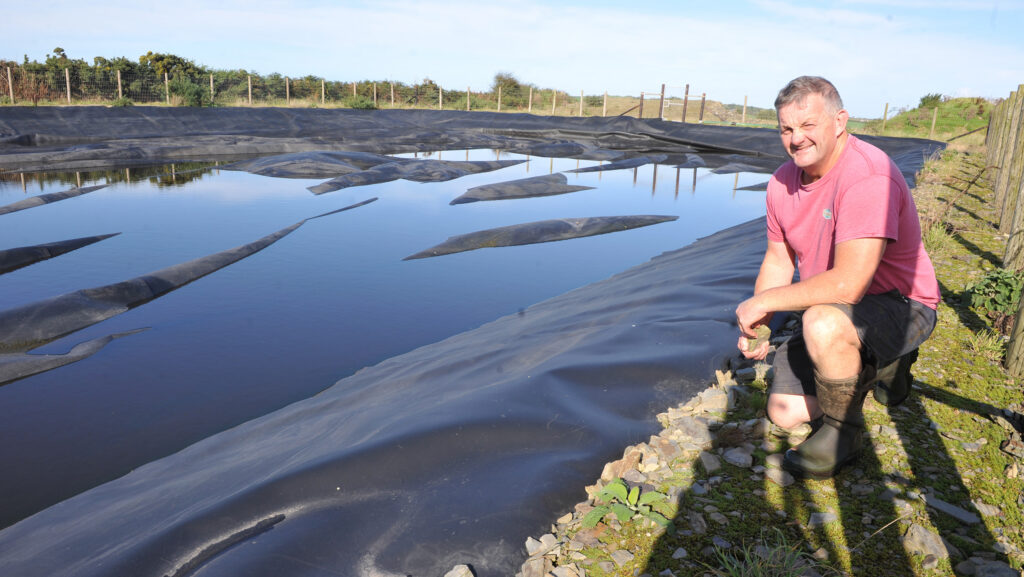
Simon Davies alongside floating slurry cover © Debbie James
Covers reduce storage requirement
It was an add-on the Davies family might not otherwise have included, but they have since seen the benefits it is delivering on storage management.
Rainfall averages 696mm (28”) between 1 October and 1 March. “Having that cover takes away the jeopardy of heavy rainfall,” says Simon Davies, the fourth generation to farm at Trewilym Uchaf.
“I reckon that without it, we would have needed to double the size of the lagoon simply because of the amount of rain we now get in the autumn and winter.”
Simon, his wife, Hilary, and their family produce milk from 250 autumn-calving cows and from 350 spring calvers on a second farm in the south of the county.
There is a 1,200 cu m (263,963-gallon) lagoon next to the cubicle housing, but that capacity was not sufficient to meet storage requirements when the Water Resources (Control of Agricultural Pollution) (Wales) Regulations 2021 were introduced.
A second lagoon was established on the site of a stone quarry some distance from the farmstead, but that is located centrally in a 81ha (200-acre) block of grassland used for grazing and making silage.
It had been partially excavated during quarrying activity, a key reason for choosing the site. “It also makes the slurry easier to manage during the growing season because it is right in the middle of the block,” adds Simon.
Lining lagoons
The site had its challenges, however, as the hard stone beneath the surface made digging difficult.
The soil isn’t clay, which meant the lagoon had to be lined to seal it; the liner and the cover together cost around £60,000. The cover was custom-made by a supplier in north Wales and has two outlet pipes: one for pumping slurry into the lagoon, the other to empty it.
Slurry is now pumped to the lagoon from the farmyard store around three times a year. As it fills, the cover rises; it then falls with the level of the slurry underneath it.
“We try to only pump dirty water there by not stirring the slurry,” Simon says. “It means there isn’t as much phosphorus and potassium in it but, because the ground we are spreading it on is for grazing and silage, we get less rejection from slurry contamination.”
Pumping surface water off covers
Ideally, he would have a slurry separator, yet can’t justify further investment of around £120,000 at the moment. A solar-powered water pump has been installed to remove rainwater that accumulates on top of the cover – this is done before the lagoon is emptied.
One downside to covering the lagoon is that the contents can’t be stirred although because the material in storage is so liquid in content, Simon says it isn’t such a big issue.
“We circulate the slurry before pumping it out, by attaching the Spreadwise pump to the outlet pipe, then fixing the lay-flat hose to the inlet pipe and pumping the slurry around to disturb it before spreading,” he explains.
Slurry cover specifications
Self-supporting and floating covers prevent rainwater from entering a lagoon, reducing the volume of slurry that needs to be stored and spread.
They can help secure planning consent for slurry storage when ammonia assessments in environmentally sensitive areas show mitigation is needed to prevent harmful emission levels.
Covers can also be a means of complying with emissions targets when farmers are expanding cow numbers if planning permission for a bigger store is refused, by taking rainfall out of the equation when calculating storage requirement.
There does need to be sufficient land to spread that slurry, however, in line with the permitted nitrogen loading. And there are sustainable drainage systems (SuDS) implications relating to the rainwater that falls onto the cover.
Farmers must demonstrate how they will control that rainwater, says specialist infrastructure adviser Keith Owen, of KeBeK.
“It is not as simple as pumping the water into the nearest ditch,” he says. “For most slurry store applications we now submit, planning authorities require information relating to SuDS, even when the lagoon is uncovered.”
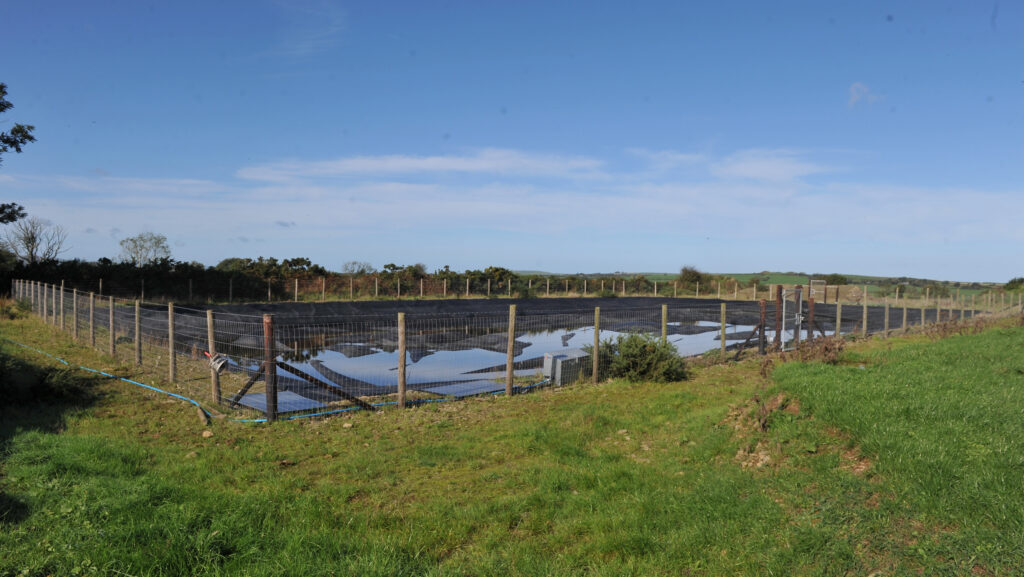
Slurry lagoon with floating slurry cover © Debbie James
Specific regulations
Whatever cover type, all must meet specific regulations, including a guarantee of a 20-year life without maintenance.
They must also be produced from a material designed for purpose.
Keith says it is a legal requirement that at least 14 days before the cover is used, the supplier must submit a document to the appropriate regulatory body (such as Natural Resources Wales) to confirm it has been built to standard and complies with pollution control regulations.
This must be signed off by a suitably qualified or experienced professional. That body must also be informed of the installation work 14 days before it begins.
A lagoon doesn’t need to be lined to have a cover fitted: it can be keyed into a trench around the top of the lagoon, Keith says.
The principal benefit of a cover is that it will reduce storage requirements and spreading costs.
Slurry is also more nutrient-rich because it hasn’t been diluted with rain, but that higher solids content can cause challenges when emptying the store.
“The slurry can’t be stirred which is why covers are more suitable for wet, dairy-type slurry, it has to have enough liquid content in it already to make it pumpable,” Keith explains, adding that some farms install a bubbler to agitate the slurry to prevent that issue but there are shortcomings with those too.
“Bubblers work really well, until they don’t. They need to be well maintained and are under pressure which can result in clogging over time.
“The only way of clear that blockage is to empty the store. If the cover is fixed another issue is how you get to the bubbler if repair is required.”
Wind damage is another risk: the build-up of methane pushes the cover up causing movement during high winds.
The combination of movement and the weight of the material can cause rips. Over time, sunlight can also create cracks and damage if the incorrect cover material is used.