

Why rearing organic poultry is good fit for dairy farm
 © Debbie James
 Growth in retail sales of organic poultrymeat could present new revenue opportunities for UK farmers.
In both volume and value, the market for organic food is increasing year on year, and poultry is a big driver of that growth, according to the Soil Association’s senior commercial manager, Clare Hadway Ball.
“While the whole organic market is in growth, the volume growth of organic poultry has been particularly impressive, at almost four times higher than the meat, fish and poultry category as a whole,” she says.
See also: New organic feed rules for 2026 confirmed by Defra
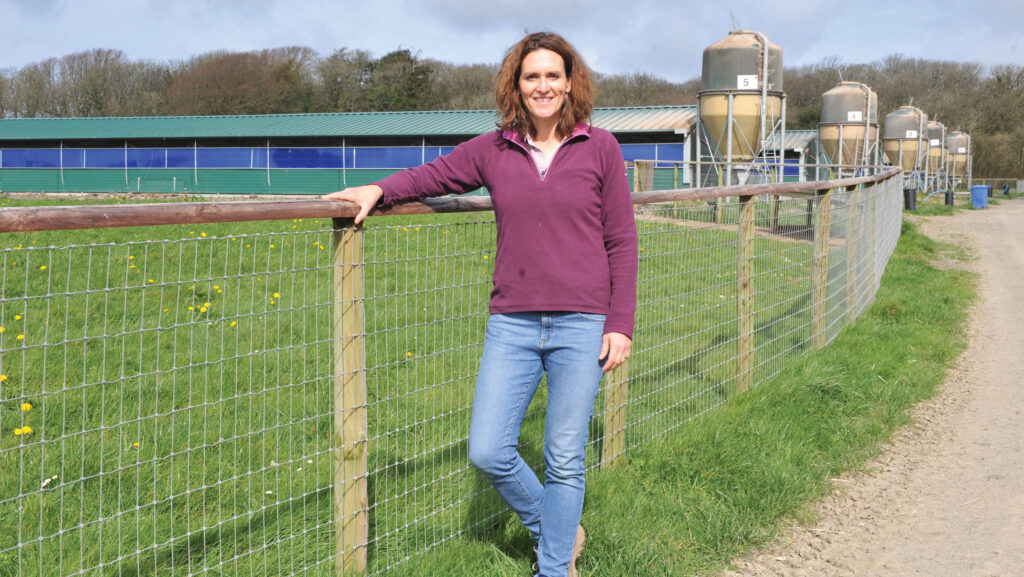
Louise Adams © Debbie James
Operators in this sector include Capestone Organic Poultry, one of Wales’s biggest poultry businesses, which produces both organic and free-range birds.
The business outsources some of its rearing through partnerships that generate new income streams for farmers like Jamie and Louise Adams, who rear 128,000 birds a year for Capestone.
Flexible working hours
While dairying is their core enterprise, they rear 16,000 birds at any one time on their farm near Haverfordwest, Pembrokeshire, where they run a herd of 500 split-block calving cows.
Poultrymeat offers an attractive alternative income, but a key reason for the couple’s decision to diversify was the flexibility it offered, compared with the tie of milking.
They have two sets of twins, aged nine and 11, and, for Louise, the work associated with the poultry fits with the school run.
“Dairy just didn’t work with me taking the children to after-school activities because that’s when I would be milking,” she says.
Although milk production at Rosepool Farm had been organic, Jamie and Louise now have a conventional dairying system.
However, when they made that transition to conventional, they retained organic certification and standards on a cluster of their poorer fields.
These are ideally suited for the poultry range and housing, allowing the business to capitalise on the higher income opportunity from organic.
Mobile poultry sheds
Planning consent was needed for the track leading from the farmyard to the poultry site, utilising an existing lane, but was not required for the housing, as these are mobile sheds.
The 10 houses each have a total floor space of 150sq m to meet the stocking rate requirement for organic birds, and a range area of 2.5sq m a bird, rather than the 1sq m a bird required for free-range systems.
Louise says the organic price needs to be higher to account for the lower stocking density.
Slow-growing birds
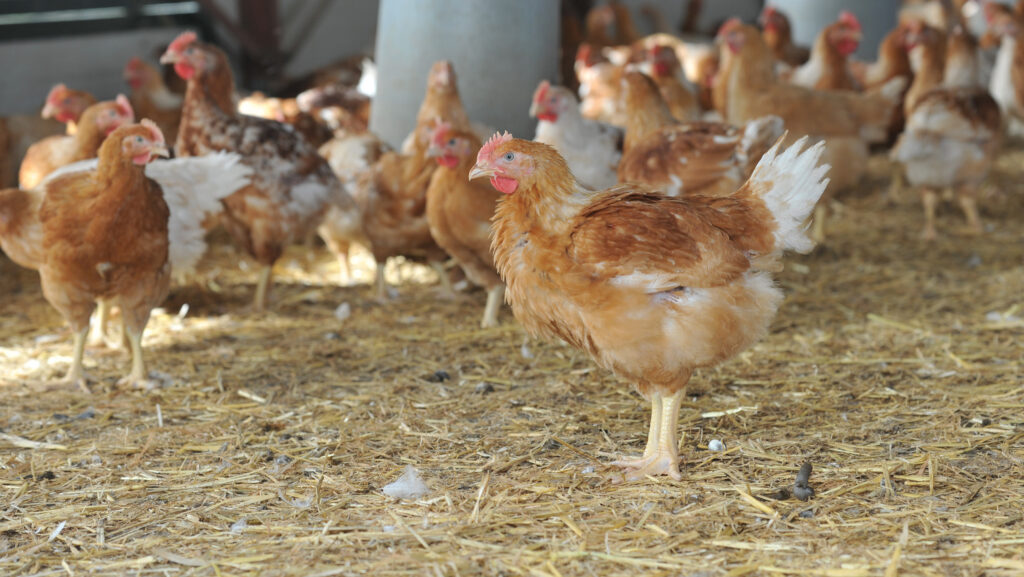
Organic space requirements for birds destined for meat are more generous than free-range standards © Debbie James
Birds are a Hubbard cross Colour Yield JA57, a slow-growing breed that fits well with the longer production cycle for organic, compared with free range.
This avoids birds getting too heavy towards the end of the cycle, protecting health and welfare.
They take delivery of the birds direct from Capestone’s brooding farms, and rear eight crops a year to an average liveweight of 2.5kg.
Feed is an organic compound supplied by Capestone, with heat-treated organic wheat added at the milling stage to slow down the growing phase.
Louise oversees the day-to-day management of the flocks.
While these can easily be managed by one person, she has occasional help to shut birds in at night and drafts in extra labour at turnaround.
Birds are checked up to three times a day. Investing in a straw bedder – a smaller machine than the standard to allow access to the mobile sheds – has eased the task of bedding down, one Louise had carried out manually for 18 months.
Regular income
Payments are received eight times a year after the birds leave the farm. “It is a bit like a milk cheque, getting that regular income after every batch,” says Louise.
Another big plus favouring poultry is that it is less reliant on the weather than some farming sectors, she adds.
“You don’t get the seasonal variability that we see on the dairy side of things – if we have a cold spring or a very dry summer, it can make a big difference to the milk cheque – but with poultry, the financial performance is relatively consistent.”
What is volatile is straw price and the volume used – since 2024, prices have doubled.
In addition, the farm uses more bedding when an avian influenza housing order is in place, preventing the birds from ranging and adding to the daily workload.
Expansion plans
For the Adamses, the outlook for organic poultrymeat is positive, so much so that they are adding a further five sheds and additional ranges, to increase bird numbers from 16,000 to 24,000 at any one time.
Louise says organic poultry can offer farm businesses a good income. “We have been able to utilise land that is not suitable for ploughing and get a really good income from that bit of land.”
Organic standards for poultrymeat production
For farmers considering organic poultrymeat production, the Soil Association is among the control bodies approved by Defra to certify organic poultry in the UK.
It has several standards members must comply with, including rules on stocking density and nutrition.
Housing density
Housing should be designed in a way that allows all birds to have easy access to the outdoor areas.
Maximum flock sizes apply to different types of poultry; for chickens destined for meat, the organic regulation’s upper limit is 4,800 chickens.
The Soil Association has its own upper limit of 1,000 chickens, but this is under review.
The total number of birds permitted is 10/sq m, and a maximum of 21kg liveweight/sq m.
There is a different maximum for mobile systems under 150sq m: the total number of birds permitted is 16/sq m, and a maximum 30kg liveweight/sq m.
However, to qualify as free-range organic, a maximum stocking rate of 27.5 kg liveweight/sq m applies.
Any other system must meet the total number of birds requirement of 10/sq m and 21kg/sq m.
From 2027, if the UK-EU sanitary and phytosanitary agreement is implemented, it is likely that the standard housing density requirement for all systems will be 21kg/sq m.
Access to land
Organic table birds in fixed housing systems should have an outside area of 4sq m a bird, or 2,500 birds a hectare.
For mobile housing, the standard is 2.5sq m a bird, or 4,000 birds a hectare.
The range area should be mostly covered with vegetation and provide sufficient shelter for birds.
While organic regulations state that a bird should range for at least one-third of its life, the Soil Association sets that standard at a minimum of two-thirds of a bird’s life.
Breeds
For a breed to be defined as slow growing, Defra states that growth potential should be no greater than 45g/day, or be a strain listed by the RSPCA as a welfare-approved free-range broiler breed.
Colour Yield cross Hubbard JA57 and Colour Yield cross Hubbard JA87 are commonly used.
Nutrition
Diets must be derived from organic feed ingredients. Birds must also be given access daily to appropriate roughage and fresh or dried forage.
If suitable organic protein ingredients are not available, for table birds under 30 weeks of age, up to 5% of their diet can come from non-organic protein ingredients to meet their specific dietary needs.