

On test: Extra ground clearance a boon for KGM Musso pickup
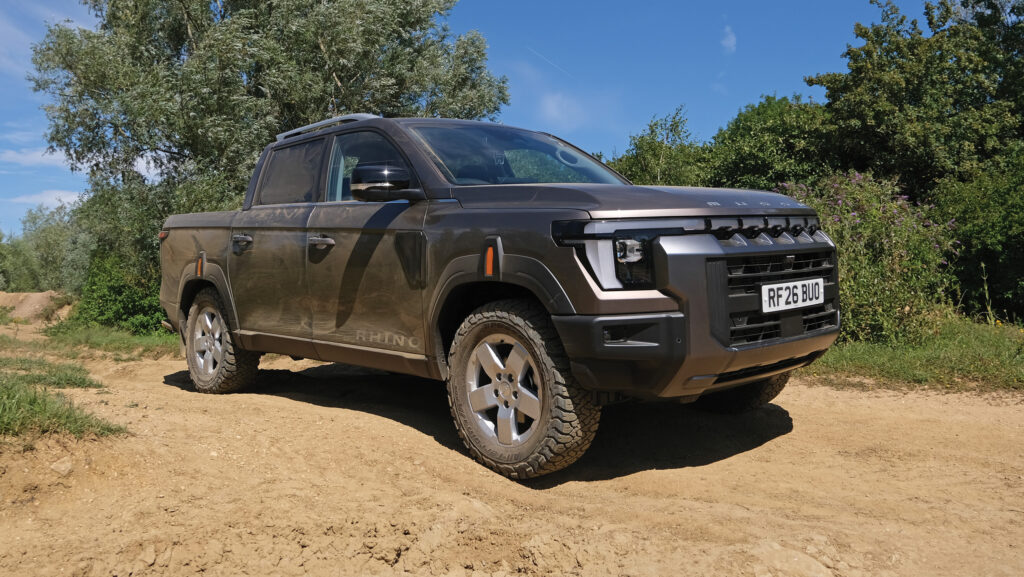 KGM Musso Rhino © James Andrews
 Fourteen years after bringing its first double-cab pickup to the UK, KGM (formerly SsangYong) is still one of the underdogs.
While Ford snaffles 44% of UK pickup sales, the South Korean maker has to settle for a modest single-digit percentage.
Yet the numbers belie the fact that the Musso is a decent vehicle.
Its 2.2-litre engine delivers 200hp – similar muscle to the Toyota Hilux and new Mitsubishi L200 – which drives the wheels via a six-speed transmission.
Plus, it can tow 3.5t while simultaneously carrying a 1,090kg payload.
See also: Pickup buyer’s guide 2026-27
KGM Musso Rhino specs
- Engine 2.2-litre four-cylinder
- Max power 200hp
- Max torque 400Nm
- Transmission Aisin six-speed auto
- Top speed 107mph
- Combined consumption 29.6mpg
- Wheelbase 3,100mm
- Ground clearance 245mm
- Kerb weight 2,196kg
- Max payload 1,090kg
- Towing capacity 3,500kg
- Price £38,995
Now, there’s an updated version. By introducing a few well-judged tweaks, KGM is hoping that it can persuade more buyers to look beyond the usual suspects.
Its hopes are currently pinned on just one plush Rhino model that sits above the existing Saracen range-topper.
However, lower trim levels will follow as stock of the previous generation peters out.
What’s changed on the outside?
The big one is the new “off-road stance”, which aims to make the truck considerably more adept at tackling rough terrain.
This sees ground clearance increase from 215mm to 245mm, with keener approach and departure angles reducing the chance of bumping its nose or scraping its tail.
There’s been some tinkering around the rear load bed, too.
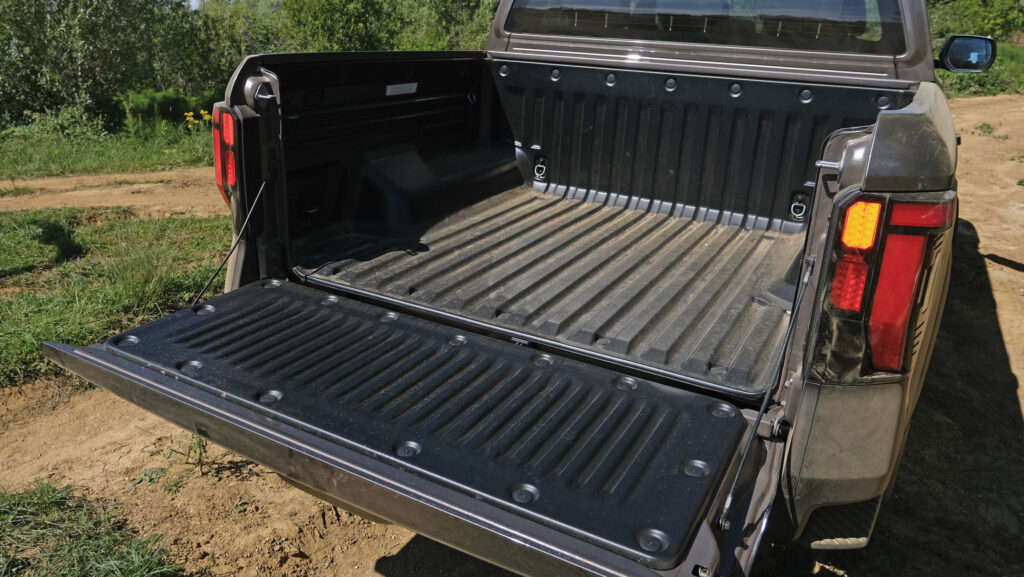
Musso Rhino load bed © James Andrews
A rear bumper step has been added to make access easier – similar to the one Ford fits to the Ranger – and there are now eight sturdy tie-down points for securing cargo.
Designers have also incorporated an LED deck light with switch and an electronic tailgate latch rather than the old manual type – all fairly minor stuff but, collectively, it makes the truck feel that bit more refined.
One perennial flaw with the Musso has been its short, tall-sided load bed – a consequence of it being based on the Rexton SUV, rather than having a dedicated pickup chassis.
Rear passengers get plenty of legroom, but it’s less useful for hauling bulky cargo. KGM’s solution is to offer the Rhino+.
Thanks to a slightly elongated wheelbase and extended rear overhang, this can accommodate a significantly larger 1,610mm-long bed.
How about the interior?
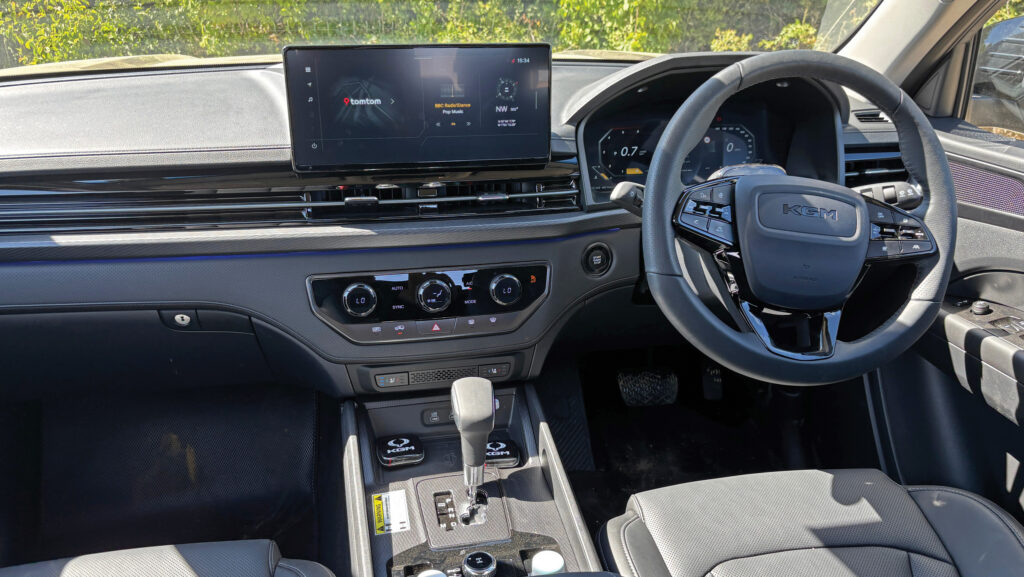
There’s been a notable refresh here, with a crisp 12.3in touchscreen perched at the top of the dash.
© James Andrews
It’s easy to use and comes with a decent TomTom satnav included, although most owners will probably use it for navigation through Apple CarPlay or Android Auto.
Both systems connected via cable in the old Musso, but the newcomer sports a slicker wireless setup, along with a wireless phone charging pad.
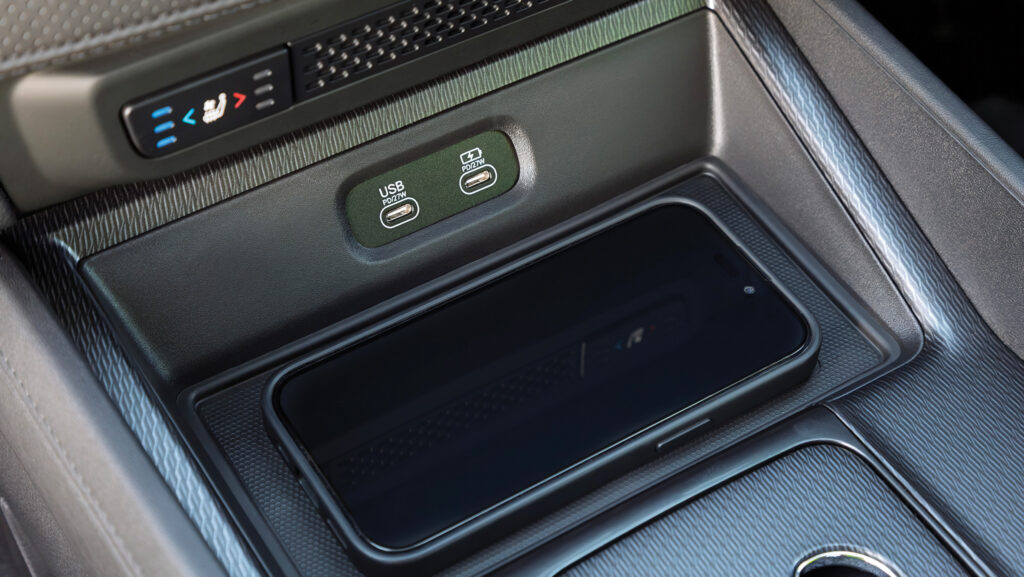
Wireless charging pad and cooled seat control © James Andrews
In addition, there’s a new 360deg camera system that makes it easy to see the vehicle’s extremities when manoeuvring in tight spaces.
Seats are clad in supple, perforated leather, with the added bonus of heating and ventilation – the latter being a serious treat in a heatwave.
Climate control switchgear has been simplified, with a trio of dials that are easy to grab and adjust without having to take eyes off the road for too long.
There’s adaptive cruise control too, and the usual suite of driver safety systems which, mercifully, are relatively easy to alter or disable.
How does it drive?
It’s a little sluggish off the mark, but once the 2.2-litre block gets wound up it romps along quite nicely.
And though the Aisin six-speed automatic gearbox has fewer ratios than more prestigious adversaries, it delivers surprisingly smooth acceleration.
Engineers have also managed to tune the rear coil suspension so that it remains supple, even when there’s no weight in the load bed.
Early Mussos jiggled like a jackhammer when empty, but thankfully the ride has been refined over the years.
Nevertheless, KGM still likes to dump a few bags of sand in the back of its test vehicles to take out any residual harshness.
What’s it like off road?
The increase in ride height makes the Rhino considerably more capable on undulating terrain and in deep ruts. There’s also less risk of clobbering fragile plastic trim.
Opting to wrap the 18in alloys with BFGoodrich KO3 all-terrains, as per our test car, gives it plenty of grip.
As for the drivetrain, this is the same setup as before with a high/low transfer case that offers switchable four-wheel drive.
With no centre differential or torque-on-demand system, there’s not the option of having four-wheel drive engaged on the road.
It’s no different to Toyota and Isuzu in this regard, though Ford, Mitsubishi and even GWM have more sophisticated setups.
Some electronic helpers are also on hand, one to assist when starting off up a hill and another to control speed when descending.
Plus, there’s a low front-mounted camera that gives a clear view of the terrain to help the driver dodge any obstacles in their path.
How about towing and payload?
Thanks to a generous 6,750kg gross train weight, the Musso Rhino is one of the most impressive packhorses out there.
While key competitors have to reduce their payload when towing 3.5t, the Korean can carry on hauling its maximum 1,090kg load.
These figures are better still on the Rhino+, which has a 6,900kg gross train weight, allowing it to carry a 1,200kg payload while pulling a 3.5t load.
Both models get a rear-view camera to take the guesswork out of hooking up, as well as a system to prevent trailers from swaying out of control.
FW verdict
There’s plenty to like about the Musso Rhino.
Performance is decent, the cabin is well equipped and it’s now geared up for more serious off-road excursions. Plus, it can carry heavier cargo than most of its rivals while towing.
The problem is that it isn’t that much cheaper than the big-name competition.
The new L200 Barbarian is just £1,000 more expensive, a top-spec Isuzu D-Max V-Cross is an extra £4,000 and a V6 Ford Ranger is yours for an additional £5,900.
Even though it matches some of the above for performance and it comes with a five-year, 100,000-mile warranty as standard, the cost savings might not be enough to tempt the masses away from the established brands.
It’s likely to remain a small player as a result, but for those who do fancy a break from the norm, it’s a solid contender.
Likes and gripes
Likes
- Solid drivetrain
- Well-appointed interior
- Improved ground clearance
Gripes
- Small load bed on regular model
- Sluggish off the mark
- Quite expensive
Commercial-spec Mussos
KGM has joined the commercial pickup bandwagon by stripping the back seats out of its current Musso Rebel and Saracen models.
In their place, there’s a flat, rubber-clad storage area, with a mesh bulkhead separating the driver and front passenger from their cargo.
Thanks to the conversion work, these trucks enjoy full commercial status for benefit in kind and capital allowances.
Prices for the lower-spec Rebel Commercial start at £32,980, with the plusher Saracen available from £36,780.