On test: Land Rover Defender Hard Top is comfortable all-rounder
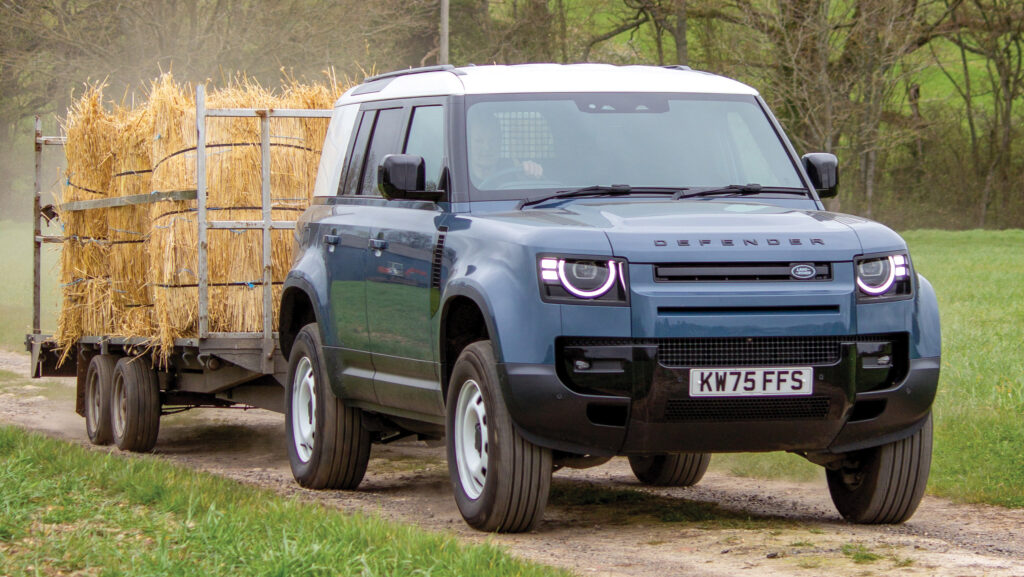 Land Rover Defender Hard Top © MAG/Oliver Mark
 Say what you like about the “new” Defender but the omnipresence of 90s, 110s and, to a lesser extent, 130s on UK roads suggests it has been a hit for the Land Rover business at large – if not entirely with the rural constituency.
Watering down the agricultural-ness of its dearly departed predecessor ridded it of the oddities that regular road-goers simply wouldn’t entertain, but which farmers found either beneficial or endearing.
As a result, it has and attracted a swathe of new buyers, many of whom seem keen on a blacked-out, urbanised trim – at least in this writer’s neck of the woods.
See also: On test: Subaru Forester e-Boxer 4×4 still a countryside favourite
Land Rover Defender 110 Hard Top S
- Engine 3-litre, six-cylinder Ingenium diesel
- Max power 249hp
- Max torque 570Nm
- Transmission Eight-speed auto
- 0-60mph 7.9sec
- Top speed 117mph
- Combined consumption 32.4mpg
- Towing capacity 3.5t
- Kerb weight 2.5t
- Turning circle 12.84m
- On the road price as tested £72,905
- Starting price £63,045 (inc VAT)
But Land Rover is still catering for those that prize load-carrying credentials above all else with its 90 and 110 Hard Top derivatives.
These commercial-spec SUVs are stripped of their rear seats and, in return, get an enlarged boot and favourable tax breaks over their passenger-bearing equivalents.
Other examples of this genre include Toyota’s recently renovated Land Cruiser and the Ineos Grenadier.
Both offer broadly similar performance at a near-identical price, but with traditional whack-it-and-weld-it ladder frames as opposed to the Defender’s aluminium monocoque.
And other manufacturers are now toiling away in the commercial vehicle mines.
KGM has been trying its luck with the Rexton, Skoda offers a fully electric Enyaq and Dacia continues to proffer its charmingly cheap Duster.
Aside from their secure and weatherproof load bay, the big attraction is cost: lower vehicle excise duty, reclaimable VAT and reduced benefit-in-kind tax for those running one as a company car.
Plus, the outlay can be written off against tax in the year of purchase, unlike double-cab pickups that are now capped at 6% per annum by those mean-spirited folk at HMRC.
Extra space
Hoick out the back seats, cover the rearside windows and fit a full-height bulkhead, and, voila, a van is born – at least in the eyes of the tax overlords.
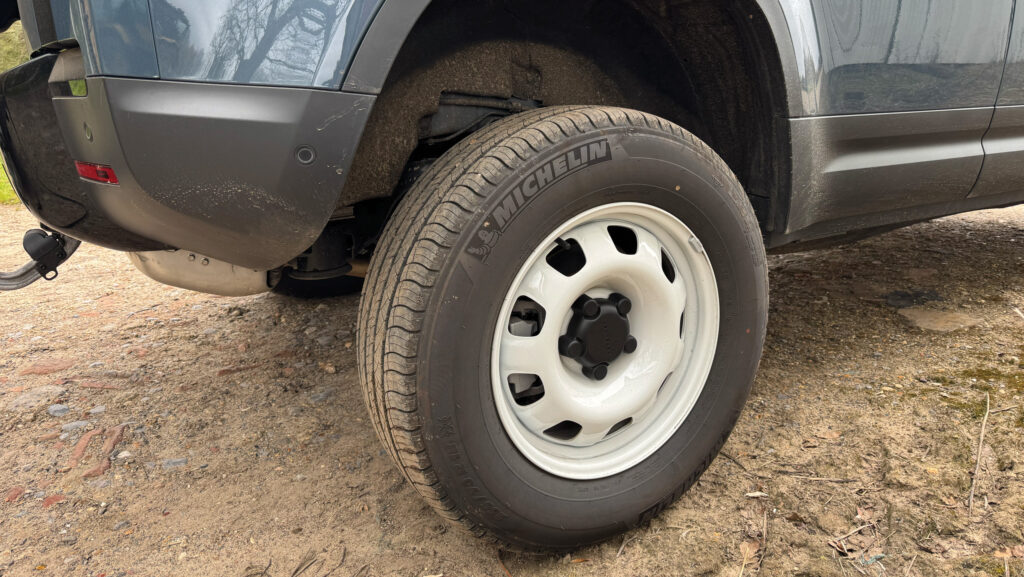
The Hard Top, seen here in reasonably understated dress (marshmallow-white steel wheels aside) is otherwise identical to the family wagon.
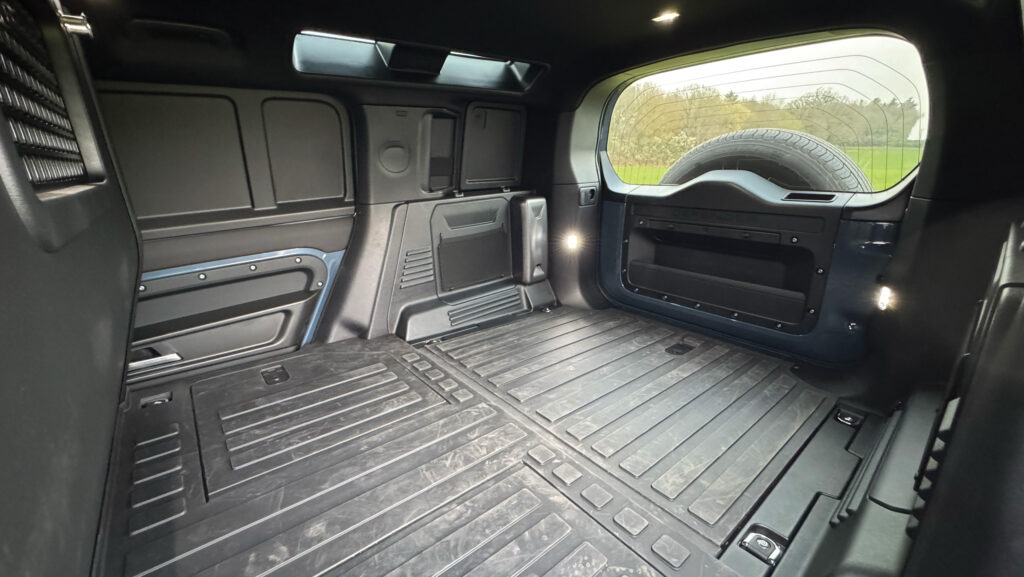
Cargo area © MAG/Oliver Mark
This is no box on wheels designed for occupation by three Monster drinkers surrounded by dog-eared paperwork and sun-yellowed copies of a red-top rag, so it certainly stretches the definition of a van.
The transformation takes place at Land Rover’s factory in Nitra, Slovakia.
It’s a simple, unremarkable fit-out in the style of a DIY campervan, with a plywood deck topped by thick, semi-loose rubber mats that allow any yukky stuff to be hosed off.
Unlike pickups, SUVs don’t have to carry more than a tonne to qualify as a commercial; the payload capacity is 800kg – about the same as a Land Cruiser and Grenadier – and the volume 2,059 litres (937mm high by 1.4m long and wide).
Access is via the side-hinged tailgate or rear doors, the latter retained but with plastic trim slapped over the glass as per HMRC diktat.
Cargo can be lashed to six floor-mounted loops, which are supplemented by an assortment of hooks, nets and can holders.
There’s also a shallow cubby under the floor and a full-width storage area with lockable doors in what was the footwell.
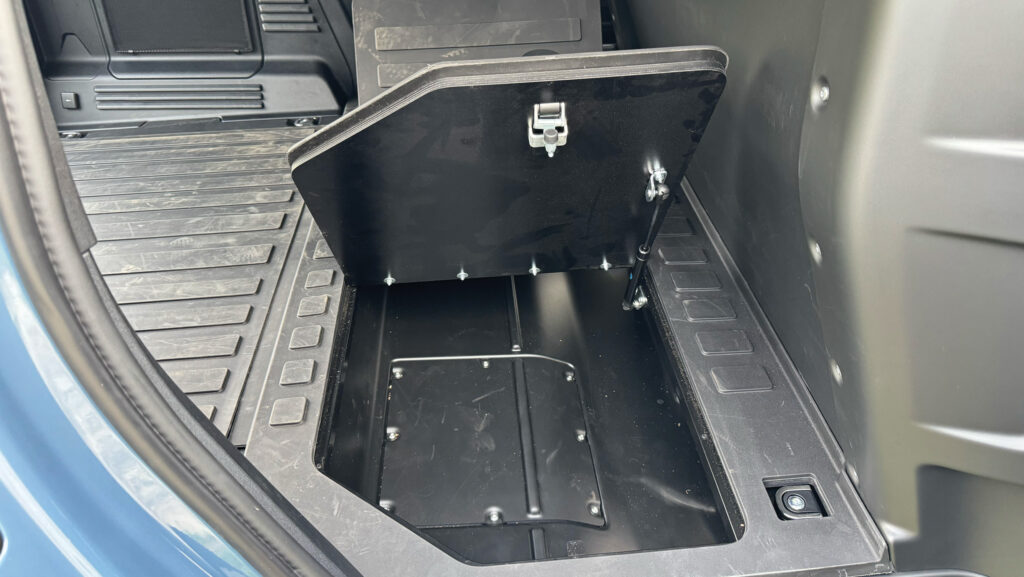
Storage in Land Rover Defender © MAG/Oliver Mark
Both keep valuables safe from prying eyes, though the latter is crying out for some compartment walls.
One downside of the conversion is that the fixed bulkhead prevents owners slotting in reasonably long lengths of timber.
And, though the air suspension can be lowered to improve boot access, it won’t drop enough to keep the polished rear bumper safe from scratches.
Any changes in the cab?
It’s largely as-you-were up front, albeit with Land Rover’s central “jump seat” – a seriously useful £815 addition for anyone taxiing kids or staff.
But first-class travel it is not, and they’ll have to be forgiving of the limited comfort they are afforded.
Given its proximity to the front console, those with the shortest legs and smallest feet are best suited.
And they may also have to assume the role of cup holder, given this facility disappears when the chunky centre console is folded up to form the rudimentary perch.
Consequently, storage space is a little disappointing but for the full-width dash sill for phones, pads and other small things.
The driver and their favourite passenger get decent leg room, especially compared with the confined footwell of an Ineos Grenadier, as well as an abundance of grab handles.
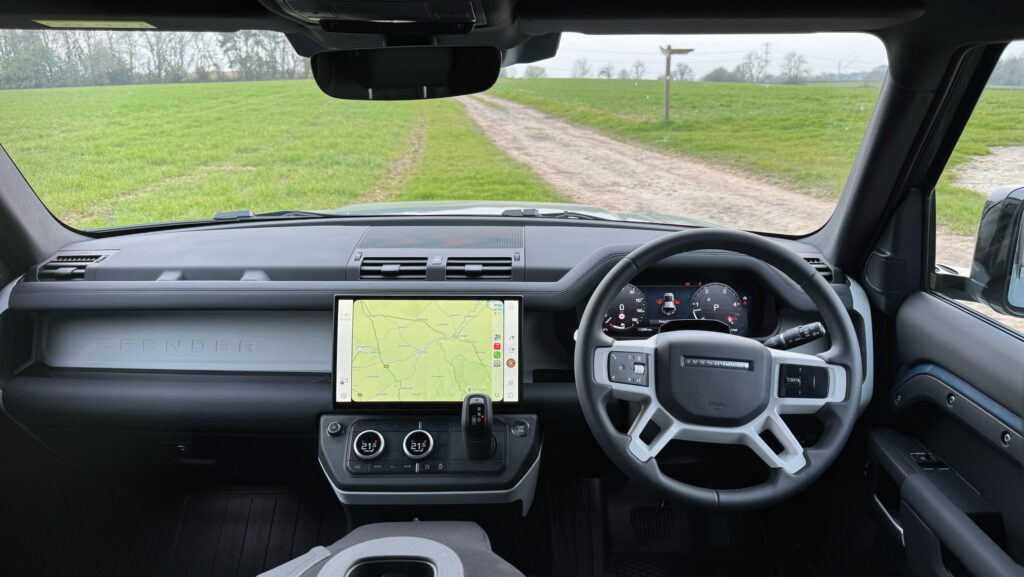
The Hard Top’s cab © MAG/Oliver Mark
Visibility is more challenging than that of the standard Defender due to the covered rear side windows and their subsequent impact on over-the-shoulder blind spots – as is the case in any commercial conversion. Wide-angle mirrors would help.
Land Rover’s ClearSight rear-view camera system might also be a sensible option to take up, as the jump seat blocks the mirror when it’s raised and the bulkhead trellis is liable to send the driver cross-eyed when it’s not.
There are already more cameras than one could shake a stick at, offering views from all angles: nose, towball and bird’s eye, plus a weird third-person, video game-style perspective from any quarter.
These are displayed through a big central touchscreen, powered by easy-to-use Pivi Pro software and supplemented by a cluster of switchgear in an otherwise pared-back interior.
One of the most useful physical controls is a button on the steering wheel that rams a gobstopper in the driver alert systems.
Selecting “low” anethetises the lane keeping assistant, driver attention monitor and speed limit warnings, leaving only forward collision warning cognisant.
One other point of note is that it’s understandably keen on security. Leave keys in the vacant car at your peril – it may lock itself.
Good to drive?
You bet. And that starts with the 3-litre, six-cylinder mild-hybrid turbodiesel.
Land Rover’s Ingenium engines generally don’t have a vintage reputation and need religious servicing but, fresh out the box, this D250 delivers on performance.
Open the throttle and it’ll crank out 249hp, maximum torque is spread across a useful 1,250-2,500rpm range, and 60mph comes in a rapid 7.9sec – three quicker than a comparatively ploddy Land Cruiser.
It’s more refined than that car’s Hilux-derived 2.8-litre four-cylinder too, purring like a contented cat at tickover and drifting to near silence as the rev dial settles on a motorway.
Expect up to 37mpg here, and more like 30mpg when tootling locally.
Even when under the governance of a heavy right boot, the eight-speed transmission remains impressively anonymous.
It is as quick witted as the steering is sharply tuned, while the optional electronically controlled air suspension and self-adjusting shock absorbers do an excellent job of managing body roll, softening jarring bumps and minimising rear-end jiggle.
Land Rover Defender suspension © MAG/Oliver Mark
Inflating the cushions also ups the wading depth to a Grenadier-beating 900mm.
Allied to this is a full-time four-wheel drive system through a central differential and an active locking rear diff that hunts feaverishly for grip.
Clever software will alter performance according to feedback from the drivetrain, or drivers can select their own Terrain Response settings and engage the twin-speed transfer box’s low range when required.
The 110’s 3m wheelbase and 2.5t weight – 500kg more than old-world Defenders – also makes it an assured towing truck.
FW verdict
Price aside, this car-cum-van is a compelling alternative to a pickup – and, for most buyers, will outperform other commercial-spec 4x4s on typical jobs of work.
It’s a comfortable tourer, tows well and is better mannered on the road than pretty much anything considered competition.
But it’s not as tough as a Land Cruiser or Grenadier and, like them, an expensive work vehicle.
Many will find a KGM or Dacia perfectly adequate and at least 20 grand cheaper.
Still, it’s the most economical way into a Defender, and having three seats may well be handy – or essential.
Likes and gripes
Likes
- Quiet and comfortable
- Great towing vehicle
- Handy third seat
Gripes
- Cab short of storage space
- Not as tough as a Land Cruiser…
- … And nowhere near as hammer- and spanner-friendly