

On test: Toyota Hilux gets better looks but same old drivetrain
 © MAG/Oliver Mark
 Two new Hilux double-cab pickups have joined the battery of Asian exports raining down on the UK.
The ninth generation of Toyota’s venerable stalwart includes four-cylinder diesel derivatives built in South Africa and, for the first time, a battery-electric version emanating from Thailand.
Their arrival is timely, with the firm under pressure to reassert its 54-year authority on the British market.
Not only must it contend with Ford’s V6 and hybrid Rangers – to which it has played second fiddle – but also the recently titivated Isuzu D-Max, KGM’s Musso and the lesser-spotted VW Amarok.
See also: On test: Ford ramps up Ranger pickup power with 281hp hybrid
And there is plenty of fresh meat to provide buyers with further thought food.
Chinese outfit Maxus is serving up diesel and electric models, albeit with limited success, and its compatriot GWM returned last year with its Poer300 for the cost-conscious.
The return of Mitsubishi’s once-popular L200 will also be earmarked as a threat at Toyota Towers, and there’s the hulking shadow of Chinese superpower BYD looming on the horizon.
Its Shark plug-in hybrid is set to arrive later this year intent on disruption.
Buyers haven’t had this much choice since the halcyon days of a decade ago.
Ironically, the incoming arsenal arrives in the face of a government-incited market malaise.
Its April 2025 decision to treat double-cab pickups as cars for benefit-in-kind tax purposes and cap capital allowance write-offs at 6% per annum butchered sales by 55% in the 12 months that followed.
What’s new?
© MAG/Oliver Mark
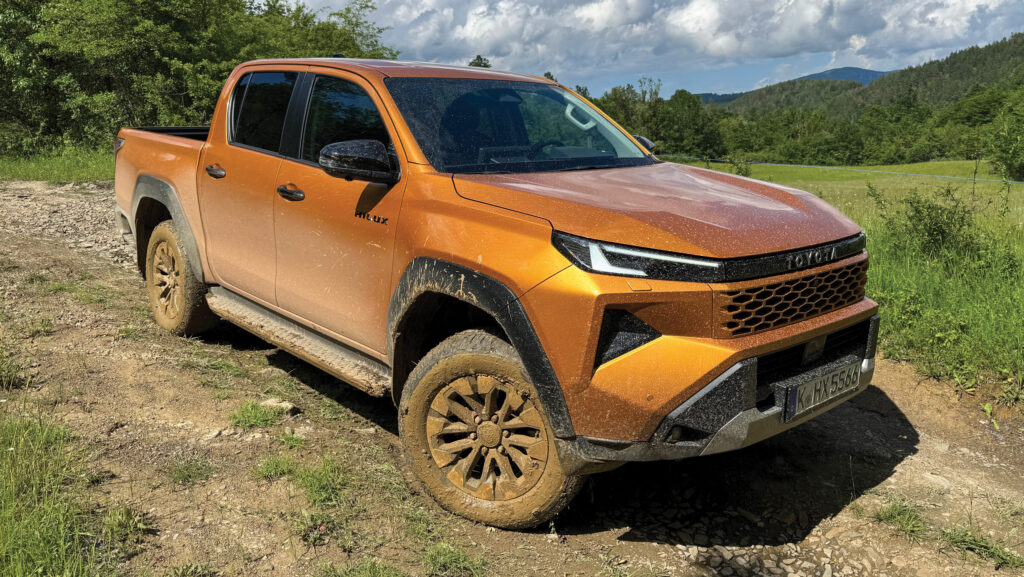
It’s all about aesthetics. The engine, mildly hybridised in 2025, has been left alone; the eighth gen’s six-speed auto is lodged in a noughties time warp; and there’s been no change to overall size.
Instead, Toyota’s R&D department has focused on injecting some long-lost style – both inside and out.
It treads a gratifying line between retro and modern, much of the legwork having already been done with the Land Cruiser, its body-on-frame stablemate.
The Hilux leads with a similar honeycomb grille and sheer vertical nose, though with squinting rather than square headlights bedded into chiselled front quarters.
© MAG/Oliver Mark
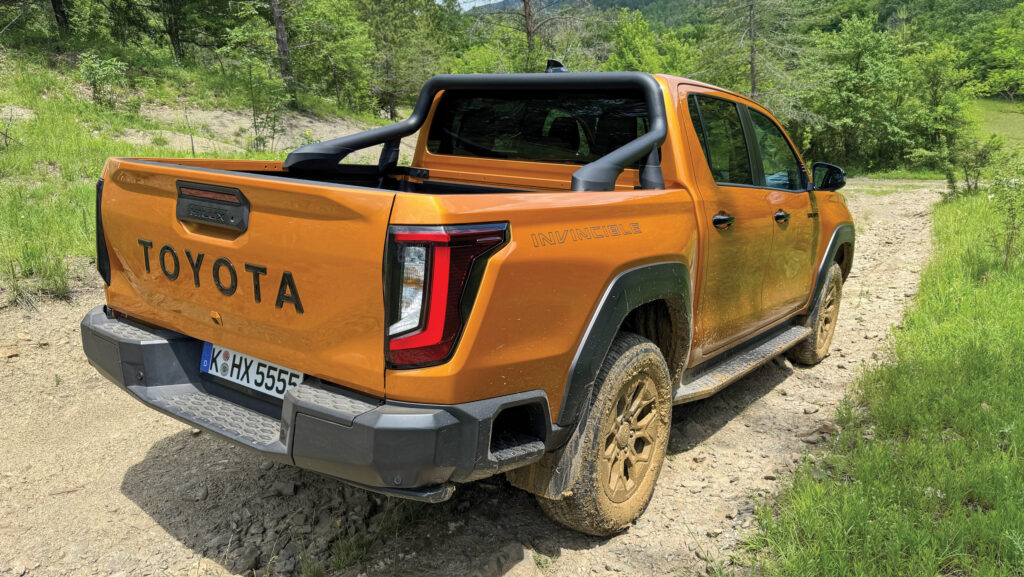
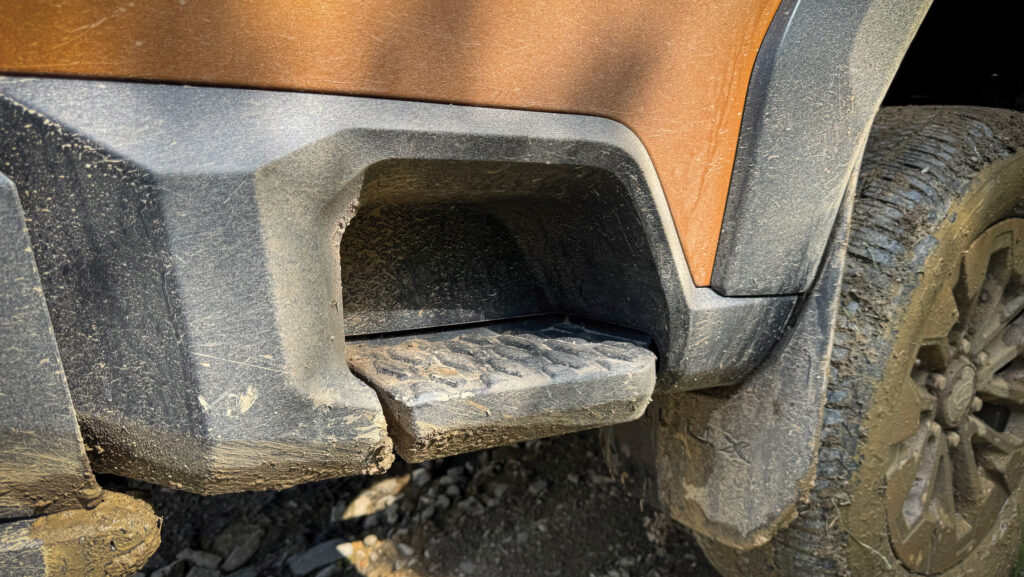
Bonnet bulges soften the straight lines but interrupt the view from the seat to the corners, and, at the back, Toyota has half-inched Ford’s idea of adding side and rear access steps to the load bed.
Toyota Hilux Diesel 48V Invincible X
- Engine 2.8-litre, four-cylinder diesel
- Power 204hp@3,400rpm
- Torque 500Nm@1,600-2,800rpm
- Transmission Six-speed auto
- Top speed 109mph
- 0-62mph 11.9sec
- Combined consumption 29mpg
- Kerb weight 2,175-2,375kg
- Towing capacity 3,500kg
- Payload 1,045kg
- Price £45,079 ex VAT
What about the interior?
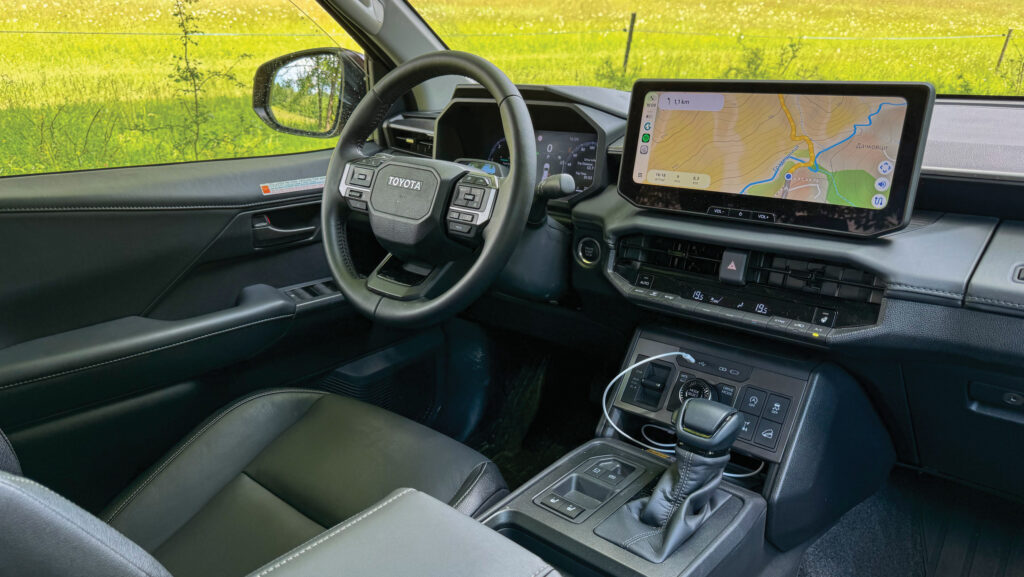
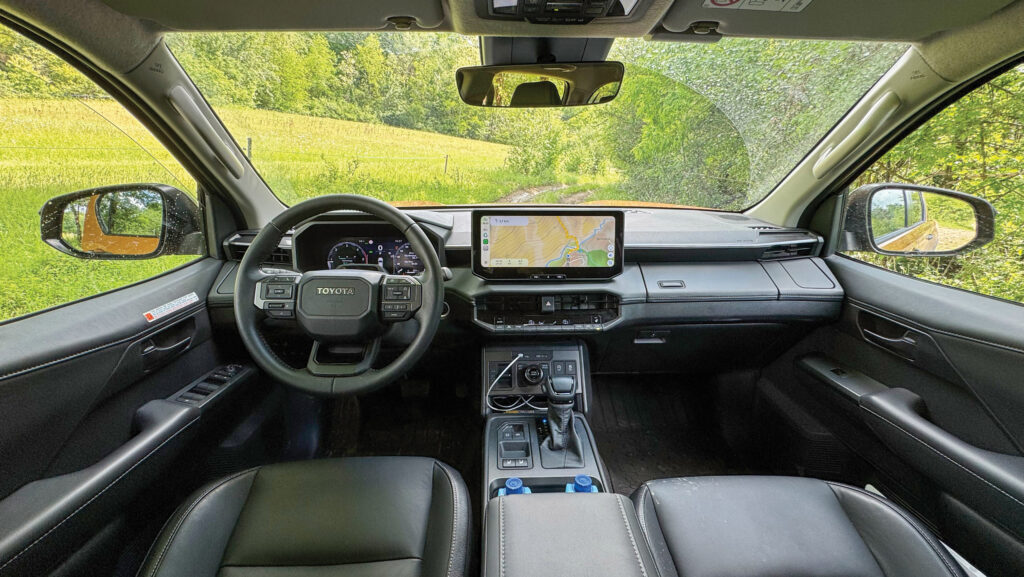
More easy wins from a rummage in the Land Cruiser parts bin, with the Hilux’s previously drab finish lifted with chunky switchgear and hard-wearing materials that are softened where skin meets furniture.
There’s decent storage provision, too: a wireless phone charging tray, bigger central bin, assorted drinks holders and a twin glove box – the upper one cooled.
© MAG/Oliver Mark
And gone are the Halfords vibes of the old touchscreen. In its place is a landscape-format 12.3-incher that is properly integrated. Budget Active models, lowest of the four grades, get a simpler 9in display.
The software behind it isn’t perfect – Apple CarPlay hides many sins – and its orientation means maps aren’t as usefully displayed as the huge portrait of a Ford Ranger, but neither matters a great deal.
More grating is the bossiness of the driver “support” system: bings and bongs sound for 1mph speed infringements; the hidden camera’s inability to see the whites of the driver’s eyes; and countless other petty violations.
© MAG/Oliver Mark
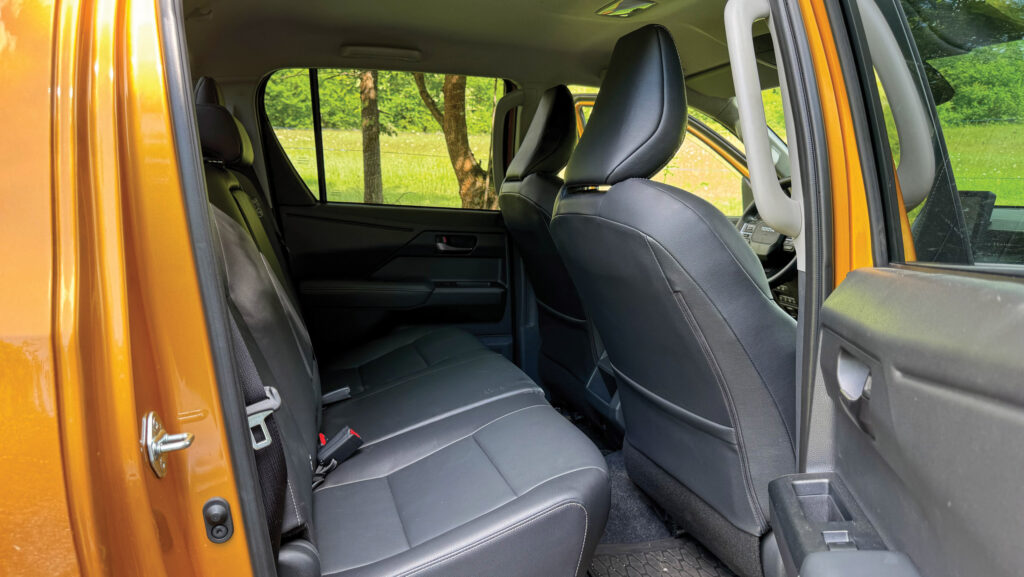
But it’s an otherwise comfortable place to live, with well-shaped seats that, on higher spec models, come with a longer cushion and better padding.
Cheeringly, those in second-from-top Invincibles are now clad in leather rather than cloth, making that model a more attactive option.
And, like Isuzu, Ford and Mitsubishi, Toyota will be offering a two-seat “commercial” version of the double cab to circumvent the aforementioned tax changes.
© MAG/Oliver Mark
Same powertrain?
Battery-electric model aside, there has been no change to the means of propulsion.
The rinse-and-repeat job sees the 2.8-litre engine remain in service and pegged at 204hp and 500Nm – less than a Ranger, more than a D-Max. A V6 is conspicuous only by its absence.
This engine was updated in 2025 with the introduction of a Hybrid 48V setup. But, as the hybridisation is milder than burger cheese, it will now be called the Diesel 48V.
That’s because the four-cylinder does all the graft, with a modicum of assistance from a 48V, 4.3Ah lithium-ion battery – the sort you might get on a big angle grinder – under the rear seats.
This is charged by an engine-driven electric motor-generator that replaces a conventional starter motor and delivers a maximum of 8.5kW and 65Nm to the powertrain. Its influence is barely perceptible.
Heightened senses might detect a slight smoothing and quietening of proceedings during acceleration and stop-start driving, and it frees the engine to idle a smidge lower.
But it makes practically no difference to the 29mpg quoted economy, up a whisker from Gen 8.
There’s more sound deadening – insulation, engine mounts and dozens of extra spot welds to keep things bear-hug-tight – but still some shouting, for which the six-speed transmission is partly to blame.
If only the raids on the Land Cruiser parts department had yielded its eight-speeder.
The selectable four-wheel drive system with two-speed transfer box and lockable rear diff is equally old-hat, supplemented by Multi-Terrain Select that adds five throttle-fettling modes to match under-tyre conditions.
There are two new things, though. An electric park brake makes its Hilux debut, as does electronic power steering. The latter provides more weight at speed and reduces finger-whipping kickbacks over rough terrain compared with the hydraulic setup of old.
FW verdict
There’s plenty to like about the look and feel of this latest Hilux – and there could have been more had the elderly six-speed transmission been sent to pasture.
That said, it’s a time-proven setup. None of the incoming pretenders to the throne will have 27 million pickups’ worth of experience in the game.
Likes and gripes
Likes
- Good looking
- Solid and comfortable interior
- Integrated touchscreen
- Great off-road
Gripes
- No eight-speed auto transmission
- “Hybrid” adds unnecessary complexity
- Too many driver warning bongs
- Not as refined as a Ford Ranger
Hilux BEV
© MAG/Oliver Mark
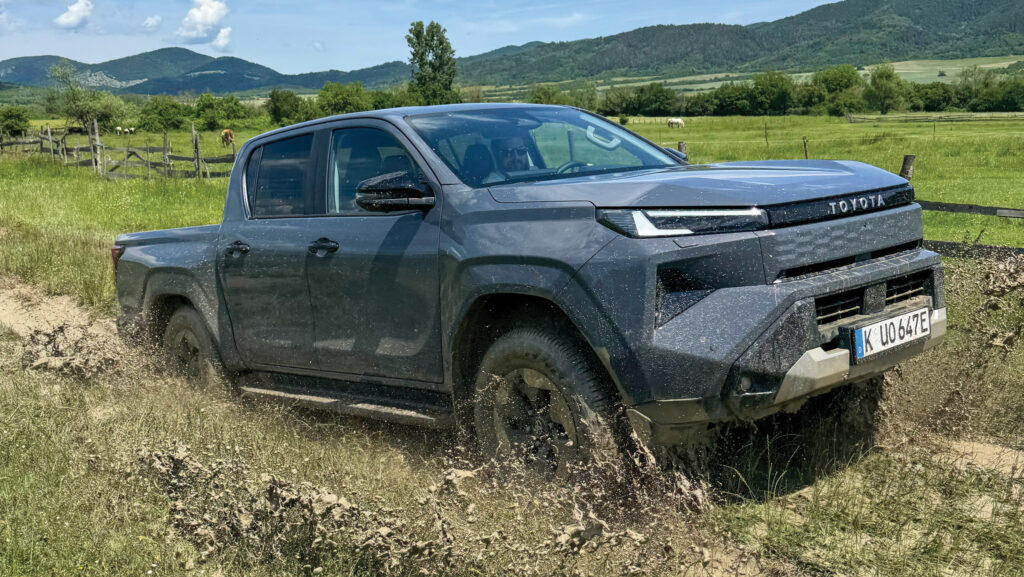
Joining the diesel on the Hilux roster is the firm’s first battery-electric pickup.
Identified by its blanked-off grille, 17in aero wheels and plastic-free wheel arch surrounds, this newcomer offers several perks over the diesel – and many more compromises.
Quieter, smoother and potentially cheaper travel are the upsides, but common farm tasks will expose umpteen chinks in the BEV’s armour.
For starters, the lump of lithium-ion cells contributes to an extra 300kg in total weight.
This, in turn, limits payload to just 710kg, meaning it doesn’t meet the standard for commercial vehicle classification and the accompanying VAT return.
Neither can it tow much. Its 1,600kg limit is less than half that of the diesel and even Isuzu D-Max’s EV.
What about range?
That’ll be 160 lightly laden miles, rising to 236 miles on city-based milk float duty and dropping to who-knows-what with a trailer on the back.
Not great, but a match, at least, for the equivalent D-Max, despite having a smaller battery.
The 59.2kWh unit, designed to fit inside the Hilux’s frame, fuels 80kW (122hp/205Nm) front and 128kW (176hp/268Nm) rear motors. Combined, they deliver 196hp.
Find a DC fast-charging system of 125kW and it’ll take 30mins to replenish the cells from 10% to 80%. Settle for 10kW AC from a three-phase wall box and 10-100% comes in just under seven hours.
One positive is that permanent all-wheel drive makes it a doddle to pilot. There’s no fiddling with low-range and diff lock mechanicals – just the Multi-Terrain Select that alters throttle, braking and distribution of torque.
It shares the same 700mm wading depth and approach/departure angles as the diesels. Not ground clearance, though – 212mm versus 309mm.
FW verdict
There are plenty of buyers out there who don’t need everything the full fat diesel can offer and, just like skimmed milk, some will find the positives.
But there are far too many compromises for regular working folk not under pressure to demonstrate their green credentials.
Plus, it’s expensive. Prices start at £57,845 and, though it qualifies for the £5,000 plug-in car grant and 4% benefit-in-kind tax (versus 37% for the diesel), the limited payload means there’s no way of reclaiming the VAT.
Likes and gripes
Likes
- Smooth and quiet
- Sharp throttle response
- Simple to drive
Gripes
- Can’t carry or tow much
- Doesn’t qualify as a commercial vehicle
- Disappointing range