Contractor Comment: Harvest headaches for R&L Anthony
 © James Andrews
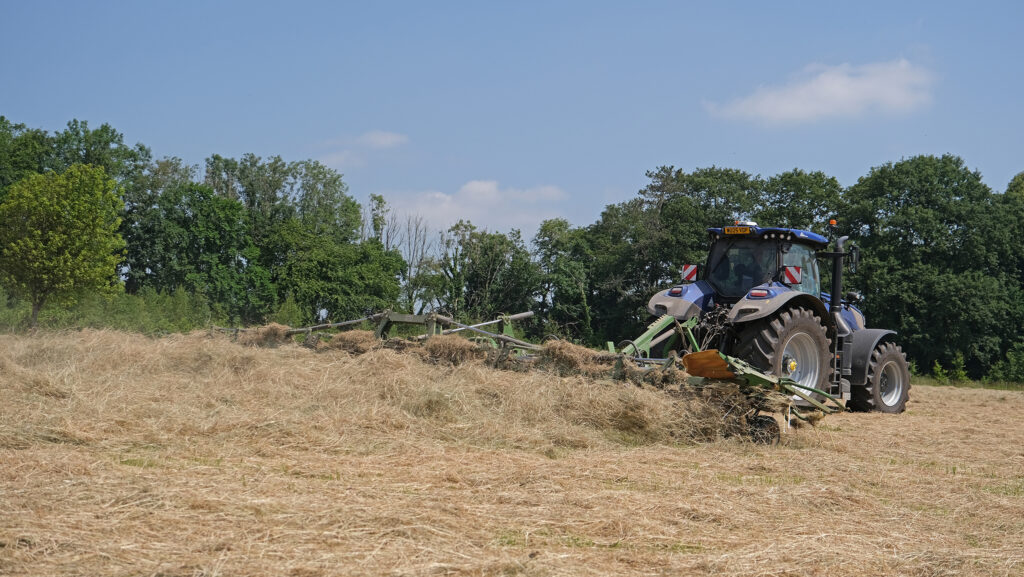
 Late June’s searing heatwave pushed David and Emma Anthony’s big square balers into overdrive as customers started cutting grass on an industrial scale.
With the mercury comfortably in the mid-30s, haymaking should have been a breeze. Yet relentless rain in the run-up to the temperature rise left soils soggy and the air humid.
See also: Ultimate guide to buying a big square baler 2026
“After mowing, the crop just kept absorbing moisture so, even though the heat was fierce, it took ages for it to dry out enough to bale,” says David.
Thankfully, a decent portion of the hay produced for the in-house farming operation was baled green, so it didn’t need so much time in the sun.
It was then moved onto drying floors heated by biomass boilers, where it will stay until the moisture content is down to about 14%.
This particular crop will be going to a customer that supplies horse owners and pet shops, but most forage goes to farmers.
Heavy silage crops
Rather than growing grass alone, R&L Anthony opts for a forage rye and Westerwolds ryegrass mix.
This slots into the rotation between cereal crops, maize and oilseed rape, allowing them to achieve three harvests in two seasons.

Emma and David Anthony © James Andrews
In contrast to many parts of the country, the Vale of Glamorgan had an abundance of rain this spring. This has helped the fast-growing blend put on a serious growth spurt.
The first cut was for silage in April and, such was the volume, it filled most of their clamps. The second cut was the hay crop mentioned earlier and the third is likely to be made into haylage.
“We’ll probably rip it up then so that we can get an early entry into oilseed rape,” says David.
R&L Anthony Contracting
Sealands Farm, Bridgend
For the past 13 years, David and Emma Anthony have been running a mixed contracting business from their base in the Vale of Glamorgan.
About 60% of their work is for the family farming operation, run by David’s parents Richard and Lyn, and 40% elsewhere.
This includes farming customers and airport maintenance for RAF St Athan and Cardiff Airport.
Business facts
Main services: Grass silage (1,200ha), maize silage (500ha), wholecrop silage (80ha), maize drilling (500ha), digestate and slurry spreading (50,000cu m), big square baling (12,000/year)
Other: Round bale maize and forage sales, holiday cottages, airport maintenance
Staff: Five full-time, plus three part time and up to 17 at harvest
As the new crop has been going into the clamps, last year’s has been steadily loaded out to local farms.
Some of this has been in bulk loads and the rest in round bales produced by a static Orkel baler.
This is still being run once a week to keep up with demand, though the market has been flatter than they would like.
“Poor milk prices have definitely had an effect – producers are struggling to make a profit and, as a result, they aren’t pushing production,” says David.
“That said, we’re just starting to see an increase in orders and we’re getting back to our winter demand levels – hopefully we’ll have the clamps clear for when the maize starts coming in.”
This year’s crop is looking well so far, thanks to ample rainfall and a decent amount of sun, and it has just received a liberal dose of digestate.
Night-time digestate spreading
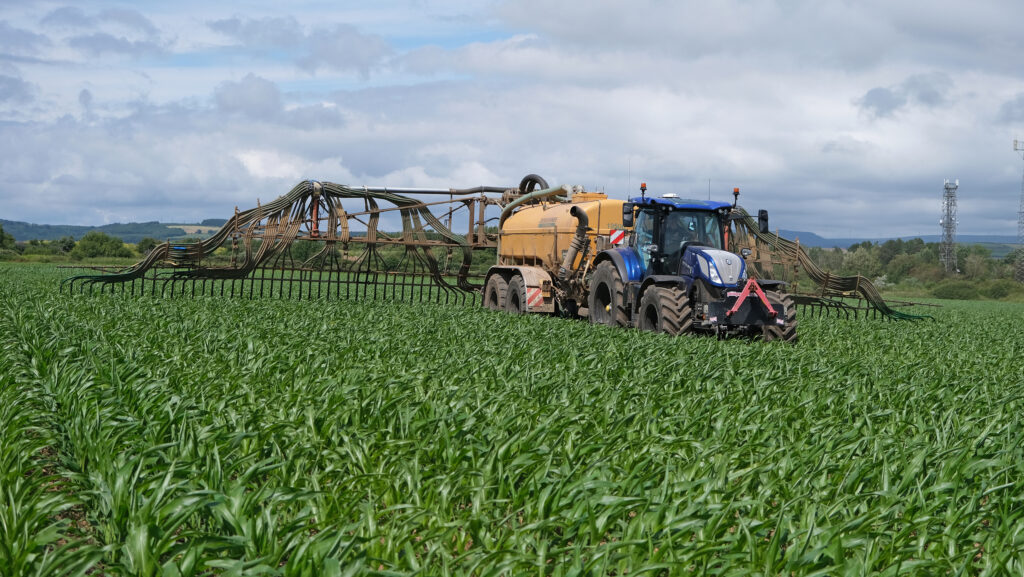
Applying this has been a serious headache, though. For two weeks, rain made the ground far too soft to carry their two 19,500-litre Zunhammer tankers with 24m dribble bars.
The pivot to blazing sunshine soon improved ground conditions, but then the risk of scorching the crop was too high.
Their solution was to put in almost two weeks’ worth of night shifts, starting in the early hours of the morning and running until 9 or 10am when it got too hot again.
Thankfully, temperatures eventually dropped to the mid-20s allowing day spreading to continue.
© James Andrews
The digestate in question comes from a 3MW food waste anaerobic digester plant run by Severn Trent that’s located next to one of the farms.
As this is produced, the water company’s HGV tankers ferry the liquid to a series of covered lagoons, tanks and portable 250cu m Albers Alligator Winbags.
The Anthonys move the latter between farms using a hydraulic reeler and custom flatbed trailer to minimise the amount of time the tankers have to spend travelling.
“They’re high-spec machines with big expensive tyres, so we don’t want wear them out constantly buzzing up and down the road,” says David.
The tankers are able to draw directly from the bags, making spreading a one-person job. And to save having to connect a pipe every time they fill, the spreading tractors carry a docking station on the front linkage.
This is dropped off and connected to the bag so that the tanker can quickly drive up, fill and start spreading again.
All the driver has to do is lower the hydraulic filling arm into the dock, and start the pump. The flow of slurry will then stop automatically as soon as the machine is full.
A possible return to swathing
Thoughts have also been turning to a future without pre-harvest glyphosate.
Even though there’s a chance this practice will be allowed to continue – the current GB licence expires on 15 December 2026 and renewal details are yet to be announced – the business is getting prepared.
One of the techniques up for consideration is swathing of the farm’s 200ha oilseed rape area. To see how effective this would be, they asked MacDon for a demonstration of its latest European-spec windrower (see MacDon M2170NT box).
This was armed with a 25ft draper header set to deposit the crop between the wheels of the tractor unit.
By driving it slightly narrower, it lays down rows close enough that the farm’s New Holland CR10.90 with 35ft MacDon flex draper header will be able to pick up two at a time.
To prevent shedding, the crop was treated with a single dose of pod stick, which is one less than they usually put on.
The swather was getting to work as the magazine went to press, so we’ll reveal the results in our final R&L Anthony report later in the year.
If it is successful, David is considering adding one to the contracting fleet.
However, in order to justify the expense, he’ll need to sign up some new customers, both in the Vale of Glamorgan and further afield.
Should glyphosate get the green light for use as a pre-harvest desiccant, the Anthonys are still considering reducing their reliance on it.
“If everyone did this, it might help us keep the chemical for longer,” he says.
New tractors settling in
Since our first visit, three new tractors have rocked up. Two of these are New Holland T7.300s fitted with the latest PLM software, which replace an older T7.260 and T7.270.
As per their usual policy, these came with a five-year/6,000-hour warranty to avoid them getting clobbered by any horrendous repair bills.
“They’re a big step up from the older models and there some handy features such as Intellifield – this allows two tankers to work in the same field and record the job as one,” says David.
© James Andrews
The only feature that didn’t go down too well with the drivers was the secondary screen mounted in the centre of the steering wheel.
They kept clonking their wrists on it when turning, so TH White fitted a kit to mount it in a more conventional position behind the wheel.
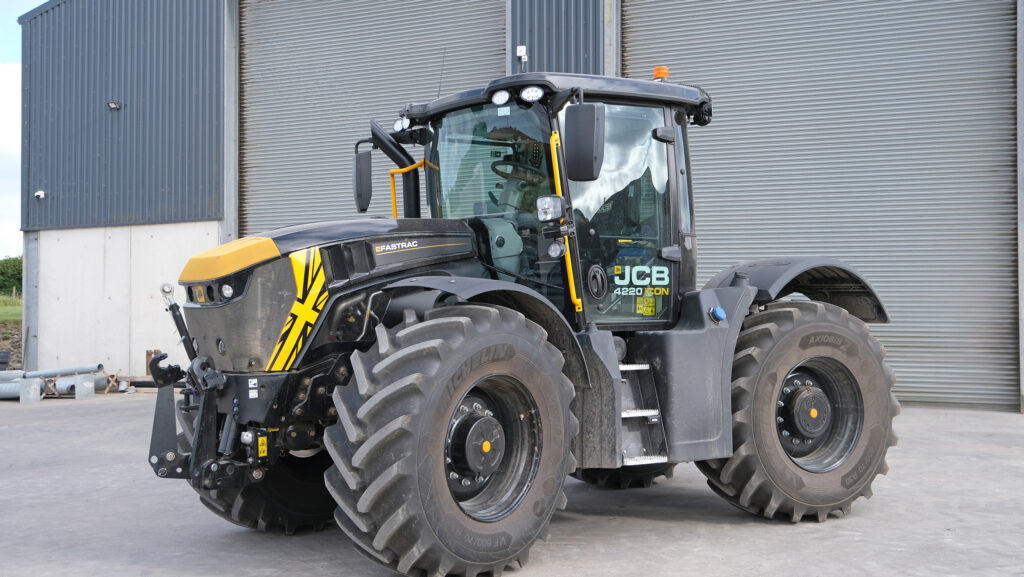
Third on the new tractor roster is a JCB Fastrac 4220 iCON which has been drafted in primarily for haulage duties.
Much of its time will be spent with a trailer on the back and it’s fitted with an air hose reel to keep tyres topped up.
Rather than having the business name and phone number on their tractors, David and Emma have opted for distinctive colour schemes.
This means all the New Hollands come in Blue Power livery with black wheels, and the Fastrac has a custom black wrap.
“It means local farmers can pick out our machines, but we don’t get calls from members of the public if we have to drive through a village late at night.”
Harvest kick-off
With combines starting to roll, the next big campaign will be big square baling with their Krone Big Pack 1290 and 890.
A large proportion of this will be for the home farm, almost all of which will be sold on. Some customers will buy this at harvest and collect bales from the field; the rest will be stored and sold over the winter.
Now that the bulk of the grass silage is in, their Krone BigX 980 will cruise through a few third and fourth cuts before it’s prepped for the maize harvest.
MacDon M2170 NT swather hits UK farms
Increasing interest in swathing has prompted Kent dealer Haynes Agricultural to run a demonstrator MacDon windrower in the UK.
Often these machines are far too wide for our roads, but the M2170 NT is a dedicated narrow transport model that can nip in to 3.47m – about the same as a large combine.
The telescopic chassis then pushes out to more than 4m wide in the field, giving plenty of room for a large swath to pass through unimpeded.
Cutting duties are handled by a 25ft draper header, with dual hydraulic side knives and a robust hydraulically driven cutterbar.
This has plenty in common with the firm’s combine headers, though the knives have finer serrations and it’s fitted with plug-free fingers that are less likely to bung up with green material.
Rather than having fixed draper belts to move the crop, operators are able to shunt them from side to side. This allows the crop to be deposited in the centre, to the left, or the right.
The former is the best option for bulky stands of UK oilseed rape, but the side positions can come in handy for shorter crops.
MacDon says typical work rates are about 7ha/hour and the four-cylinder, 173hp Cummins engine sips less than 4 litres/ha.
Most functions on the machine are powered hydraulically, from header services and track adjustment to drive motors on each of the front wheels.
These also handle steering, allowing the machine to spin on sixpence and head straight into the next run.
The rear wheels are simply castors and free to move in any direction. However, they are fitted with dampers and rubber suspension to keep them stable and give the machine a smooth ride.
Just like a modern combine, operators are treated to a swish cab complete with a seat-mounted armrest, multi-function joystick controller and touchscreen display.
However, the rotating control station isn’t something you see that often. This allows the steering column, seat and controls to spin 180deg, quickly converting the machine from field to road mode.
It’s then able to travel at 45kph, towing the header behind with custom weight block and drawbar assembly keeping the outfit nicely balanced.
In addition to being used for oilseed rape, the firm says the windrower can significantly speed up the harvesting of wholecrop and other feedstocks for large AD plants.
Retail price of the M2170 NT with 25ft draper header is about €425,000 (£364,314).