

Farm Inventions Competition: £2,500 up for grabs
It’s time for another season of Farmers Weekly’s long-running Farm Inventions Competition.
If you’ve been burning the midnight oil building a new machine, modifying an existing implement to transform its performance, or developing a neat gadget that saves time, money or hassle, then why not try and bag some free cash for your troubles.
See also: How a Wiltshire-based mechanic built his own hedgecutter
The competition’s format means you could win a share of the £2,550 prize pot, no matter if your creation or modification is mind-bendingly complicated or small and relatively simple.
Each entry is judged against four criterion – inventiveness, originality, safety and usefulness to others.
Several from the past couple of years have subsequently been taken on by manufacturers, and many will have inspired like-minded farmers to develop something similar of their own.
So, as well as the cash prizes, it serves as a great opportunity to get your invention in the shop window – and help others that might be struggling to come up with machinery workarounds without resorting to buying new.
How the competition works
Entries are split into three categories that cover everything from perfectly welded drills to simple knick-knacks knocked together on a rainy afternoon.
- Simple Items that took a day or so to knock together and are fairly basic in the way they work, but still save time or money.
- Intermediate Anything more sophisticated, perhaps with a simple form of hydraulic or electrical system.
- Complex Machines that have taken months or years to design and build. They usually involve an engine or a complicated combination of electrics and hydraulics.
Who is eligible to enter?
The terms of entry are simple – it just needs to have been built by a farmer or contractor and have a use on the farm.
What if I’ve entered my design in other local inventions competitions in the past?
You are still welcome to enter.
What are the prizes?
Prize money is the same across the three categories: simple, intermediate and complex.
The winners of each will take home £500, there’s £250 for the runners-up, and third-placers get £100.
All nine prize-winning inventions will be featured, along with the best of the rest, in Farmers Weekly magazine and online.
How do I enter?
Just email brief details of what the machine is, how it works and what you use it for to oliver.mark@markallengroup.com, including a couple of decent-quality pictures and a contact phone number. Alternatively, you can get in touch via Farmers Weekly’s Facebook account.
The closing date is 22 January 2027.
Who won last time?
Complex category – Jim George’s Hej Harvester
Hej Harvester © Jim George
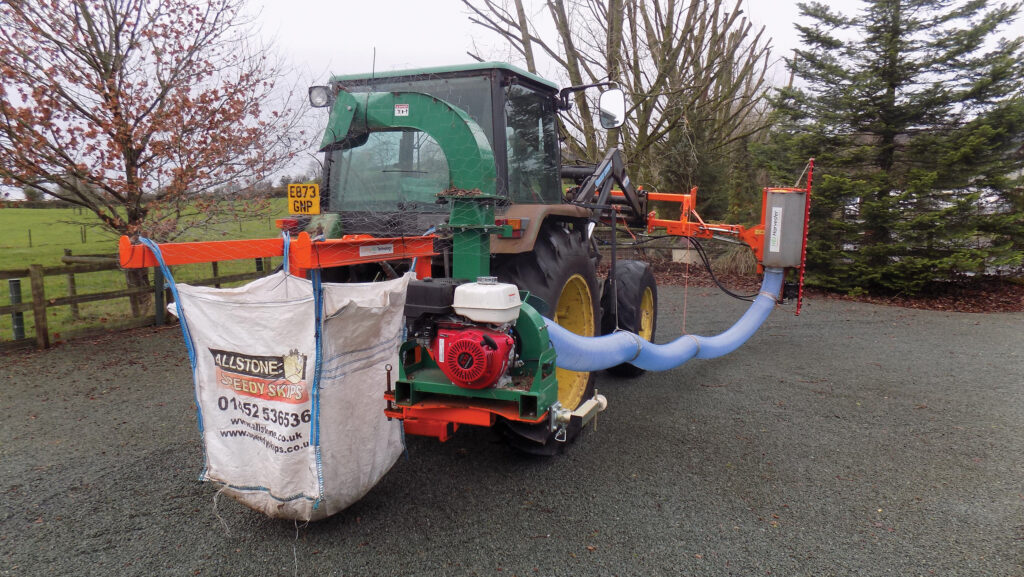
Hedgetrimming needn’t be an unprofitable job loathed by farmers and contractors across the land, reckons Jim George, who devised a machine that could turn cuttings into cash.
His prototype Hej Harvester does exactly as advertised, trimming and bagging woody stems for burning as biomass, producing biochar or selling as a hitherto untapped commodity.
The project has taken eight years thus far, with most of his engineering effort devoted to the novel 130x50cm cutting head.
In contrast to a conventional power-hungry flail, which uses brute force to batter bushes, he’s opted for a series of rotors armed with comparatively refined cutting discs.
These slice like secateurs through stems up to 8-10mm in diameter, leaving a crisp finish more akin to a master barber than a heavy-handed butcher.
This grooming encourages quicker regrowth and more yield from the following “crop”.
One of the head’s other benefits is its significantly lower power demand, he says, which means it can work slightly faster than a flail and, in theory, run on a small electric tractor.
Chop length is altered by adjusting the distance between the cutters. During his trials he’s set it at about 50mm so that it compacts well in the collection bag and is easier to process there on.
And though the Hej Harvester is currently rigged up on a tractor front loader, plans are afoot to mount it on the power arm assembly of a regular hedgecutter to improve reach.
Once sliced and diced, material is sucked by a Billy Goat vacuum system from the base of the head along an 8in tube, before being spat out from a spout at the back.
He’s using a little 5hp Honda engine to power this in the interim, with the intention of plumbing it into the tractor’s hydraulics in the long term.
Material ends up in a dumpy bag that can be dropped off quickly, in lieu of a dedicated tipping hopper – another item on the lengthy pre-production to-do list.
Intermediate category – Neville Kirkham’s cow sledge
Cow sledge © Neville Kirkham
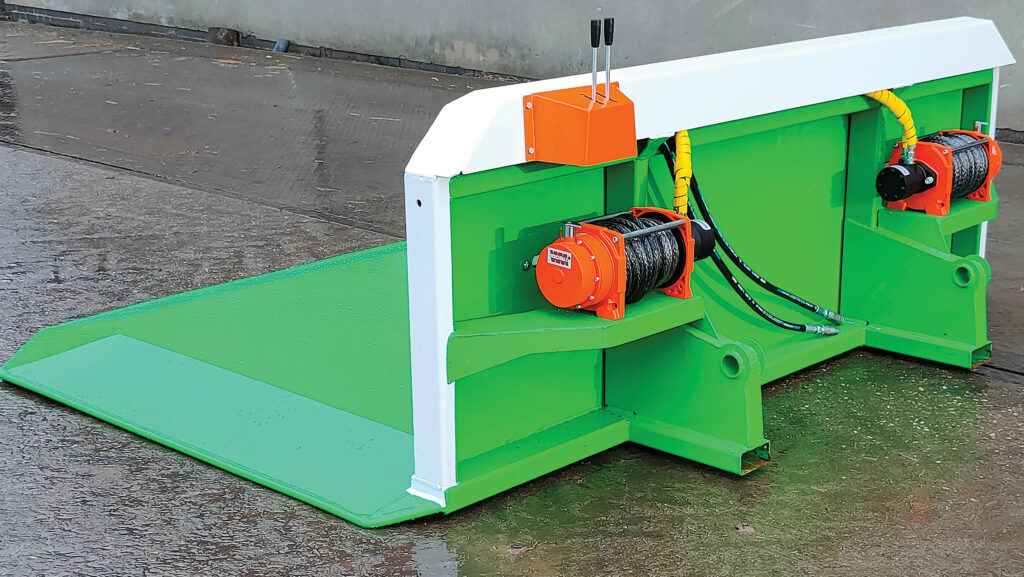
Leicestershire dairy farmer Neville Kirkham built a telehandler-mounted cow sledge to quickly get down cows back on their feet without causing undue stress or injury.
Thanks to a slim profile and chamfered edges on three sides, the base plate sits tight to the ground, offering a smooth transition during loading.
No manual handling is required for this process – instead, a custom-made harness is placed over the animal.
This is attached to two hydraulic winches positioned behind the backplate which, when wound in, gently tighten the straps before sliding the cow onto the platform.
Power for the winches is provided by the handler’s third service and there are separate spool levers to control each of them.
This allows operators to adjust the tension on either side of the harness according to the position of the animal and the area it needs to be retrieved from.
Rather than having loader-specific brackets, the rig has slots to accommodate pallet tines, meaning it can be quickly picked up by any machine.
There are also chains to lock it securely in place.
Neville has been using the sledge for more than two-and-a-half years and says it has massively improved animal welfare and recovery, as well as staff safety.
Simple category – Andrew Myatt’s tramline sprayer
Tramline sprayer © Andrew Myatt
Like many growers, Andrew Myatt has stopped putting in conventional tramlines with the drill, instead using his sprayer’s RTK guidance to follow annually repeatable wheelings.
This has helped reduce soil erosion and improved travel conditions during early-season applications.
The downside being that, without a dose of pre-harvest glyphosate, it leaves strips of unfit grain come August.
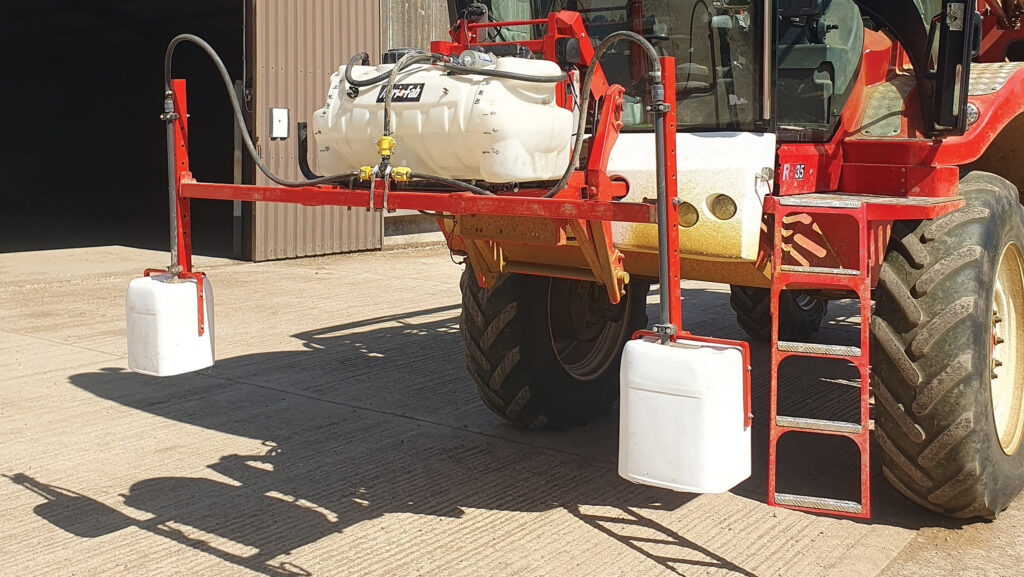
But that problem has been solved with his dedicated tramline sprayer that allows Roundup to be applied at the same time as a flag leaf-protecting T2 fungicide.
Handily, his 4,000-litre Bateman sprayer already had a hydraulic front linkage, so was semi-prepped for the retrofit.
The first job was to devise an easy means of mounting and removing its Techneat Outcast slug pelleter.
After fabricating a quick-attach mounting bracket and storage stand, he replicated the format for the second-hand spray pack he’d picked up from a landscape gardener for £90.
New pipes and fittings followed, delivering the herbicide to a pair of 80deg 03 flat fan nozzles tucked inside old 20-litre containers.
These shrouds ensure the non-selective spray doesn’t stray beyond the width of the wheels.
As Andrew likes to run them as low as possible, he used just one bolt to secure the vertical box-section arms to the main frame on each side, thus providing the pivot for a rudimentary break-back system.
