

Home-built cultivator towed by steel rope transforms steep fields
 © James Andrews
 Few things irk John Roberts more than unproductive farmland, even when it’s clinging to a precipitous hillside.
But having flipped a tractor and rolled five times while trying to improve the steepest slopes on his family’s 170ha farm near Welshpool, Powys, he needed to rethink his methods.
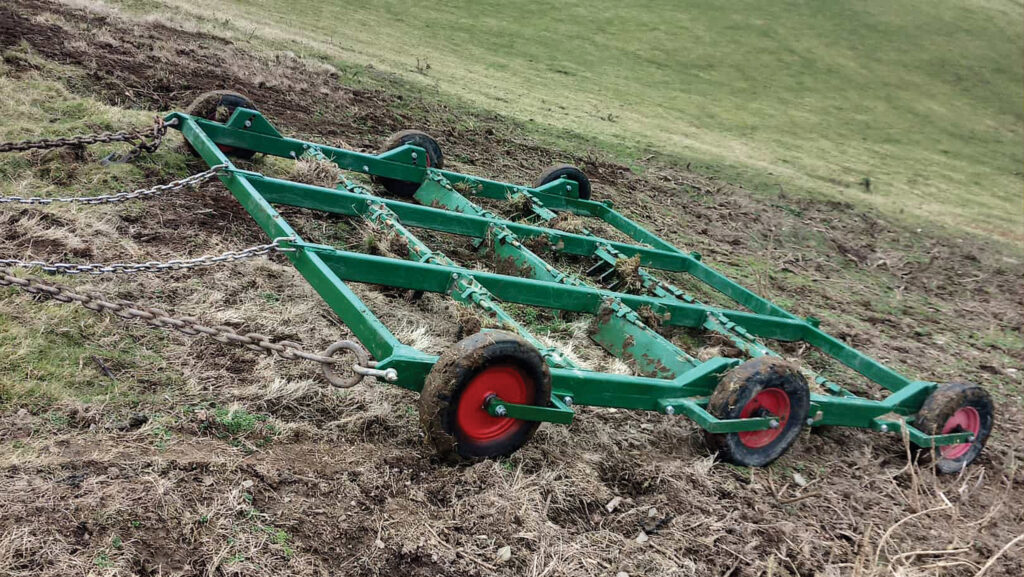
His answer was to build a 2.8m custom cultivator towed by long lengths of steel rope.
See also: Home-built 6m straw rake saves Northants farmer £10k
This could be dangled down the hairiest of hillsides before being hauled up by a tractor, ripping out woody gorse roots, bracken and tangled webs of bramble in the process.
First on his list of challenges was making the machine manoeuvrable and stable enough to trundle down slopes and not tip over while working.
The solution was to build a ground-hugging frame out of heavy-duty 100x50mm and 80x40mm box section with three wheels on solid rubber tyres each side.
“I wanted to make sure it wouldn’t bend when it gets hooked up in big roots or the frame gets grounded,” says John.
Surviving a tractor tumble
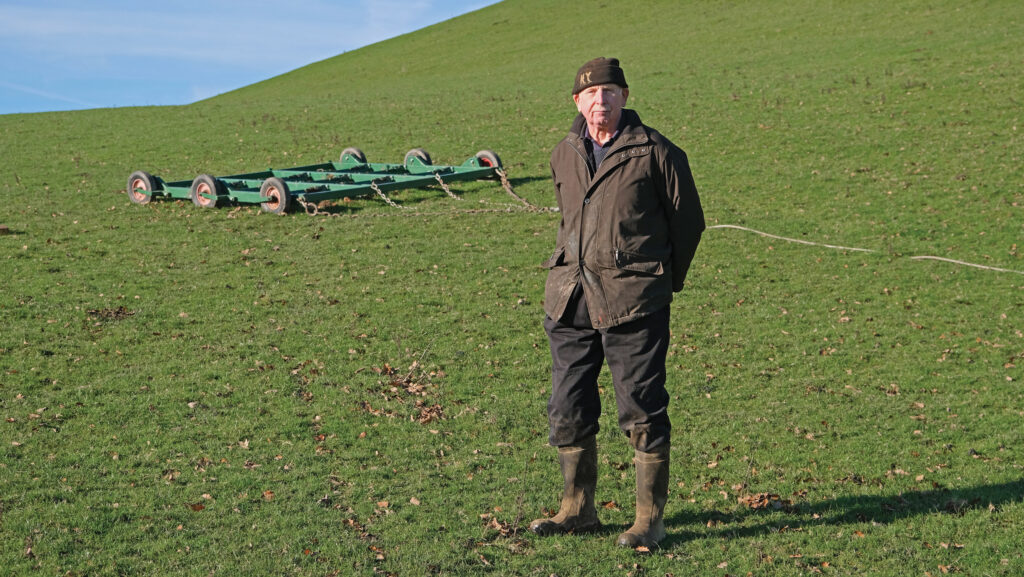
John Roberts © James Andrews
As a native of the Welsh hills, John Roberts knows how to drive tractors on steep slopes. But when attempting to run the topper over a particularly sharp bank in 2019, his luck ran out.
The tractor in question was a New Holland 7740, fitted with dual wheels and a front weight block to give the maximum amount of grip.
The ground was dry and there was plenty of traction as he inched down in the lowest reverse gear.
All was going well, until something suddenly gave out in the transmission, causing it to start freewheeling backwards.
He tried to slow it on the brakes, but as it gathered speed the topper dug into the ground, lifted the front axle and slewed it sideways.
John was then a passenger as the tractor rolled five times, before coming to rest on its wheels at the bottom of the slope.
Thankfully, the cab proved much tougher than the transmission, with almost no deformation of the frame.
As a result, he was able to climb out unaided and, though badly knocked about, had no serious injuries.
Swinging legs

Tines and blades on the custom steep land cultivator © James Andrews
As for the cultivating elements, these needed to fold away as the machine backed down the slope before re-engaging as it was pulled uphill.
To do this, he mounted a series of tine and levelling board sections on a piece of bar with a socket at either end.
Such is the geometry of these that they bounce over the ground as the implement is reversing, but dig in as soon as it starts going uphill.
Clearly, this would cause a problem when moving between blocks of land, so he also fitted sliding bolts that lock them in their out-of-work position.
The rig has nine cultivating sections, spread across three rows.
The first and last of these are home to three banks of short, straight ripping tines, with the centre run housing steel blades for levelling bumps.
Tow rope
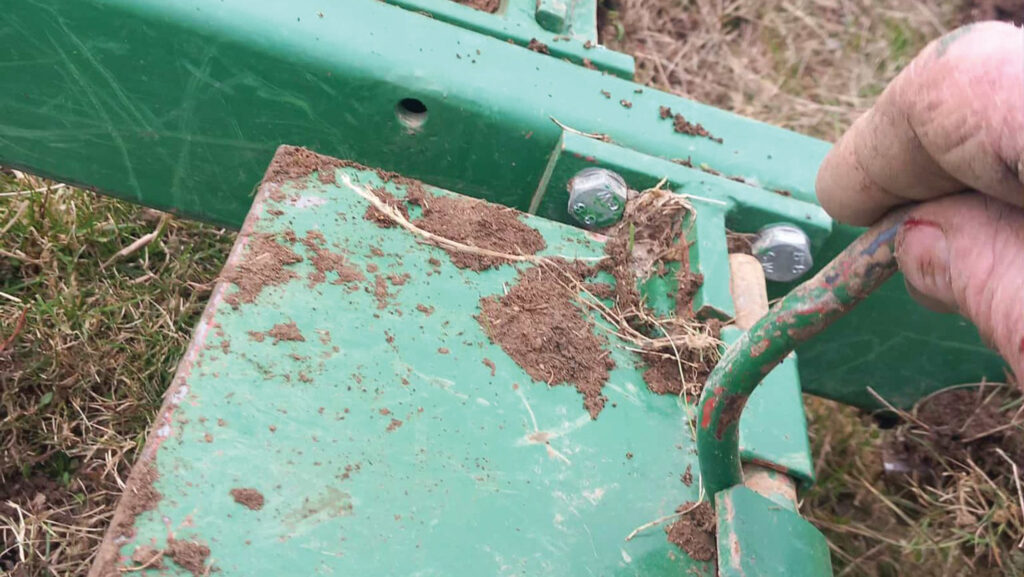
Tines can be locked in transport position for moving between fields © James Andrews
Next on the agenda was sorting the towing method. Because the slopes John wanted to tackle had large flat sections above, he opted for straightforward tow ropes pulled by a tractor, rather than a winch.
Not only was this simpler and cheaper to build, but it’s also far quicker to operate.
“I tend to drive at about 3mph, which is fast enough to get it moving some soil without it bouncing around too much,” says John.
“Even though I can’t see it while it’s working, I can tell roughly what’s going on by how much tugging there is on the rope.”
Once the cultivator nears the top of the hill, he lowers it back down and moves the tractor across to tackle the next run.
All in, he has 100m of cable, which is long enough for him to attack any slope on the farm.
This comprises one 50m length, two 20m and one 10m, giving him plenty of options depending on how far he needs to pull it.
Ground preparation
Before the cultivator hits any scrub-covered slopes, John puts in a healthy amount of preparation work. This includes spraying the weeds off with a knapsack, before cutting rides through by hand.
He then carries out controlled burning of the woody material so that there’s minimal trash left on the surface.
As a general rule, the cultivator will perform three passes, after which it will have created a rudimentary seed bed.
“I don’t want to loosen the soil too much and damage the integrity of the slope, but the old roots need to come out and I want just enough soil for the seed to take,” he says.
Currently, he’s reseeding by hand and likes to go out on a blustery day so that the wind does much of the work for him.
That said, for future endeavours he’s considering mixing some seed with water in the slurry tanker and using a hose to spray it down the banks.
To date, he’s been using seed left over from other grassland rejuvenation projects on the farm, but is considering adding drought-resistant fescues to improve hardiness in dry summers.
So far, John has reclaimed more than half a hectare of ground that’s too steep for a tractor, and it’s already proving popular with the farm’s flock of Beulah ewes and their Welsh mule lambs.
He has three more slopes to tackle in this particular field which, once finished, will bring the total rejuvenation tally up to 1.6ha.
Ongoing maintenance
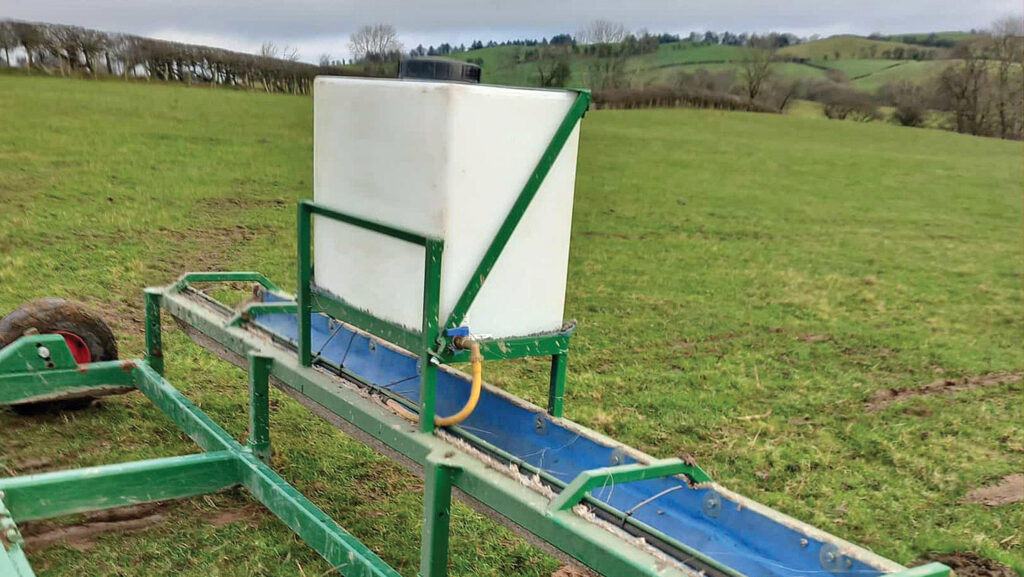
Weed wiper © James Andrews
Another addition to the cultivator’s arsenal of tools is a weed wiper, which slots into
box-section sleeves at the rear.
The main role for this is clobbering any undesirable seedlings that rear their heads, before they get too established.
The simple setup has a central plastic tank to hold the chemical with a tap to control the flow of liquid.
This then seeps out of irrigation tubing, with slightly enlarged holes for better flow, which is positioned above lengths of old carpet.
As the saturated carpet brushes over the weeds, it delivers just enough chemical to kill them off.
Total cost of the materials for the cultivator project was about £1,500, but John hasn’t factored in anything for the considerable amount of time he has put in to the project.
Get your Inventions Competition entries in
John Roberts’ cultivator claimed third place in the intermediate category of this year’s Farmers Weekly Farm Inventions Competition.
If you’ve made a nifty machine or gadget in the workshop, you could also be in with a chance of winning, as next year’s contest is now open for entries.
As well as seeing your creation immortalised in these pages, a cash prize could be coming your way.
The total pot is £2,550, with the results decided by a panel of journalists and farmers.
The winner of each of the three categories gets £500, runners-up will bag £250, while third placers receive £100.
- Simple is for items that took a day or so to knock together and are fairly basic in the way they work, but still save time or money.
- Intermediate covers more sophisticated builds, perhaps with a simple hydraulic or
electrical system. - Complex entries will have taken months or years to design and build. They usually involve an engine or a complicated combination of electrics and hydraulics.
Entering is easy – just send some details about how the machine works and what you use it for to oliver.mark@markallengroup.com.
Please include a couple of decent-quality pictures and a phone number.
The closing date is 23 January 2026.