Getting your HGV C+E licence – all you need to know
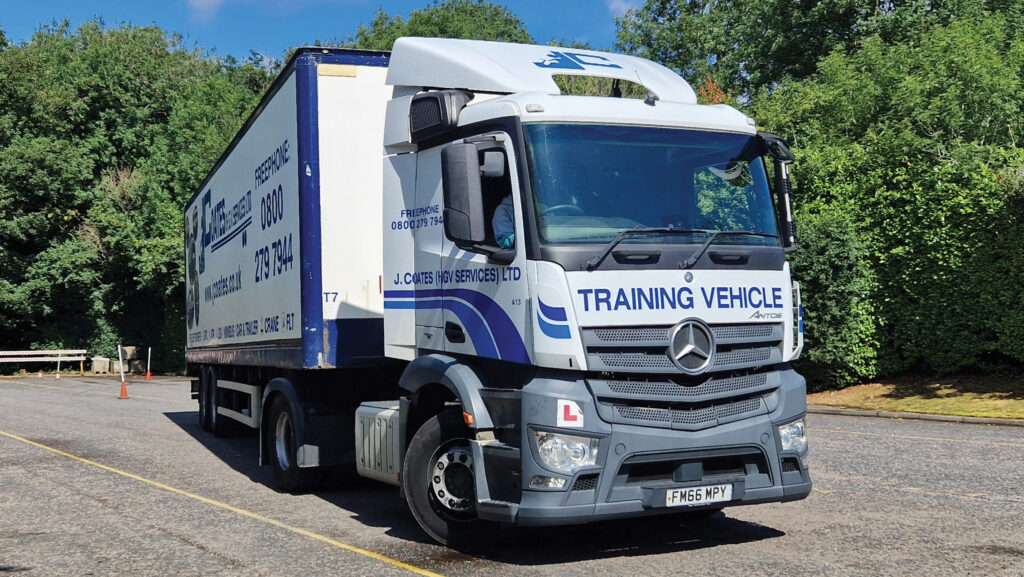 © Trinity Francis
 Tractors and trailers are perfectly capable of carrying big loads, but nothing beats the speed and efficiency of HGVs for bulk transport.
As well as being permitted to travel faster, they are often cheaper to run and give arable-focused contractors more involvement in the transfer of crop from field to farm to bulk store.
Plus, they can be used all year on other haulage errands – whether moving plant and machinery, livestock, stone or woodchip – to keep staff busy and cash flowing.
See also: NAAC contractor price guide 2026-27
But a crucial piece of the puzzle is who is going to sit behind the wheel. Buying a truck and trailer is perhaps the easiest part of the process; getting the right driving licence takes a bit more planning.
Navigating the requirements and compliance can feel like a daunting prospect, but things become clearer once you know what you need for your specific operation.
The first decision is whether the business will exclusively use rigid vehicles or stray into articulated truck and trailer territory.
A change of the rules in 2021 means drivers can now go straight from a car licence to a C+E (Class 1) for articulated vehicles without needing to do a category C (Class 2) rigid test first.
As a result, it’s often simpler to target this licence and cover all bases, rather than upgrading at a later stage.
The theory
To kickstart the process, the driver needs to apply for a provisional licence and complete a medical assessment.
The latter sounds more intimidating than it is; essentially, a doctor runs through a series of questions about the applicant’s medical history.
The only physical assessments are a blood pressure check and short eye test.
This paperwork, and the driving licence, then gets sent off to the DVLA and can take up to four weeks to come back, though it’s typically much quicker.
The next step is to book theory, hazard and case study tests. Training providers usually handle the logistics of organising dates.
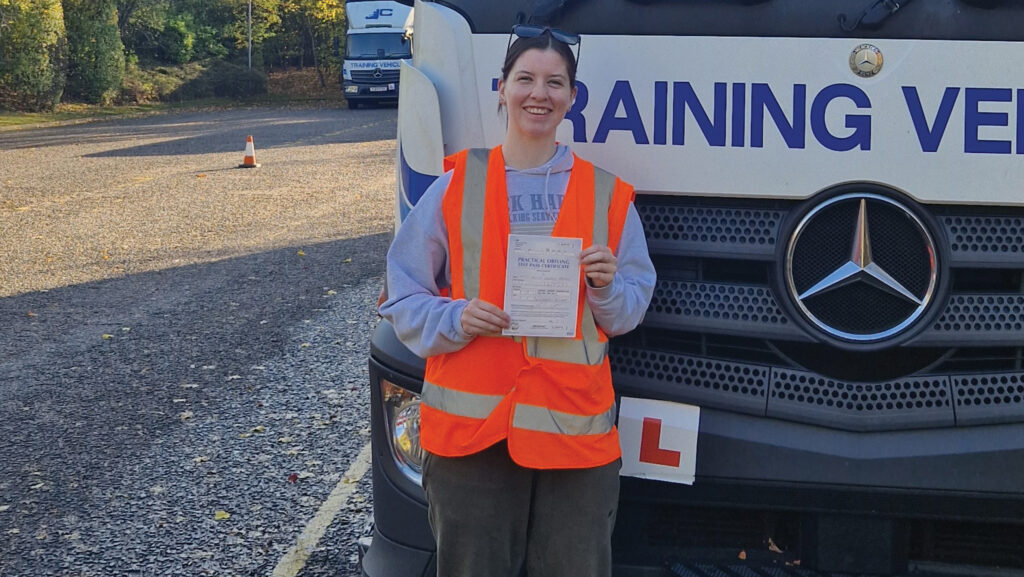
Trinity Francis © Trinity Francis
Admittedly, this stage is quite theory heavy as it runs through all the rules and regulations drivers need to be know.
The case studies involve examiners asking drivers about what they would do to meet regulations or best practice standards in certain situations based on example scenarios.
There’s a lot to remember, so building in time for revision and mock tests is key to increasing the likelihood of passing first time.
I found that about four to six weeks was adequate to study around work commitments.
The practical
Once the theory side is out of the way, it’s on to moving backwards – specifically, a reversing manoeuvre and the coupling/uncoupling of a trailer.
For those that are a dab hand at reversing trailers, this aspect will be second nature.
The assessment involves backing through an “S” shape and parking between two cones, before demonstrating the uncouple and recouple procedures.
This is usually wrapped up in a day, with a morning of practice and an afternoon assessment.
Regardless of whether you need a certificate of professional competence (CPC) for driving after the test, every new driver needs to complete the initial CPC, which includes a module on vehicle safety.
This step features some classroom training followed by familiarisation with a vehicle, so the driver can demonstrate to the examiner what they would do on their daily walkaround checks and how they would secure different types of loads.
Although you can complete some of the modules in a different order, the culmination of the process is the on-road driving segment.
Drivers typically spend about a week getting used to routes around their chosen test centre to master challenging road layouts, lane discipline and HGV-specific considerations such as restricted weight, width and height zones. I spent four mornings in the truck before taking my test on the fifth day.
The test
The driving exam starts with five “show me, tell me” questions, where the examiner asks about specific aspects of the vehicle.
They use a standard set of 28 questions which are published online so drivers can study the answers in advance.
Some will be unique to the test vehicle, so make sure to discuss these with the instructor beforehand.
While your local test centre might be the first option, it’s worth having a look at different sites and considering somewhere that has a higher pass rate.
The test itself is one hour of driving, which will be a mix of A and B roads in urban and rural areas.
The examiner will ask you to pull over at least twice and do 10 minutes of independent driving, following road signs.
Since C+E licences are professional qualifications, they require a bit of ongoing maintenance to ensure compliance.
In some instances, farmers are exempt from needing CPCs: if the lorries are moving loads for the company’s own business, if driving is less than 30% of the driver’s main job and if the transport isn’t for hire or reward.
As soon as the trucks start doing paid work for other people, drivers must have a CPC qualification.
To maintain a CPC, 35 hours of training is required over a five-year period, which ensures operators are up to date with the latest regulations.
Anyone who moves livestock will also need an animal transportation certificate of competence.
“Type 1” certification permits the transport of animals over 40 miles (65km) and for up to eight hours, and “type 2” is for journeys over eight hours.
From start to finish, obtaining a C+E licence typically takes around four to six months depending on training and test availability and whether modules are successfully completed at the first attempt.
Mine took about six months in total, accounting for 10 working days of training and assessments.
While the initial time and financial outlay can be significant, building resilience within a business is never a bad thing.
The transport sector is experiencing a driver shortage that isn’t expected to improve any time soon.
Some of the strongest candidates for HGV drivers are young farmers who have a natural knack for reversing and plenty of experience loading vehicles and handling machinery.
How much does it cost?
Until recently, the government funded 16-week courses for drivers to obtain C or C+E licences in a bid to address the UK’s HGV driver shortage.
At the time of writing, the skills bootcamp has been discontinued, meaning businesses or individuals need to self-fund the process.
Prices vary depending on the training provider and how long you want to spend in the truck before taking your test.
Typically, C+E courses for drivers that only have a car licence tend to be more expensive as there’s a steeper learning curve than those who already hold a C licence.
Expect to pay £3,000-£4,000, or more if test re-takes are required.
Training providers usually include access to online resources such as Driving Test Success Anytime, which covers all the theory, hazard perception and CPC case study information and mock tests.
After passing all the exams, you need to apply for a digital tachograph card which costs £32 for the first time and £19 to renew or replace a lost card.
Tachograph requirements
Commercial vehicles over 3,500kg are fitted with tachographs to record information about driving time, speed and distance.
Modern vehicles have digital or smart units while older ones are equipped with analogue tachos to record data.
The idea is to make sure drivers are following the rules that mandate breaks and working time.
Due to the unique nature of agricultural, horticultural, forestry, farming and fishery work, some specific exemptions to tachograph rules apply.
Vehicles used within a radius of 62 miles from the operating base are exempt, as are those carrying animals from a farm to market or from a market to a slaughterhouse, provided the distance doesn’t exceed 62 miles.
Other exemptions include vehicles used for milk collection from farms or the return to farms of milk containers or milk products intended for animal feed.