Dutch contractor establishes self-propelled mixer operation
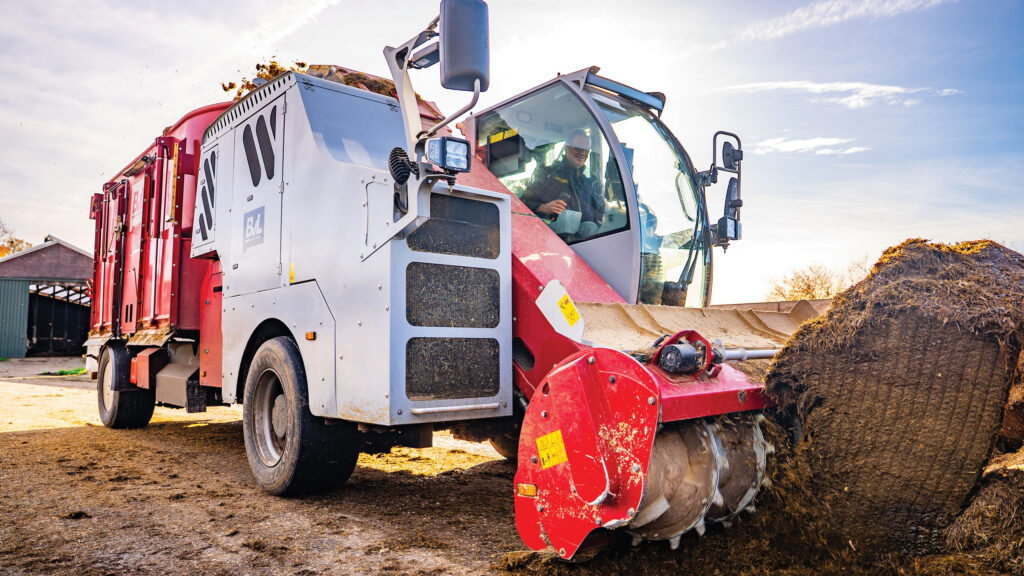 BvL V-Mix Drive Maximus Plus 21-2S © Steve Sutton
 It’s rare to find a contracting operation in the UK devoted exclusively to one line of work.
A spread of jobs generally helps ensure year-round cashflow, employment for staff, and means they can provide a one-stop shop to minimise the risk of customers wandering.
But for Martin Botterhuis, offering a single dedicated service to his clients has been the key to success.
See also: Dutch dairy saves time with powered silage clamp cover rollers
Business facts
Botterhuis contract feeding service, near Enschede, eastern Netherlands
- 20 dairy herds daily
- 2,800 animals fed daily
- 80 miles travelled daily
- 10-11 hours clocked daily (3,800 hours/year)
- Charging 50c/head (44p/head), based on diesel at £1.14/litre
Based in eastern Netherlands, close to the German border, he has spent the past 20 years building a business based solely around feeding dairy cows and their followers.
On any given day throughout the year, he’s out in his self-propelled BvL feeder wagon mixing rations for more than 2,800 cattle across 20 different units.
Herd sizes are relatively small in the region – anything between 60 and 300 cows – so many farms struggle to make the machinery sums add up, instead favouring using a contractor to do the job.
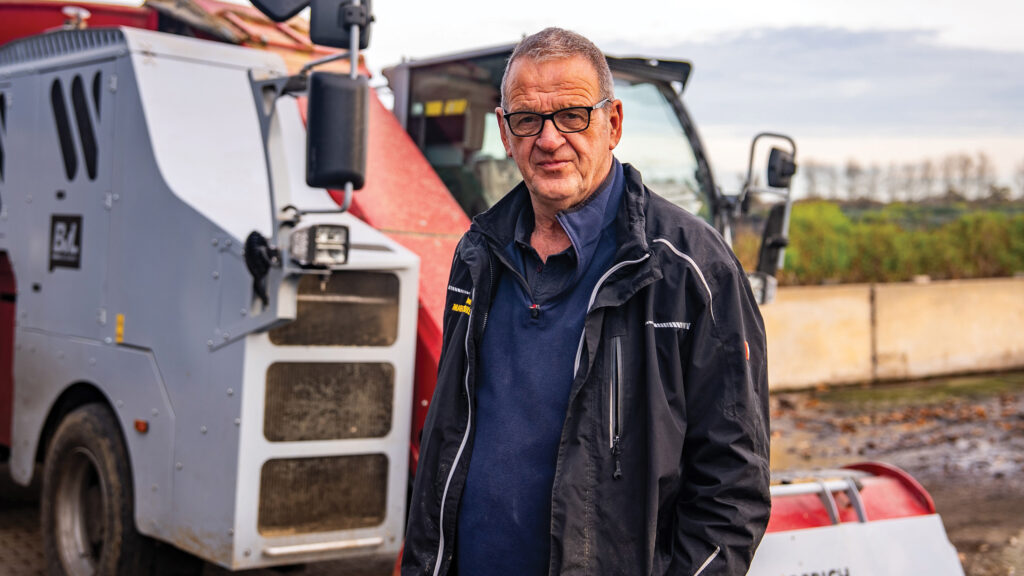
Martin Botterhuis © Steve Sutton
“I’d been working as an inseminator for 25 years and, going from farm to farm, I could see an opportunity to provide a dedicated, specialised service,” he says.
“Machinery prices were climbing, making it impossible for smaller businesses to justify the costs of running a mixer wagon, the tractor to pull it and handler to load it.
“But consistency in a dairy cow’s diet is critical in maintaining milk production and the only way to achieve that is with a decent feeder capable of precisely mixing the same ration day-in, day-out.”
Establishing a round
Though self-propelled feeders were a relatively new concept at that time, Martin says he could see the potential in offering a specialised feeding service travelling between dairies every day.
So he took the plunge and invested in a self-propelled 16cu m RMH single-auger wagon, initially looking after just eight farms.
“It was a bold step and, to begin with, I was worried that I’d made the wrong decision.
“But word spread very quickly and people could see how having me come in every day to put the same portion in front of each cow not only improved their productivity but also worked out cheaper than owning their own equipment,” he explains.
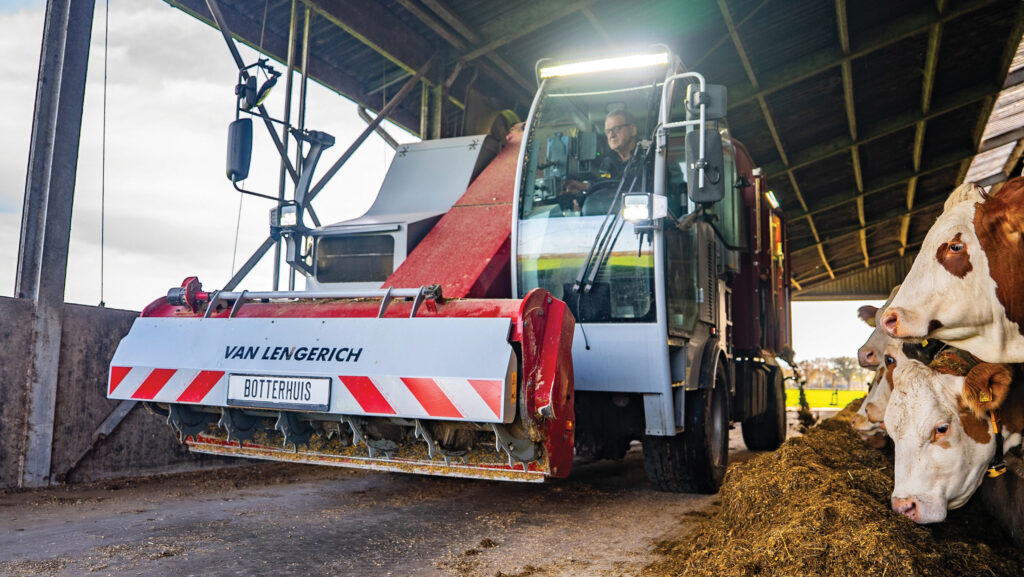
BvL V-Mix Drive Maximus Plus in action © Steve Sutton
“Their neighbours would look over the fence, see what they were doing and when the day came to replace their own trailed feeder, tractor or loader, they would do the maths and realise having a contractor to do the job was actually a cheaper option.”
On the subject of costs, charging has always been done on a per head basis.
When Martin started out, he was billing 35c (31p) a cow.
Today, that figure is closer to 50c (44p), based on diesel costing €1.30/litre (£1.14/litre).
Should it rise above that level then he applies a fuel surcharge; if it falls below then the per head rate drops accordingly.
Machinery upgrade
While the RMH wagon proved the theory, after two-and-a-half years the customer base had grown and he had many more mouths to feed.
This extra workload had begun to take its toll on the machine and getting parts from Israel wasn’t always as quick as it needed to be.
So, in 2008, he took the decision to swap it for something built much closer to home.
“I’d been looking at the options and I liked the twin-auger BvL Maximus – its design seemed like a better fit for feeding small numbers of animals on multiple sites.
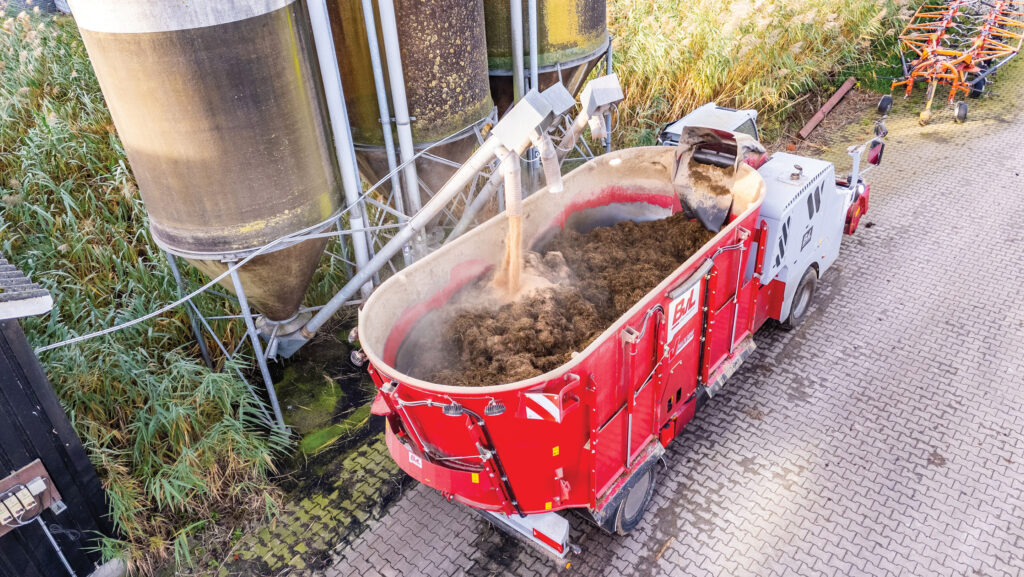
Filling up the mixer © Steve Sutton
“And being just 80km away, I could easily get parts from the factory and talk direct to the engineers should anything go wrong.
“I opted for a 18cu m model, which pretty quickly proved the right decision.
“I had considered something larger but, at the time, BvL’s bigger machines were just too expensive to justify.”
Feed consistency
One of the key advantages of a self-loading feeder wagon is its ability to precisely scoop up the required amount of each diet component without under- or over-dosing.
Plus, with digital scales monitoring what was on board, Martin could accurately produce a consistent ration.
But it relied on the operator keeping a close eye on the scales and having a reasonably agile mathematic ability, with most rations scribbled on a piece of paper wedged into the machine’s sun visor.
As cow numbers within any given herd rose or fell, a bit of rapid arithmetic was required to adjust the total tonnages.
Now on his seventh self-propelled feeder, it’s a totally different story, with cloud-based ration recording providing real-time updates to the diet.
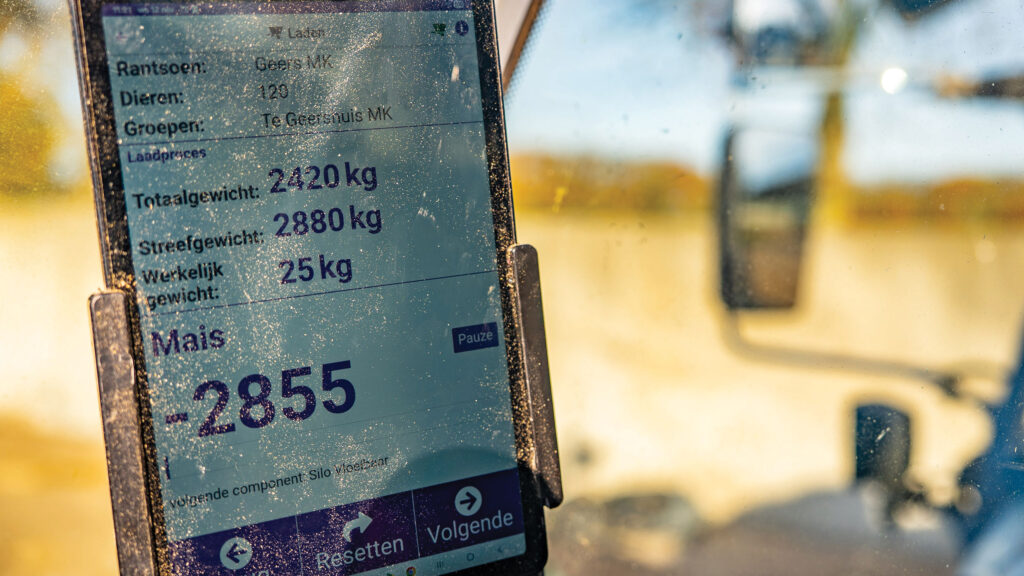
Dairy Feeder computer © Steve Sutton
“One of the biggest developments was the introduction of the Dairy Feeder computer,” he says.
“It can automatically adjust an entire farm’s ration according to cow numbers and constituents, which has done away with all the scribbled bits of paper.
“And because each customer can tweak their diet remotely, the system updates without me even knowing it.
“I just drive into the heap, it tells me how much to load up and it’s done.”
Hours and miles
Martin’s machine covers some 80 miles every day, with the time taken for loading, mixing and discharging the ration on each farm depending on the complexity of the diet and how well the site is laid out.
Typically, he’ll be on farm for less than 20 minutes, though the travelling between units means the self-propelled mixer tends to run for 10-11 hours.
This means it clocks in excess of 3,800 hours annually, so he tends to replace it every two years.
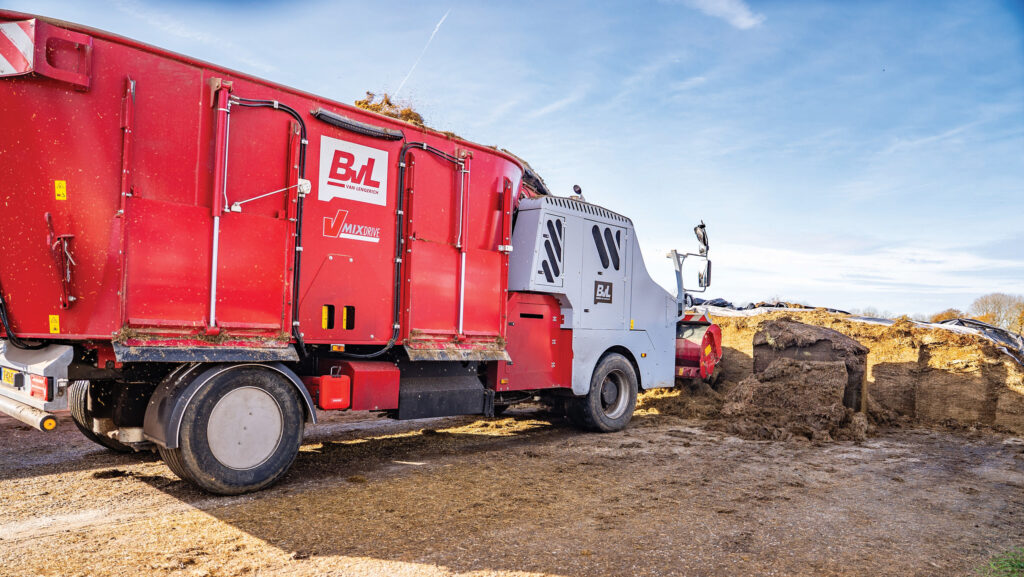
His latest machine is an early version of BvL’s latest generation V-Mix Maximus Plus, delivered mid-way through 2025.
BvL V-Mix Drive Maximus Plus 21-2S
- Capacity 21cu m twin auger
- Height 2.83m
- Width 2.64m
- Turning circle 7.6m with four-wheel steering
- Weight 14t (empty), max 21t loaded
- Engine 174hp 4.5-litre four-cyl FPT
- Driveline 40kph hydrostatic with 4wd and auto locking differentials
- Price €280,000 (£244,700)
Teething issues have been limited to chafing and wear of some hydraulic hoses – an issue the German manufacturer sorted with improved clamps and by separating the circuits for the hydrostatic transmission and mixer hydraulic functions.
However, the rear axle on all Martin’s machines have struggled with the road miles, often covered at flat-out speed to get from site to site in good time.
As a result, the brakes get heavy use and subsequently contaminate the oil in the rear beam.
© Steve Sutton
BvL did offer an additional cooling package to deal with this issue but it didn’t quite meet expectations.
The company says it is currently working on a solution for operators with a heavy transport requirement, though it won’t be drawn on exactly how it is going about it.
“Being paid as a contractor on a per head basis means we have to get round all the farms as quickly as possible, which means I’ll go as fast as I can on the road.
“Consequently, the brakes get a fair hammering. I had hoped the additional cooling package would help but it really wasn’t worth the expense,” he says.
One optional extra that was worthwhile was the uprated loading head.
With high torque motors for the rotor, it doesn’t tend to slow when it gets into some tough stuff, which has made a big difference to turnaround times.
“To maintain our reputation, we have to be seen to be doing a better job than our customers could do themselves.
“By putting exactly the same, consistently mixed ration in front of the cows at the same time every day, they can see the herd performs better,” he adds.
“But it comes at a cost to us.
“We have to invest €280,000 [£244,700] in a new machine every couple of years to maintain a reliable service, and hold a back-up machine in the yard should the main feeder break down.
“It’s essential in giving our customers peace of mind that they’re covered should things go wrong.”