The perks and pitfalls of owning ageing foragers
 © James Andrews
 The prospect of entering a silage campaign armed with an ageing, out-of-warranty forager would leave the nerves of many agricultural contractors in tatters.
But for Will Bright of Devon-based WM Bright, well-worked second-hand choppers are his bread and butter.
See also: Driver’s view: Contractor rates pre-production Claas Jaguar 1200
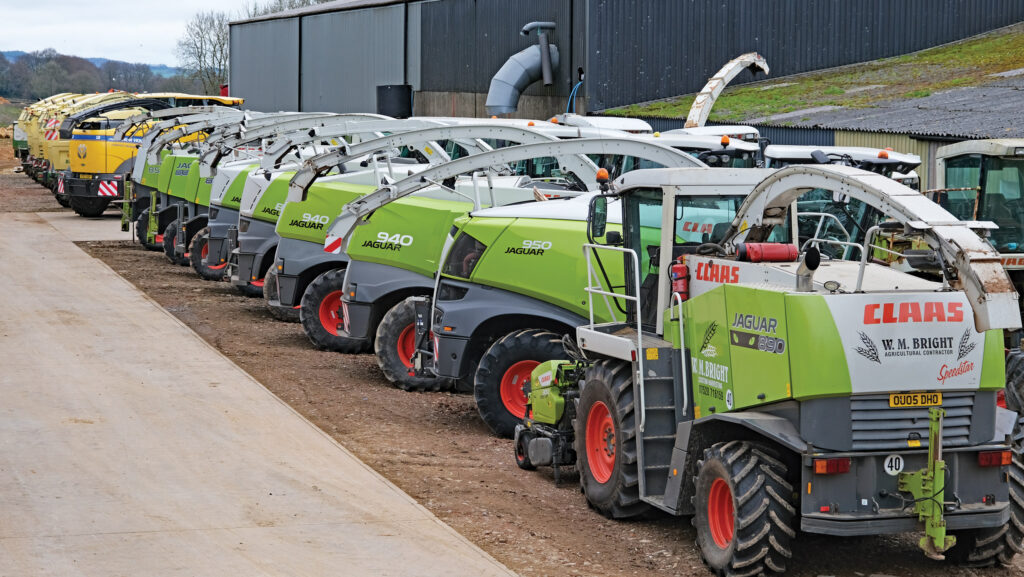
He runs nine such machines in his own contracting operation – half Claas Jaguars and half Krone Big Xs – as well a small hire fleet and a successful sales business.
The attraction of buying, running and selling used is that there are some bumper savings to be had, providing you know what you’re doing.
“The UK is obsessed with hours and fixing costs, which is all well and good, but removing risk is an expensive business,” he says.
“To put it into context, two years’ worth of depreciation on a brand-new Jaguar is enough to buy you a decent used machine outright; one that should give six to eight years of good service and still have some resale value at the end.”
And, by his reckoning, self-propelled foragers can often be at their best after they’ve clocked about 3,000 hours, assuming they’ve been properly looked after.
The challenge is having enough know-how to weed out the gems from those that have been flogged to death.
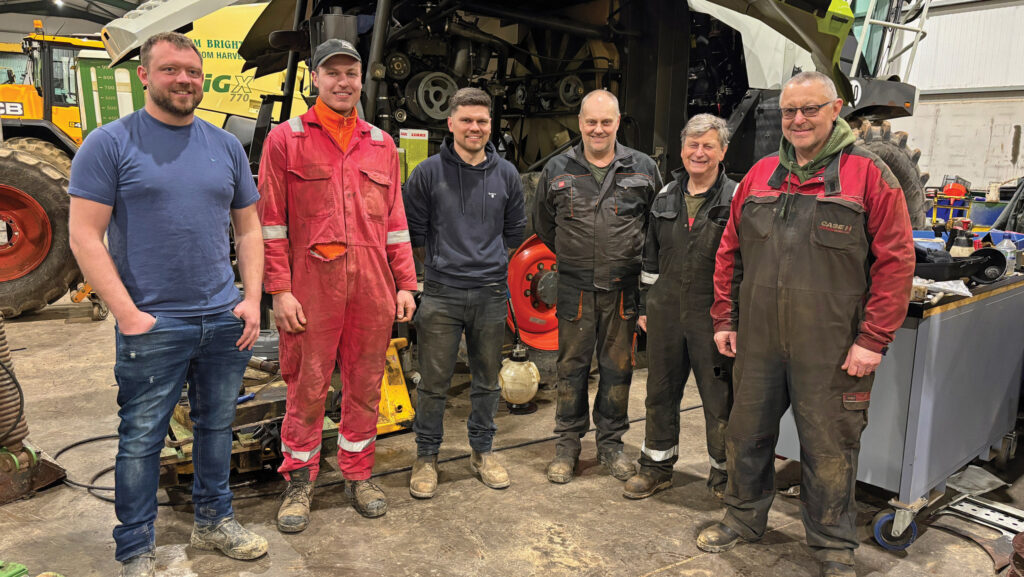
Will Bright (left) with some of the team © James Andrews
Learning the hard way
Few people are as well-versed in this area as Will, who’s run and repaired countless foragers of varying age and condition in his 18-year career.
In the early days, when he stepped away from his apprenticeship at local dealer Hamblys to set up his own contracting business, money was particularly tight.
This forced a make-do-and-mend approach to buying and running machinery, which started with a trailed Taarup 108 that he pulled with a hired John Deere 7810.
There was virtually no spare cash to keep it going, so he patched it up on the cheap by buying a scrap donor to rob parts from.
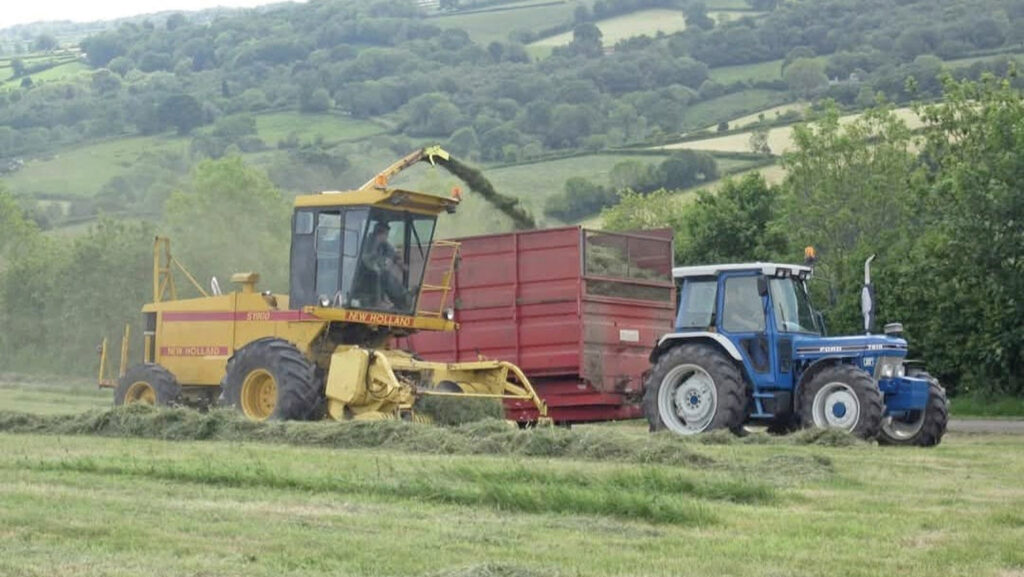
The firm’s first self-propelled was a New Holland 1900 © James Andrews
Then he launched into the self-propelled arena, buying an old New Holland 1900. “I thought I was onto a winner as I could ditch the hire tractor, but that thing broke my heart and my wallet,” he says.
The next step up was a 1998 Jaguar 840, picked up on Copart for just £8,000 as the cab had been destroyed in a fire.
With the help of his friend Larry Diamond, he ploughed 1,500 hours of workshop time into it, grafting on a replacement cab salvaged from a scrapper belonging to his friends at SE Voysey & Son.
He took a similar approach when he was first asked to cut some wholecrop.
Unable to justify buying or hiring a header, he created his own Frankenstein setup from parts he found lying around – a Claas Disco mower bed, some Coma gearboxes and other assorted scrap.
“We got it finished in the early hours ready to go to work the next day and were so pleased with ourselves that we forgot to come up with a way of moving it.
“So we spent the rest of the night making a header trailer out of two lengths of RSJ and the back axle off our old Iveco van.”
After running the 840 for two seasons, he was able to take out some finance to buy a 2005 Jaguar 890 for £52,000, which he’s still running now.
“That was a big deal and though the borrowing gave me some sleepless nights, it was the first chopper I spent more hours driving than rebuilding.”
Will ran an array of different machines over the next few years and, as the workload increased, he eventually worked his way up to owning brand new models – a Krone Big X 630 and 680 – before reverting to good second-hand examples.
“Buying new was something I had to do, if only to prove how the finances worked. But I got fed up with the depreciation – it’s a constant drain, whether you’re having a good year or a poor one like last season.
“When you’ve got older machines that are bought and paid for, you don’t have to stress too much if they’re parked up because the grass isn’t growing.”
Mixed contracting line-up
On the Claas side of the fleet, Will now runs four models built between the late 1990s and early 2010s with hour counts ranging from 3,000 to 7,000.
Oldest of these is a 1999 Jag 860 which tends to get used on smaller farms, followed by the 890 from 2005 and a 940 and 950 hailing from 2010 and 2012, respectively.
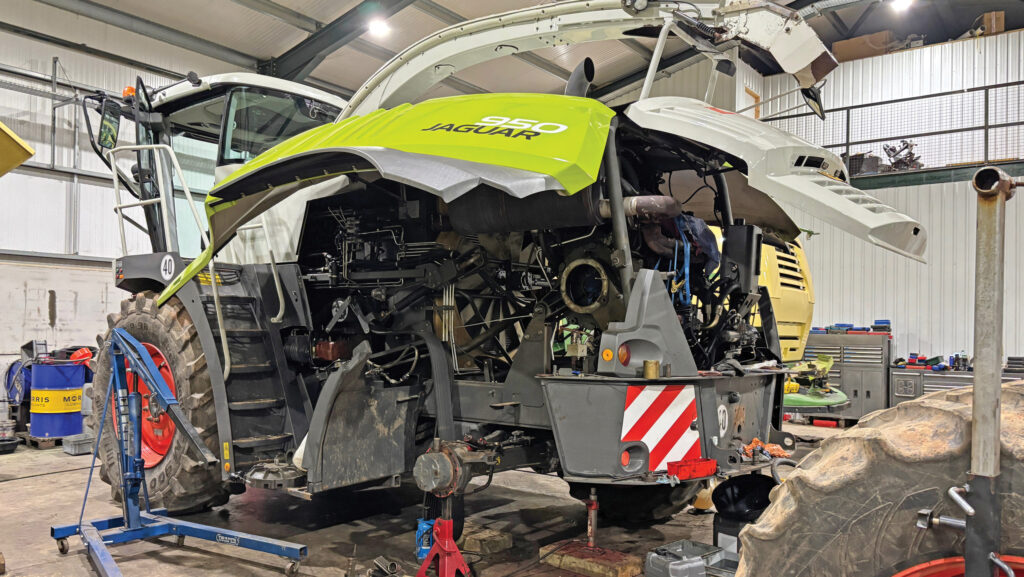
A Claas Jaguar 950 undergoing a miscanthus conversion © James Andrews
These mainly chop in grass and wholecrop, with a stint cutting miscanthus in the spring.
This requires a raft of temporary modification work, such as fitting re-engineered Orbis maize headers and hollow drums that give a more consistent chop length.
A diverter plate is also installed between the drum and accelerator, along with a removable panel to direct the crop onto the ground, forming a swath that can be baled.
As soon as the miscanthus harvest is complete, the spannering process is reversed so they can resume normal service.
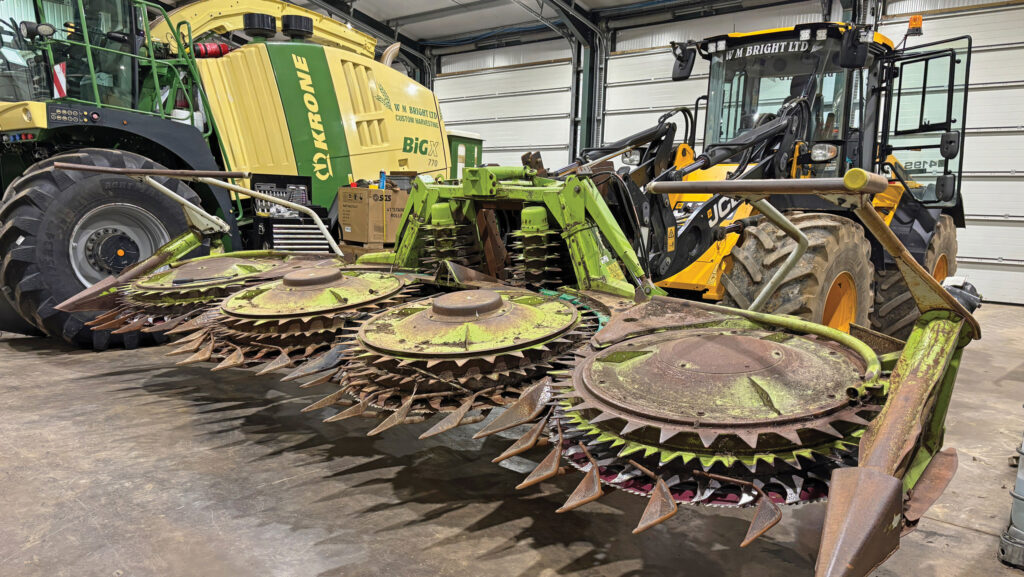
An Orbis header being modified for miscanthus © James Andrews
The maize harvest is handled by Will’s five wide-body Krone Big Xs – an 1100, three 770s and a 700.
These run 12-row headers and 40-knife drums to satisfy the needs of his AD customers, but he also has complete 20-knife chopper units ready to bolt in when switching back to grass.
“This means we don’t have to mess around taking individual knives in and out when we move between crops,” he says.
It’s the same story with corn crackers, headers and a clutch of other parts, allowing him to quickly adapt to different crops and cutting conditions.
“Over the years we have built up a fantastic network of customers who we enjoy working with and we’re always keen to find ways of doing the job more efficiently for them,” he adds.
“This can involve modifying a machine to work better in a specific situation, or it can simply mean bringing in multiple units to make sure a crop is harvested at peak dry matter.”
Building reliability
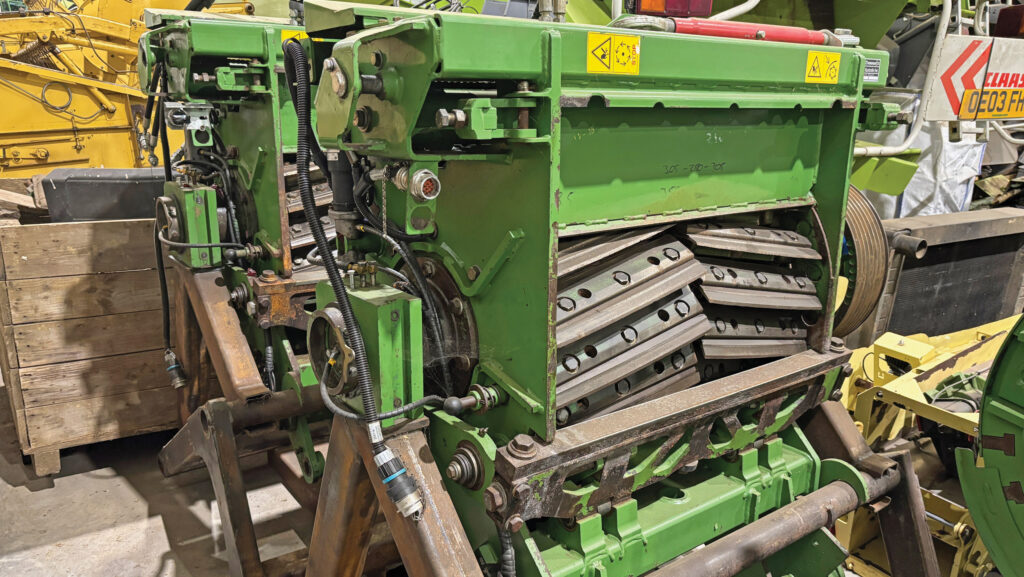
Spare chopper units speed up the switch between maize and grass © James Andrews
Will has also bolstered reliability by amassing a hoard of spare parts, from feed rollers, chopper units and blowers to transmissions and engines.
All this means he can get up and running in double-quick time after a breakdown.
Plus, he has enough spare capacity to not feel the heat if a machine is benched while awaiting repair.
That said, because he and his eight-strong team of drivers/mechanics are diligent with their maintenance regime, in-season failures are fairly rare.
“I’m lucky to have a great team, who know the job inside out, can spot any problems early and know how to fix them,” he says.
“Even if the worst happened and we had an engine failure, I reckon we’d get a replacement fitted in 10 to 15 hours, so it wouldn’t be that big a deal.”
And because he’s got spares in stock, the financial outlay would be manageable too.
“The problem comes for those that have to consider buying a new engine, as the prices are eye-watering – a MAN V12 is more than £100,000 these days.”
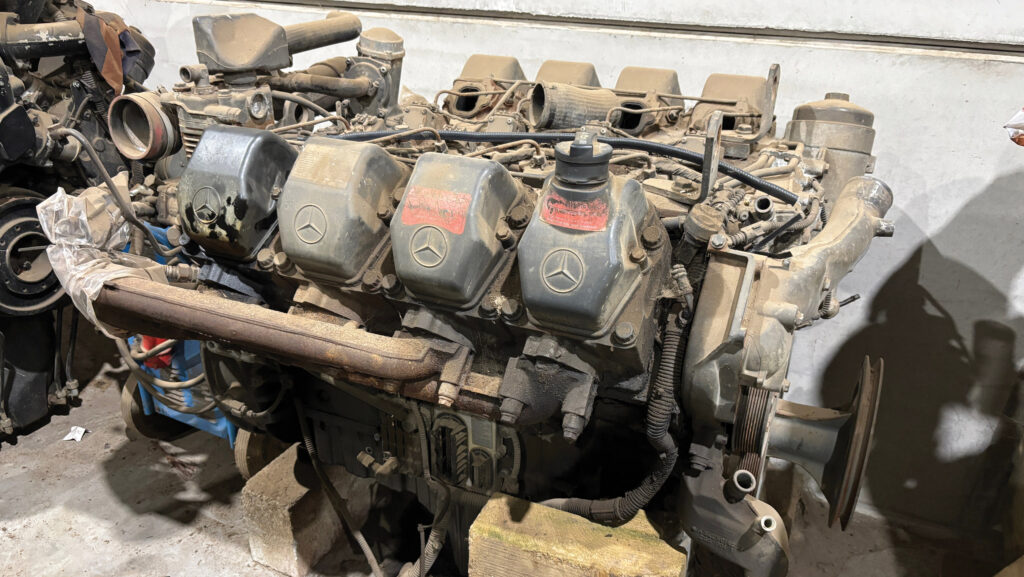
Extensive used parts stock includes this Merc V8 © James Andrews
Self-drive hire
With his own fleet well sorted, the natural progression was to begin hiring out for customers to operate themselves – the only caveat being that the driver must possess a degree of mechanical sympathy.
Some of those he supplies simply don’t have enough work to justify buying a machine but want the flexibility to do their own work; others might need one as a stopgap while their chopper is being patched up due to a mid-season blow-up or major breakdown.
Will’s team are often able to carry out this work too, using good second-hand or refurbished parts.
“This is useful when foragers get older and insurance companies are likely to write them off as total loss due to the cost of new replacement parts.
“We have salvaged several in this way, keeping the repair cost down and getting them moving with a hire machine, the cost of which is usually covered by the customer’s insurance.”
Buying and selling
Another side of the business that’s grown steadily over the years is second-hand forager sales.
It started with Will moving on his old models as newer ones came into the contracting and hire fleet, but it’s grown to become another arm of the business.
Some 50 to 60 used foragers – most of them either Claas or Krone – now pass through his yard each season, all of which are given a thorough health check before they’re moved on.
This includes testing engines and transmissions for any faults and, at times, sending oil samples off for assessment.
They can also check for excessive wear on driveline components using DTI gauges.
A chunk of these foragers will be mint low-hour examples that are ready to go straight to work, while others will have varying degrees of wear.
“When requested, we can produce a report for each one, so buyers can see exactly what they’re getting – some will have the budget to buy them fully serviced while others can save cash by doing bits of refurb work themselves.”
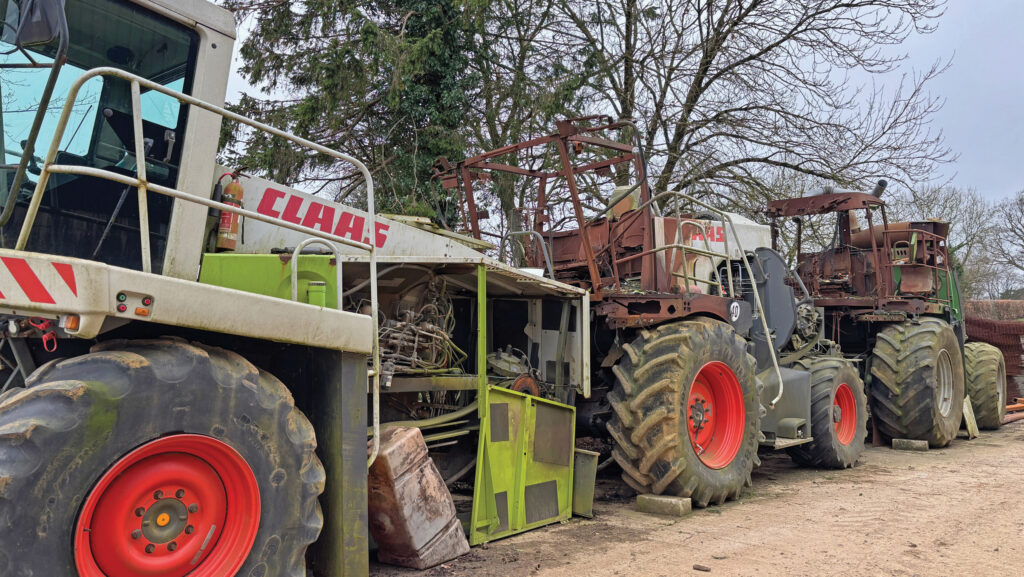
Stripping breaker machines helps keep the fleet running © James Andrews
When to call it quits
Despite his proclivity for high hour counts, there comes a time when a forager has done too much work to warrant frontline service.
“You won’t find many people willing to take a risk on an 8,000-hour machine, even if it’s in good working order, so that’s when the talk of breaking comes in,” says Will.
Some of the harder-worked members of his fleet are therefore on the “conveyor belt” to being dismantled, after which time their various components will be used to replenish his stores.
That said, he’s keen to see the current five Krone machines and the 890 get to 10,000 hours and still be working reliably.
Thanks to the rigorous preventative maintenance regime they’re treated to, he reckons they’ve got a decent chance.
This attitude means he doesn’t disassemble a sufficient number of machines to become a bona-fide breaker.
However, he processes enough to keep his own line-up going strong – and those of loyal customers.
“I don’t like to see them go that way, so I’ll often post a Facebook ad for a high-hour machine to see if anyone wants to rescue it – occasionally they do and it’s always nice to see them going again.”
Will’s used chopper dos and don’ts
Self-propelled foragers get a hard life, so it pays to go into any used purchase with your eyes open.
Some will be in nearly new condition, others will be virtually fit for the scrap heap and the rest will be somewhere in between.
“The number of hours worked does matter to a degree, but the way it has been looked after is most important,” says Will.
“The condition of wearing parts isn’t a big deal as these are all replaceable – the important thing is to pay the appropriate price for what you’re getting.”
Of more concern should be the engine and transmission which, regardless of the brand, will put a serious dent in the owner’s finances if they fail.
The best bet for avoiding trouble in this area is to buy from a known source or a trusted dealer.
Once a used chopper is pressed into service, regular preventative maintenance is the key to getting a long and trouble-free service life.
“For those who are doing 200 to 400 hours of chopping a year, spending £6,000 to £8,000 on parts annually will keep it in good condition,” he says.
“That might sound like a lot, but it really isn’t when you compare it to the depreciation on a new one.”
WM Bright forage harvester fleet
Claas
- 2012 Jaguar 950 on 4,500 hours
- 2010 Jaguar 940 on 6,000 hours
- 2005 Jaguar 890 on 7,000 hours
- 1999 Jaguar 860 on 3,000 hours
Krone
- 2016 Big X 1100 on 4,300 hours
- 2018 Big X 770 on 3,800 hours
- 2017 Big X 770 on 3,500 hours
- 2017 Big X 770 on 2,500 hours
- 2014 Big X 700 on 3,500 hours