Driver’s view: The good and bad of JCB’s 435S loading shovel
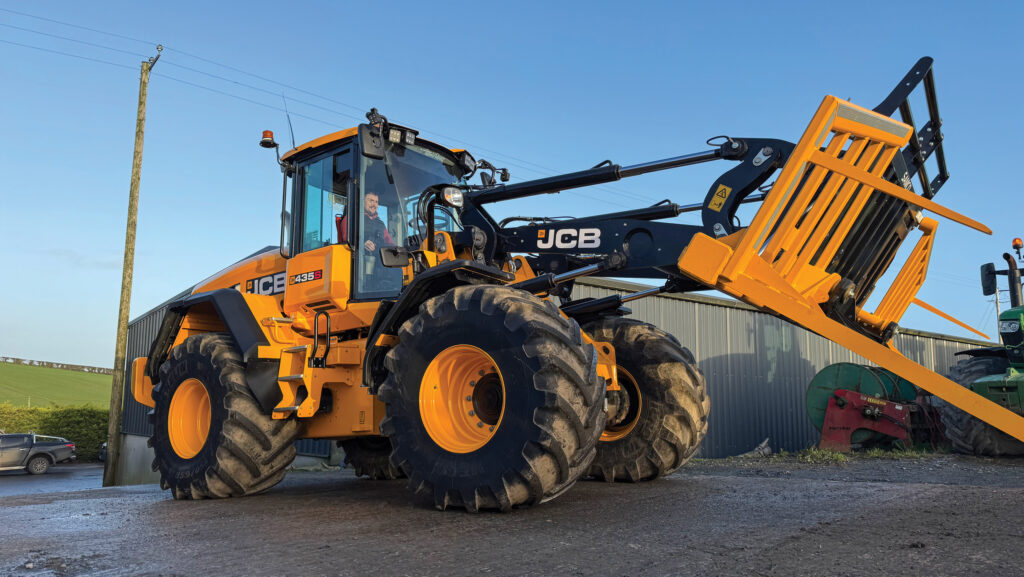 JCB 435S wheel loader © MAG/Oliver Mark
 JCB’s self-proclaimed “king of the clamp” underwent some subtle surgery last winter, giving it more power, more torque and a nifty new lever-steer system.
An early example of this latest 435S wound up in the hands of Nathan Lockhart, chief clamp constructor for Newry-based Wallace Contracts.
It is the firm’s third 435, bought to replace an eight-year-old, 6,000-hour model and working alongside a 21-plate currently showing 4,000 on the clock.
See also: Tractor-mounted pick-up slashes forage wagon chop length
JCB 435S wheel loader
- Hours 900
- Year 2025
- Engine 6.7-litre, six-cylinder Cummins
- Max power 282hp@1,900rpm
- Max torque 1,200Nm@1,300rpm
- Transmission ZF six-speed powershift with torque lock-up
- Top speed 48kph
- Operating weight 15t
- Hydraulics 153-litre/min pumps x2
- Tipping load 9,142kg
- Standard shovel capacity 2.4cu m
- Tyres Michelin MegaXBib 750/65 R26s
- Price paid £185,000
Together, the pair pushes 6,000ha of grass, nearly 500ha of maize and 160-200ha of wholecrop harvested by a trio of Claas Jaguars: a 990, 970 and 850.
Nathan gives us the lowdown on the newcomer’s performance after a season in the saddle.

Nathan Lockhart © MAG/Oliver Mark
Why a JCB 435S?
JCB has the best machine out there by some margin.
No shovel is better set up for working a clamp and, though Volvo might have the edge for longevity, we’re not depending on them beyond about 6,500 hours.
We were almost certainly going to get another 435 when the old one’s time was up, but we did try a 457.
Its hydraulics were far superior – the lack of power on the crowd function is one of the 435’s weaknesses – but there’s no doubt it was more sluggish and less agile.
That said, we’re not ruling it out for the future, purely because of the volume of grass we are pushing, and the speed at which we’re having to do it.

JCB 435S cab © MAG/Oliver Mark
Did you spec any extras?
It’s got the full “contractor” package, so was already specced to the max.
Included in that were LED lights, which don’t leave a single dull spot, and an auto lube system that takes care of everything bar the middle pin and driveshafts.
One thing we did request was an extra auxiliary coupling on the front.
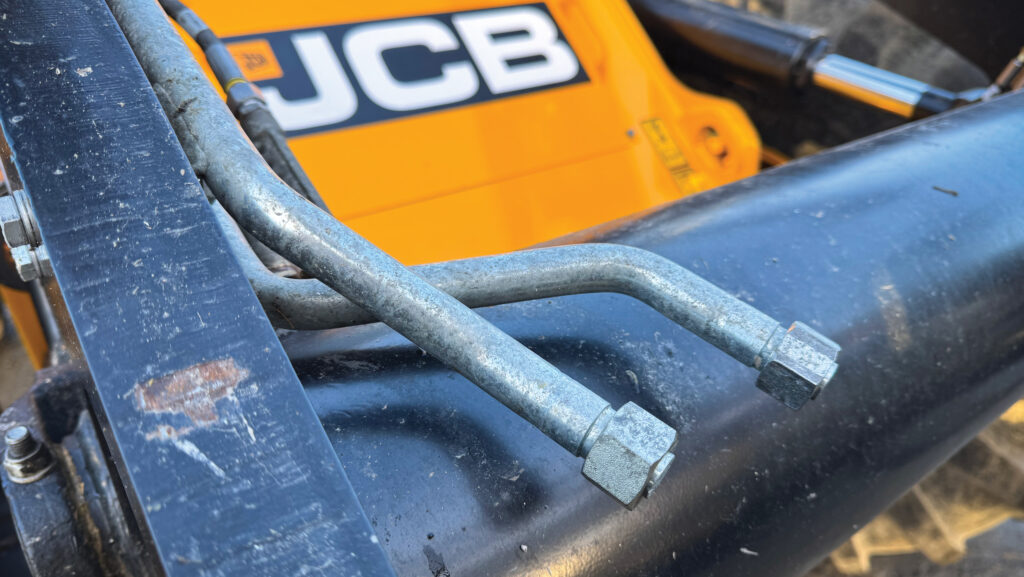
Extra auxiliary coupling © MAG/Oliver Mark
We’ve currently no use for it, but it gives us the option of running a push-off buck rake someday.
That would mainly be for maize; grass can only be properly levelled by flicking.
For now, I’ve got a new Samco buck rake with 7ft tines.
Previously, I had a six-footer, so it should give me a bit more capacity – provided the hydraulics can handle it.
Biggest improvements?
The extra torque is the most noticeable, especially low down the rev range.
As it hangs on that much better, I can let the revs drop right back, limit the wheelspin, then walk through the grass.
There’s more power too – it’s now 282hp in “dynamic” mode [up from 252hp].
Rightly or wrongly, I run it in this all day, rather than the lower output “standard” setting.
Despite the extra poke, fuel consumption is no different to the older ones.
It averages about 20-25 litres/hour – 250-300 litres on a 12-hour day – and rarely strays above 30 litres/hour, even at full capacity behind two harvesters.
I can’t see anything else using less fuel relative to the power output and amount of grass it’s shifting.
The other thing I love about this 435 is the new joystick steering.
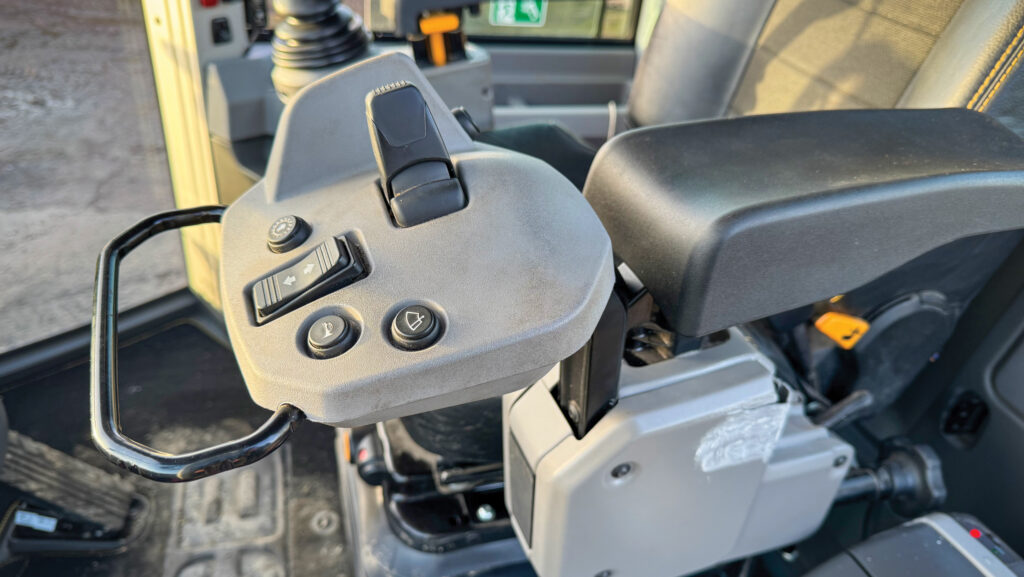
Joystick steering © MAG/Oliver Mark
It’s so smooth and comfortable that I don’t think I used the steering wheel for a single load of grass last year. Going back to it would feel pretty foreign.
The only time it gets swung down is for road travel, as it’s limited to 25kph on the joystick – and seriously twitchy at that speed.
It might be a different story if there was a means of altering the sensitivity in the screen.
In fact, the biggest problem with the system is that the steering wheel is still there.
It slightly interrupts the view forward and completely blocks the dash, so either the column needs to drop down further or JCB needs to move the display somewhere else.
As it stands, I can’t even see the diesel gauge without moving the wheel.
Another minor issue is that the left armrest rubs on the side of the hot/cold storage box when it’s folded up and I’m bouncing on the seat. The plastic trim has already cracked.
What’s it like on the clamp?
The balance of power and weight [19hp/t] is about perfect, and it’s manoeuvrable – one of the major appeals over the 457.
You can have as big a machine as you like in some yards, but we work in all sorts, and some of them are ridiculously tight.
This was even more of a challenge last year. It pushed the 4,000ha of grass behind our new Jag 990, plus a bit more from the other two harvesters. And there was a serious amount of it.
We were cramming it in every nook and cranny we could find, so the mudguard-mounted side mirrors came in particularly handy.
However, I’ve still snapped both foamy fender extensions.
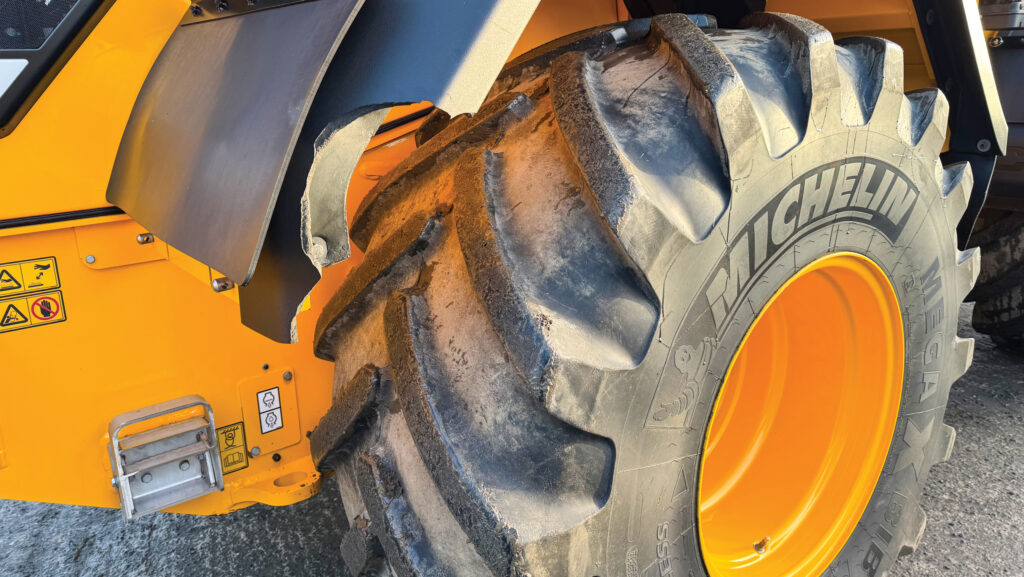
Fender extention on JCB 435S © MAG/Oliver Mark
They tend to catch on the heap of tipped grass when I reverse back down the clamp towards it and the suspension hits the stops.
Ideally, I’d also like a bit more clearance under the back, though I’d probably still hit it if it was a foot higher.
But the 435’s one major weakness when dealing with big volumes is the lack of hydraulic power on the crowd function.
It’ll sometimes refuse to flick a big load and, though it’s not impossible to work with, I’d like more – especially when the grass is flying in and I’m under pressure.
We’ll see how it fares with the longer tines of the new buck rake.
By comparison, I drove a Volvo years ago and it had unreal power on the crowd ram – to the point that it pushed the machine back and lost grip.
And on the road?
Most of the work is on our doorstep, but we do travel up to 25 miles for some jobs.
It’s seriously comfortable and I barely feel a bump, especially with the Smoothride system on the loader arms.
Plus, it’ll easily do 50kph with the direct drive torque convertor auto lock up.
That’s almost too quick in the wrong hands.
We found the brakes got squawky after about 700 hours, but changing the axle oil sorted that.
How much?
There’s no question these yokes are dear. And at the best part of £190,000, they’re getting hard to justify.
But we’re reliant on them, so reliability and warranty are critical, especially on the front-line machine.
Fortunately, it has given us very little trouble so far, bar the odd electrical niggle and an issue with the NOx sensor, and we’ve never had to pull out of a job because of a breakdown.
That said, every clock hour costs money.
For starters, there’s the £18-£20/hour on diesel, and £2/hour for the service plan with our local dealer, Kennedys.
And tyres are big money. A set usually lasts about two years and the previous BKTs we bought were £8,000 – about £3/hour.
We’ll probably put them on this one, too, as they seem to go just as well and are far cheaper than the £12,000 for Michelin MegaXBibs.
Then there’s another £20/hour in depreciation.
The lead machine will do 1,000 hours a year and the back-up about 600.
So this one will have clocked about 6,500 hours by the time it has dropped down the pecking order and is ripe for replacement.
It’s still well sellable at seven or eight years old, albeit for £60,000-£70,000 – down at least £100,000 on what we paid.
That’s really at the limit of what’s affordable, and it’s worrying that we have to assume all these costs to get the reliability and performance we need.
But that’s the way with agriculture these days. High costs mean high workloads to pay the bills.
The upside is that it’s fit to handle 80-120ha a day, so it can at least do the work to justify the expense.
In fact, the biggest challenge for us is finding skilled labour.
It’s an intense job that demands complete focus from the minute you turn the key.
And there aren’t many people that can handle it – or are willing to devote themselves to learning the trade.
When we’re going, there’s no rest. All our customers are looking for the same weather windows, and the grass just keeps on appearing.
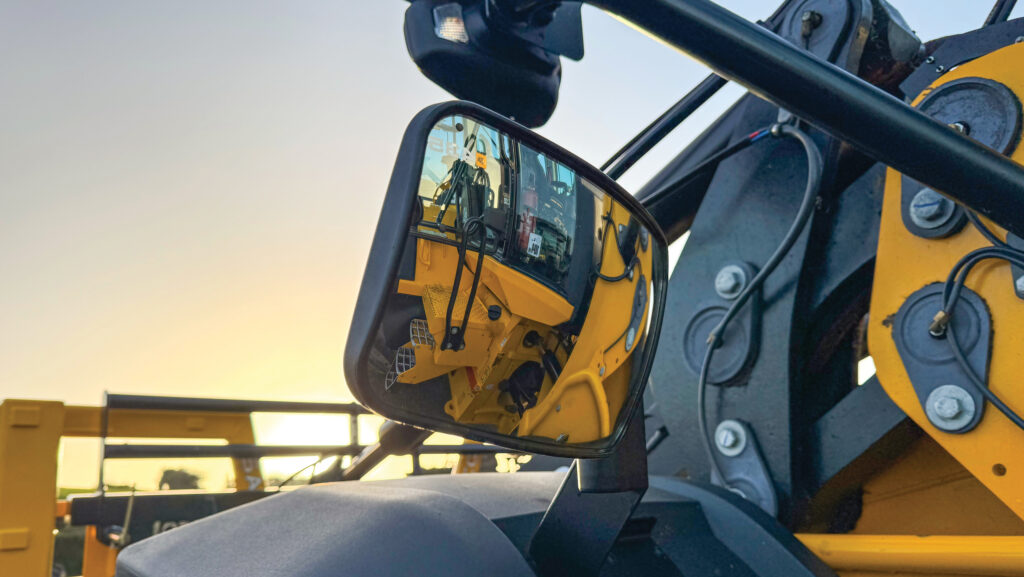
Side mirror © MAG/Oliver Mark
Likes and gripes
Likes
- Torquey at low revs…
- … And less wheel slip as a result
- Side mirrors improve view to rear wheels
- Brilliant joystick steering system
Gripes
- Lack of power on crowd function
- Expensive to buy and run
- Steering wheel blocks dash view when not in use
- Left-hand armrest rubs on fridge