Driver’s View: Guy Walker rates Lexion-like Claas Trion 760
 © MAG/Oliver Mark
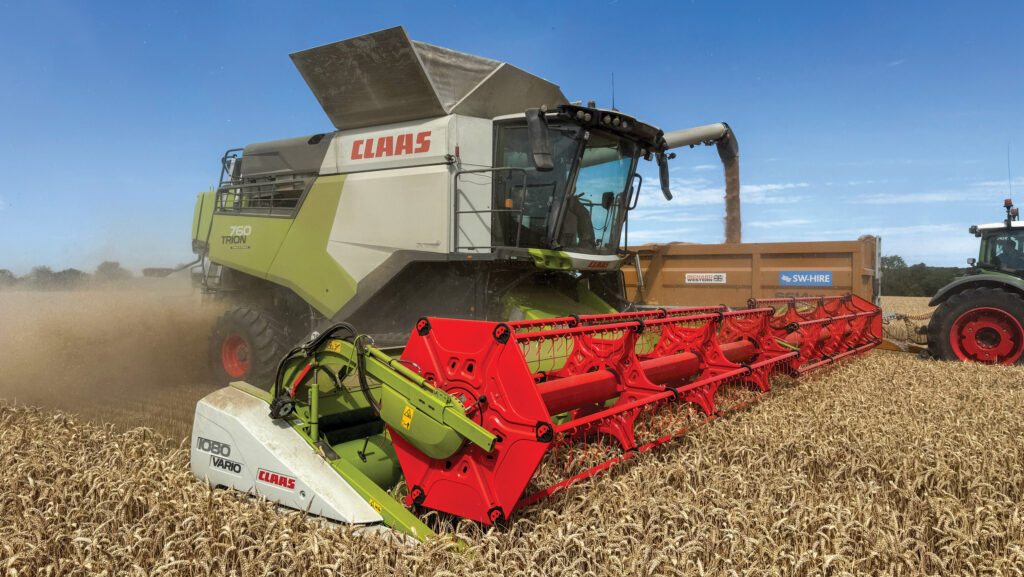
 A gnat’s doodah is about all that now separates the top Trion from the lowliest Lexion in Claas’ combine line-up.
The two ranges were drawn closer than ever last summer with the introduction of the Trion 760 that comes with a higher spec cab, bigger engine and a ruck of features common to the firm’s hungriest acre-eaters.
See also: Driver’s view: Ed Layton’s John Deere T5 600 Hillmaster
While single-rotor Trions remain Cummins-powered – a mix of 6.7- and 8.9-litre six-cylinders – the 750 (462hp) and 760 (507hp) now run MAN’s 12.4-litre oil-burner.
And to boost performance, it has several new-to-Trion attributes, such as automatic engine power management and “dynamic cooling”, which varies fan speed according to load.
Together, Claas reckons these additions can cut fuel use by up to 10% and save more power for threshing and chopping.
Combined with the extra firepower, they should make the 760 better suited to running a 10.8m (35ft) header than any previous Trion model.
The threshing hardware has remained largely unchanged: a 1,420mm-wide hybrid crop processing system with a 600mm drum, impeller and pair of 445mm-diameter separation rotors.
One of the first Trion 760s to land on UK soil was snapped up by Rob Davies. His Wiltshire-based contract farming business, Davies Agriculture, also runs a six-year-old Lexion 7600 to handle 1,400ha of harvesting spread across five farms from Warminster to Salisbury.
We caught up with operator Guy Walker as his machine gobbled the last few acres of second wheat in late July.

Guy Walker © MAG/Oliver Mark
What made you choose a Trion 760?
Our old machine was a 13-plate Lexion 760 that had been with the business since new. It had clocked about 4,000 hours, so well out of warranty and due a change.
The replacement was always going to come from Claas. New Holland might have had a look in if it wasn’t for the backup from Claas Western at Frome, which is superb.
We started sizing up the options with a Lexion 7600 demo a couple of years ago, but never pulled the trigger. Then the Trion 760 came out.
It was £50,000 less for what is pretty much the same machine. The only notable difference is that the Lexion has a 100mm wider feeder house that can swallow a bit more material.
Previously, power would have been a major limiting factor, but that’s no longer an issue as it matches the Lexion.
This is critical for us because, bar one farm with a beef unit, we chop all the straw. Prior to going down this route, Rob did a full cost-benefit analysis on baling versus chopping, and his calculations have proved correct.
I’ve seen it first hand, as one of the farms we work for is my own near Warminster. It’s on greensand and the yields have almost double in the decade since we stopped baling. I wouldn’t dream of starting again now.
RD Agriculture’s Claas Trion 760 Terra Trac
- Year 2026
- Engine 12.4-litre MAN
- Max power 507hp
- Threshing system 1,420mm-wide hybrid processing system with APS drum, 600mm threshing drum, impeller and twin rotors
- Rotor length/diameter 4.2m/445mm
- Header 10.8m Vario
- Grain tank capacity 12,000 litres
- Price paid £450,000
What header has it got?
We went for the 35ft [10.8m] 1080 Vario – an upgrade on the previous Lexion 760’s 30ft.
Any doubts we had about the combine handling it were laid to rest when Claas offered a guarantee to take the header back and provide a 30ft replacement if it didn’t work out.
It has proved just right. Average engine load is about 85% – albeit in an easy year – and the chopper and spreader probably account for 40% of that, especially as I prefer to leave a slightly shorter stubble that is easier to cultivate.
The header has a few new features, one being the tool-free oilseed rape knife that just latches on to a locking plate without faffing with hydraulics.
Another is the ability to pitch the centre of the auger to leave a bigger gap for chewy crops.
I was really looking forward to trying it, but only managed to do so in oats and oilseed rape – conditions were so dry that there was no call for it in the wheat.
We’re on stony ground, so a Convio belt header was out of the question.
© MAG/Oliver Mark
What’s it like to operate?
The cab is brilliant. It’s wider and deeper than the 7600, and they’ve moved the console in the roof lining up and away, so it doesn’t hang right in your face.
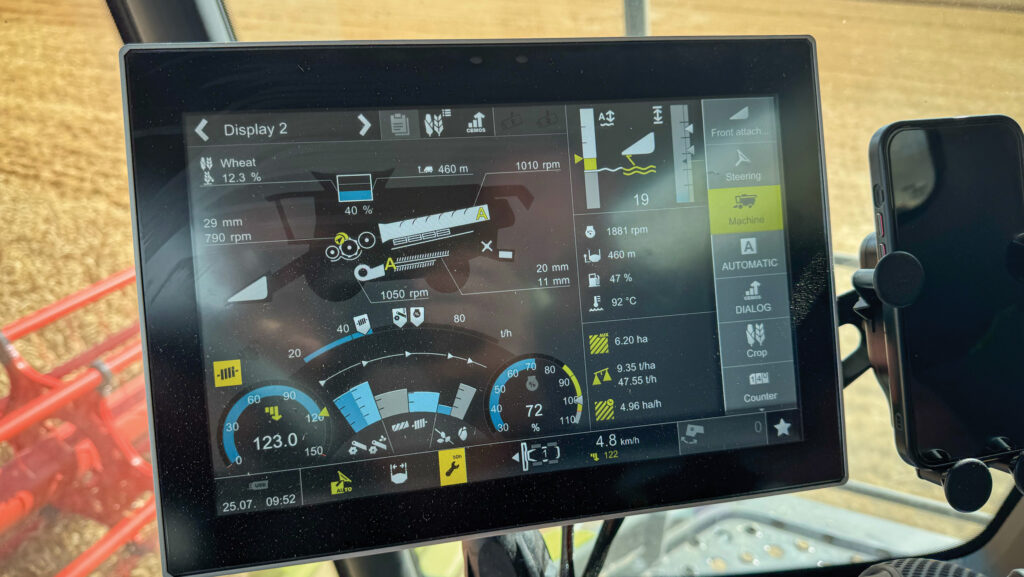
As for operating it, I’d love to take the credit for the clean sample, but it’s almost all down to the Cemos Automatic system.
A dummy could probably drive it in an easy year, though I’m not sure whether the technology would be up to the job in a more challenging one.
There are generic settings for each crop, which it then tweaks as it goes. In my defence, it does need a fair bit of hand-holding early in the season.
To help, it has a camera that scouts the sample for cracked grains and chaff, which it shows on the screen in the cab.
Based on this, the computer will throw up suggested alterations to improve cleanliness and quality, such as lifting the header to reduce straw volume.
I’ll sometimes leave it to control the combine’s forward speed too, but it only really works in a uniform crop. It struggles to react to variability and never quite mastered the oats.
As they were light, it thought it could fly through at 6kph – which I wasn’t happy with.
The 7600 also has Cemos Automatic, but its version is less proactive; the Trion is constantly live to crop changes and suggesting ways to optimise performance, whether it’s engine rpm, concave opening or anything else in the threshing system.
© MAG/Oliver Mark
Has it been reliable?
Granted, it has had the easiest season for years, but it has barely put a foot wrong. The sole issue was a faulty a sensor on the unloading auger, which took the dealer an hour or so to sort.
Bar that, it has cruised through harvest – starting on 6 July and finishing, unbroken, exactly three weeks later.
The two combines tend to run together in the same field, except on small farms without the infrastructure to handle the incoming loads from two high-capacity machines. I have GPS, so can open the breaks, with the Lexion then following with its Laser Pilot to track the edge of the crop.
Together, they comfortably cut 65-75ha/day. During that, the Trion almost always used less fuel. It tallied 13.6 litres/ha and typically bettered the Lexion by 2 litres/hour.
© MAG/Oliver Mark
Maintenance is marginally easier, too. There are slightly better grease nipple banks, including on the back of the rear axle for the straw chopper and chaff spreader, which take all of five minutes to get around.
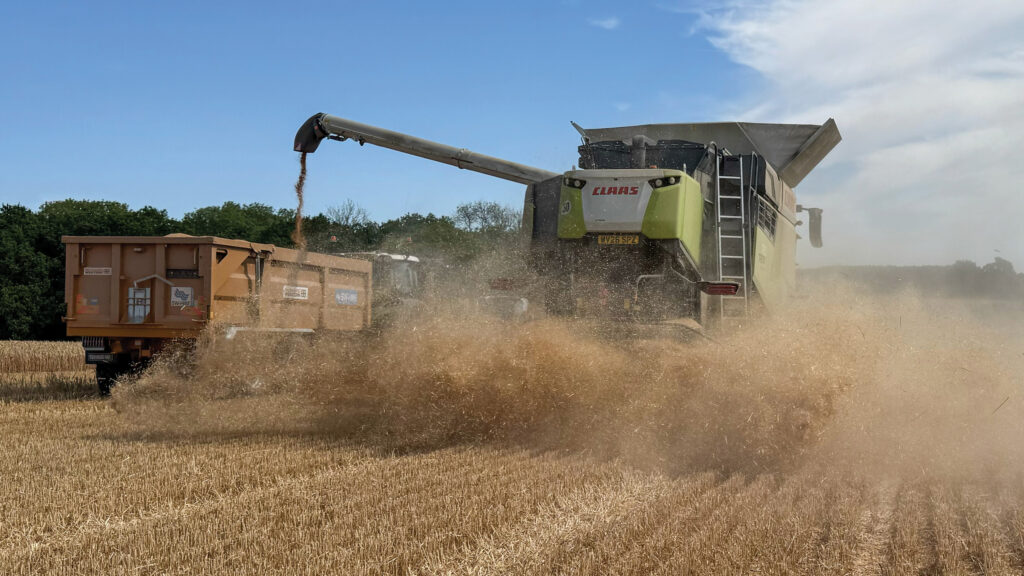
Blowing down takes about half an hour. The exhaust heat shield has been revised so that it is now completely enclosed, which reduces the fire risk, but the machine does seem to get quite dirty.
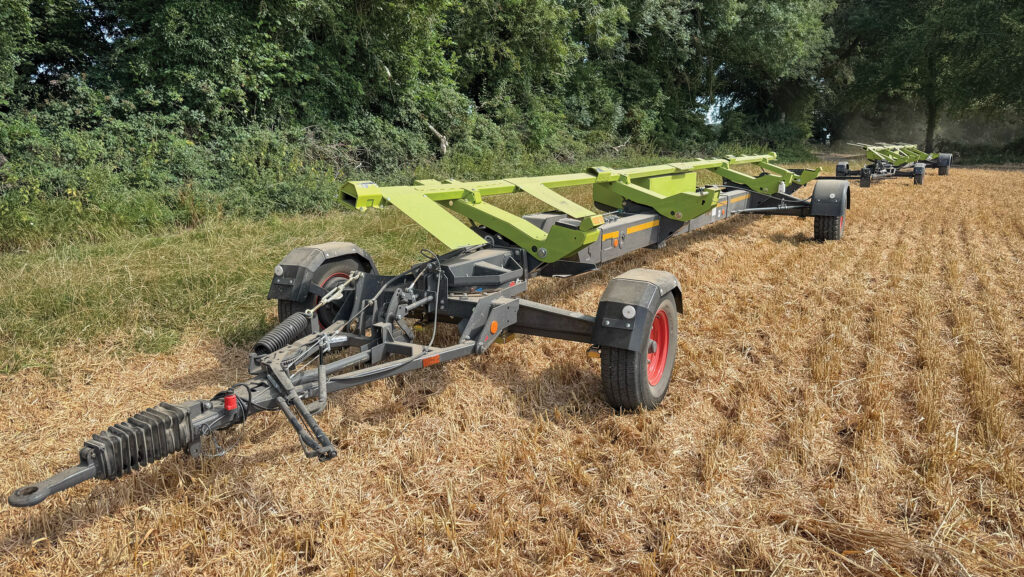
One thing I do like is the addition of a header trailer service alarm. It’s a great idea, as the trailers are a forgotten part of the fleet and would only get greased if we were twiddling our thumbs on a rainy day.
© MAG/Oliver Mark
What could be improved?
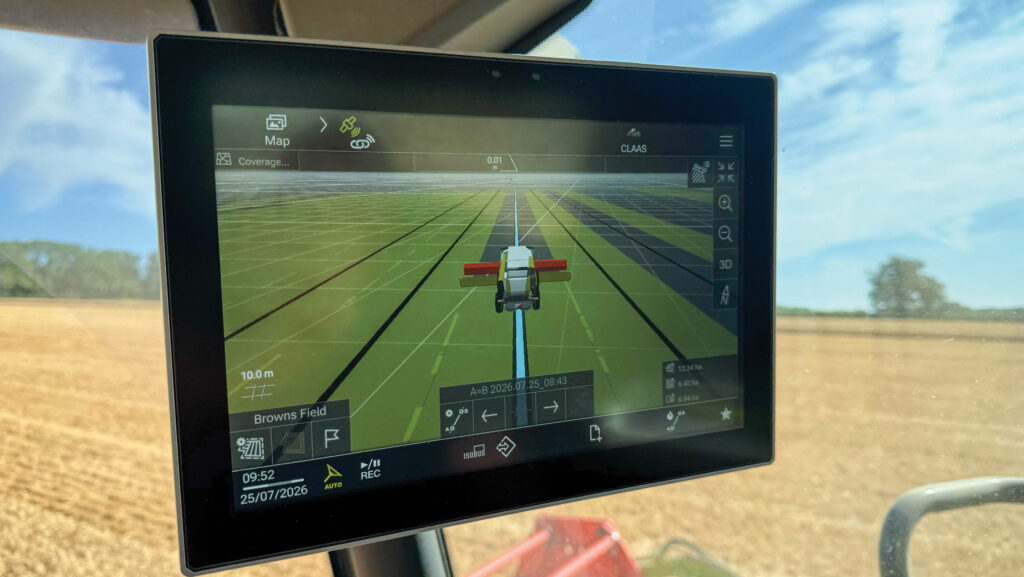
Very little. My biggest bugbear is the GPS system and, in particular, its inability to automatically load a field as I cross the boundary.
We have 120 fields spread across five farms, so I have to remember the name of each, then scroll through a huge list to select the right one. It would be nice if this happened automatically or, if nothing else, there was a search function to find it quicker.
The Egnos signal doesn’t like trees, either. But that’s just the way it is – it’s generally accurate enough and doesn’t seem to suffer from daily line drift.
If I was being picky, one thing I’d quite like is an automatic filling system that allows me to control the carting tractor, like John Deere’s Machine Sync.
Equally, though, it would be taking skill away from the trailer driver. And, anyway, I’ve got spout end control, so I can direct the flow like a forager to get it where I want.
Though this machine might not end up staying as long as the last one, it’ll no doubt be here for the best part of 10 years. In the meantime, we might end up with another.
The Lexion 7600 will be moved on in the next four years, as it’s out of Maxi Care warranty, and I can’t see any reason why we wouldn’t get a matching pair.
People might be put off buying a Trion purely because of the name, but it’s basically a Lexion – even according to one of Claas’ lead engineers.
Likes and gripes
Likes
- Slick Cemos Automatic system
- Supremely comfortable cab
- Easy daily maintenance
- Low fuel consumption
Gripes
- Field maps don’t automatically load
- Dust suppression not as good as the Lexion
- No auto-fill system for trailers